Have you ever wondered how large companies manage to run hundreds of separate, secure operating systems at the same time using just a single physical server? The answer lies in a deep understanding of what a virtual machine (VM) really is. This technology allows businesses to make the most efficient use of their physical hardware by creating isolated, flexible workspaces while significantly reducing costs. In this comprehensive guide, you'll learn what is virtual machine and how it works, what types of VMs exist, and why they've become so important today in terms of security and scalability.
What Does VM Stand For?
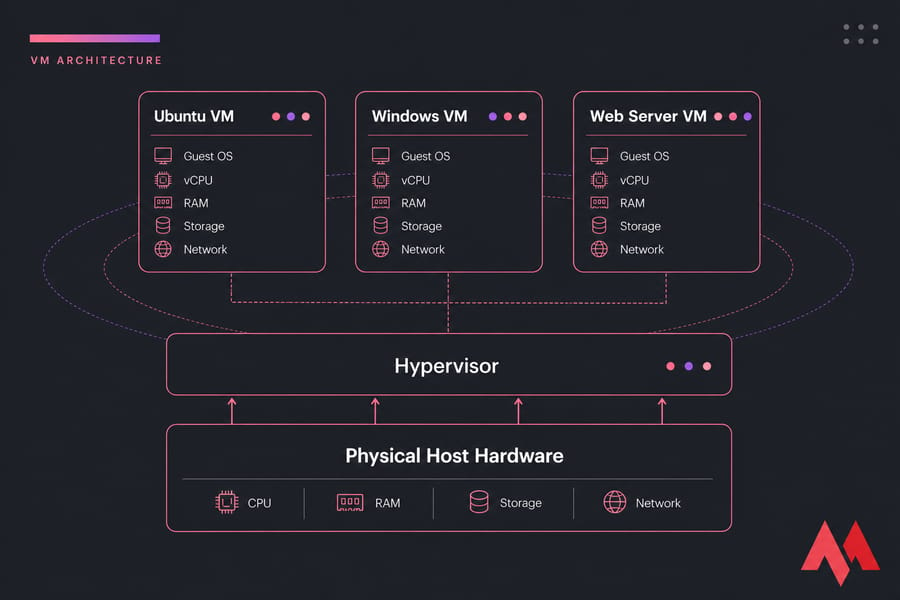
VM stands for virtual machine. In computing, a VM is a software-based computer environment that acts like a separate machine, with its own guest OS, virtualized CPU, RAM, storage, and network devices managed by a hypervisor.
VM meaning in computing
In plain English, a virtual machine is a simulated computer. You install an operating system on it, give it resources like vCPU and RAM, and use it almost like a physical PC or server. I usually explain it this way: a VM is like renting an apartment inside a building. You've got your own space, your own setup, and some separation from neighbors — but you're still sharing the larger structure underneath.
What Is a Virtual Machine? (Core Definition)
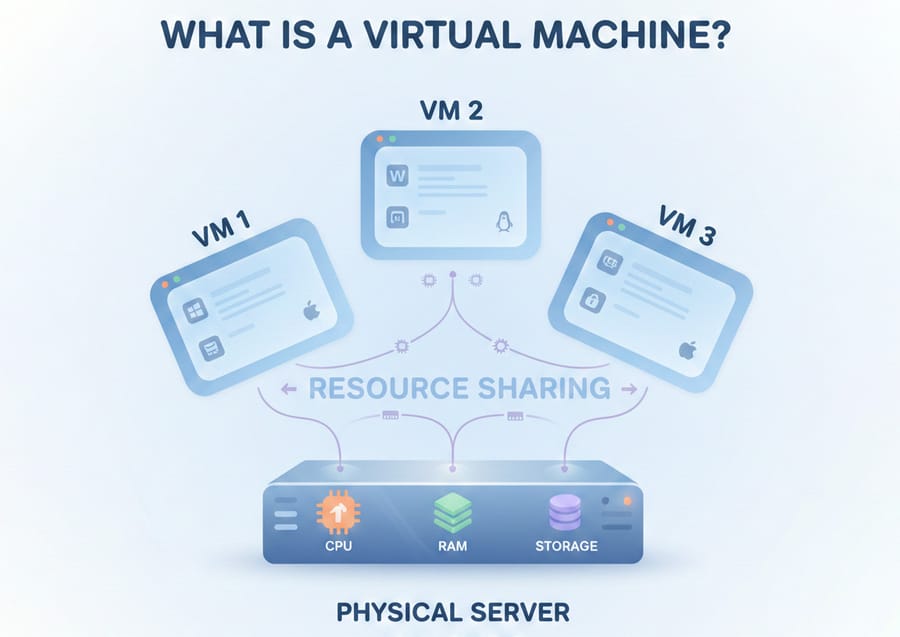
When we talk about a Virtual Machine (VM), we are referring to a fully independent execution environment that is created by software. A VM provides an isolated space where a guest operating system (Guest OS), along with all its applications, can run. This guest OS can be anything, from Windows and Linux to even older versions of operating systems.
Just like a regular computer, a virtual machine needs memory, CPU, storage, and virtualized network adapters. The key word here is "virtual." These resources are not physical; they are simulated by a software layer known as the hypervisor. This simulation is so convincing that the guest OS believes it is running on its own dedicated hardware.
If you want the broader background first, it helps to read about what is virtualization, because virtualization is the underlying method that makes VMs possible.
Virtual machine example
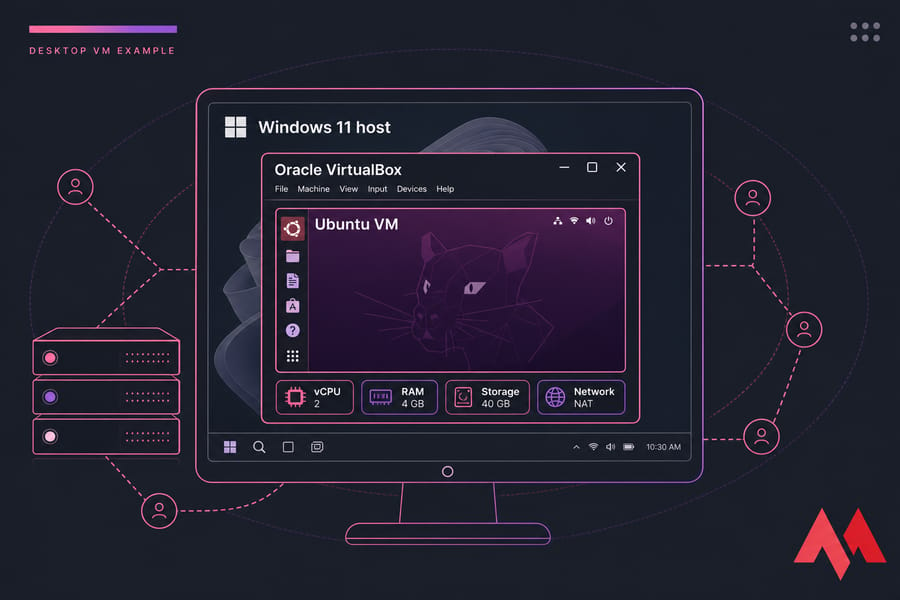
A common desktop example is running Ubuntu on a Windows 11 laptop using Oracle VirtualBox. A common server example is hosting a small Nginx website on a Linux VM. A common cloud example is launching an Amazon EC2 instance. And a process VM example is the Java Virtual Machine, or JVM, which runs Java bytecode across different operating systems.
A Fundamental Distinction: VM vs. Physical Machine
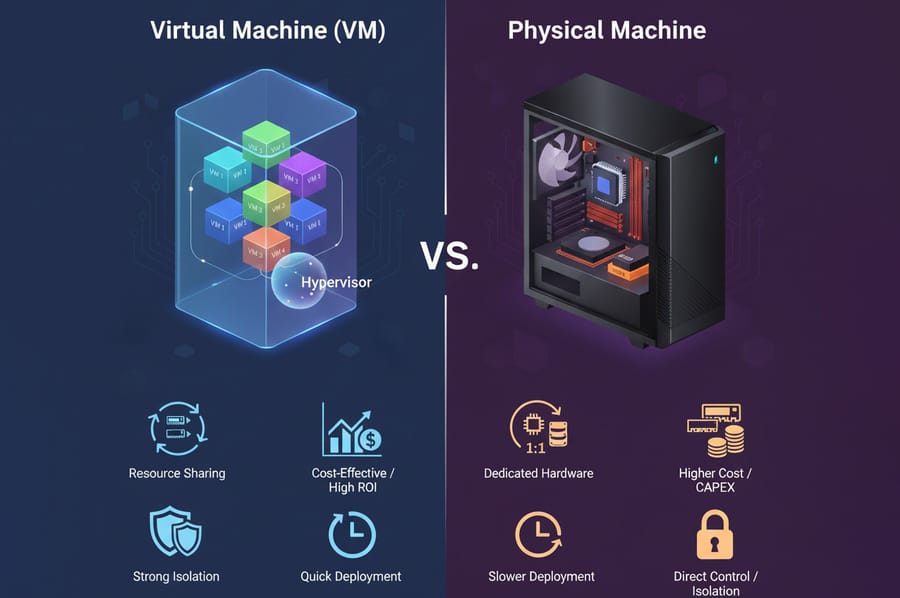
Understanding the difference between a VM and a physical machine is essential for anyone managing IT infrastructure. The main difference lies in how resources are managed and how the cost structure works.
| Comparison Aspect | Virtual Machine (VM) | Physical Machine |
| Hardware access | Virtualized hardware presented by a hypervisor | Direct access to real hardware |
| Cost efficiency | Better for workload consolidation; reduces need to buy multiple hardware systems | Higher cost per server; more expenses for purchasing, maintaining, and powering |
| Flexibility | Easy to clone, snapshot, resize, and migrate | Slower to redeploy or repurpose |
| Performance | May experience slight overhead under extremely heavy workloads | Maximum performance and very low latency |
| Isolation | Strong isolation at the hypervisor level; each VM completely separated | Strong physical isolation |
| Deployment Speed | Quick to deploy and ready within minutes | Deployment and installation take more time |
Physical machines are ideal for demanding and mission-critical workloads that require raw performance and complete hardware control. In contrast, VMs are designed to optimize resources, improve efficiency and reduce CAPEX and maintenance costs.
If you're comparing hosted infrastructure options, these related guides help: dedicated servers vs VPS, and what is dedicated server.
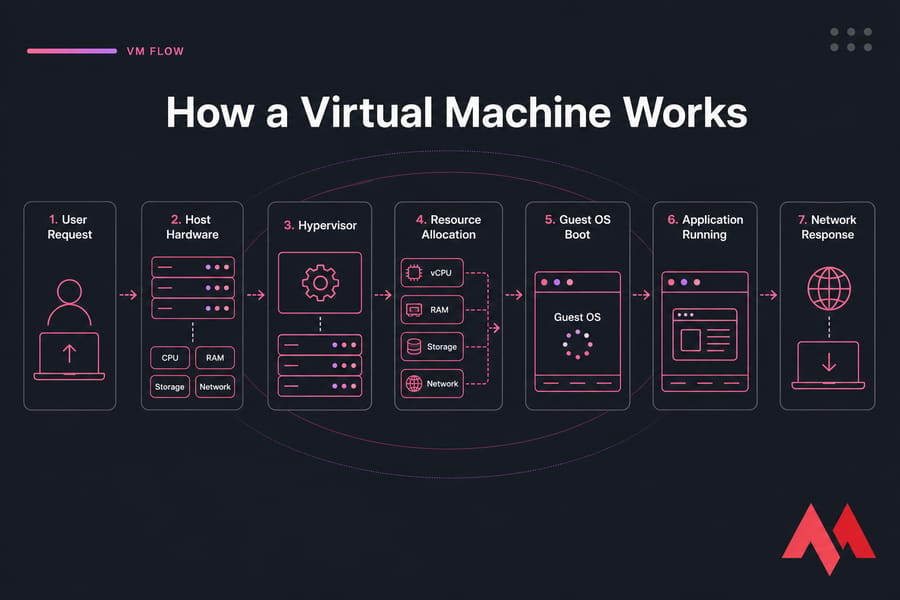
How Does a Virtual Machine Work?
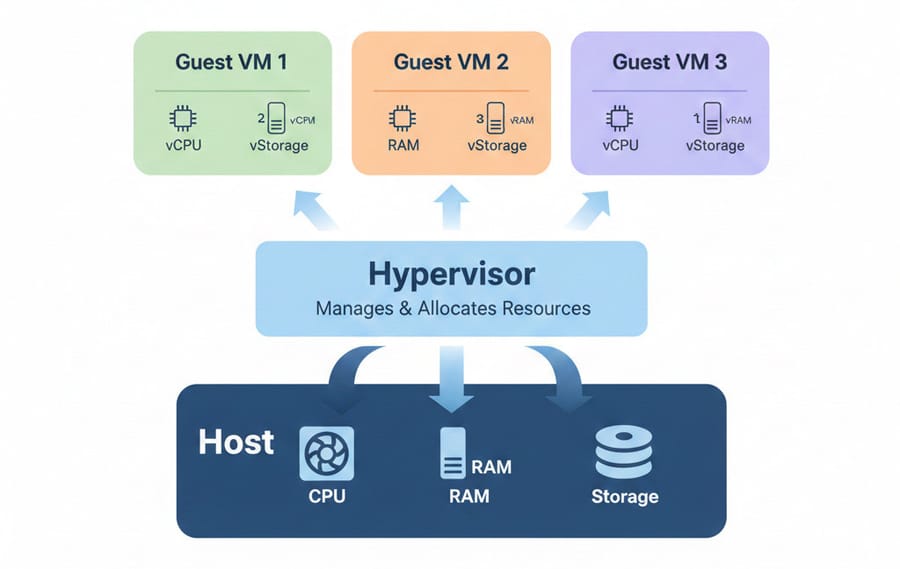
Virtual machines operate through virtualization technology. In practice, virtualization relies on software called hypervisors, which allow multiple VMs to run on a single physical device. The physical device is called the host, and the virtual machines running on it are referred to as guests.
Put simply, the hypervisor is responsible for allocating and managing resources such as RAM, CPU, and storage from the host to the guest. It also schedules operations across all VMs to ensure fair execution and proper timing for every workload.
What a hypervisor does
The hypervisor is the layer that creates and manages VMs. It abstracts the real hardware and presents virtualized components to guest systems. It decides how much of the host's CPU, RAM, disk, and networking each VM can use. It also handles things like snapshots, virtual switches, and sometimes live migration between hosts.
It is worth noting that there are two types of hypervisors: Type 1 Hypervisors and Type 2 Hypervisors.
| Feature | Type 1 Hypervisor (Bare Metal) | Type 2 Hypervisor (Hosted) |
| Execution Method | Runs directly on physical hardware with no need for a host operating system. | Runs as an application on top of a host operating system. |
| Advantages | Lower performance overhead due to direct hardware access. Provides stronger isolation for each VM. | Easier to manage and user-friendly, suitable even for non-technical users. |
| Use Cases | Ideal for enterprise-scale datacenter environments requiring high performance and security. | Suitable for personal use, testing, learning, or small-scale development environments. |
| Examples | VMware ESXi, Microsoft Hyper-V, KVM, Xen | VirtualBox, VMware Workstation, Parallels Desktop |
CPU Virtualization
The hypervisor takes the physical CPU and divides it into virtual units called vCPUs. These vCPUs are scheduled on physical cores as needed, creating the impression that each VM has full processing power. That's why a VM can feel fast one minute and sluggish the next on an overloaded host — CPU ready time is one of the classic warning signs.
RAM Virtualization
The hypervisor maps each VM's assigned memory to the host's physical RAM to keep workloads isolated. If total VM memory exceeds the host's RAM, the system starts swapping and performance drops noticeably. Always make sure the host has more physical RAM than the combined allocation of all VMs.
Storage Virtualization
VMs usually store data in virtual disks, such as VDI, VMDK, or VHDX files, or on block storage volumes in cloud environments. To the guest OS, that virtual disk looks like a normal hard drive or SSD. For better performance, store VM files on a separate disk from the host OS and allocate at least 10 GB per VM.
Network Virtualization
A VM typically uses a virtual network adapter connected to a virtual switch. That setup lets it access the internet, talk to other VMs, or remain isolated on an internal network segment. This is also where network virtualization and NFV-style designs start overlapping with VM architecture.
What Is a Hypervisor?
A hypervisor is virtualization software that creates, runs, and manages virtual machines by abstracting physical hardware resources. It is the control layer that lets multiple guest operating systems share one host safely and efficiently.
Read: What is a Hypervisor
Examples: ESXi, Hyper-V, KVM, Xen, VirtualBox
| Hypervisor / Platform | Type | Best Fit | Notes |
| VMware ESXi | Type 1 | Enterprise virtualization | Widely used in data centers |
| Microsoft Hyper-V | Type 1 | Windows-centric shops | Strong integration with Microsoft ecosystems |
| KVM | Type 1-style Linux hypervisor | Linux servers, VPS providers, cloud stacks | Common in hosting and OpenStack environments |
| Xen / Citrix Hypervisor | Type 1 | Cloud and enterprise use | Historically important in hosting and cloud platforms |
| Oracle VirtualBox | Type 2 | Beginners, labs, desktop testing | Easy to start with and widely documented |
| VMware Workstation | Type 2 | Power users and developers | Desktop virtualization with mature tooling |
Components & Architecture of a VM
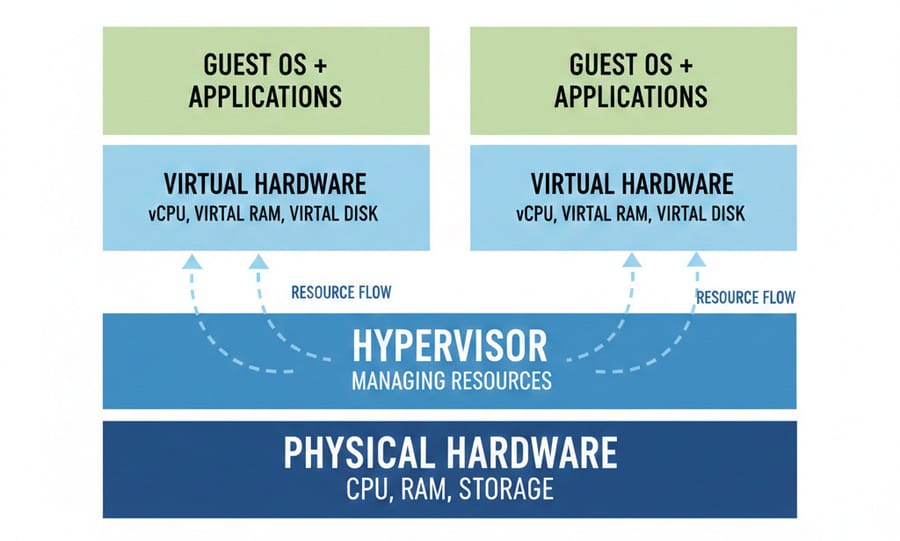
The architecture of a virtual machine consists of several layers that work together to create the illusion of a physical computer:
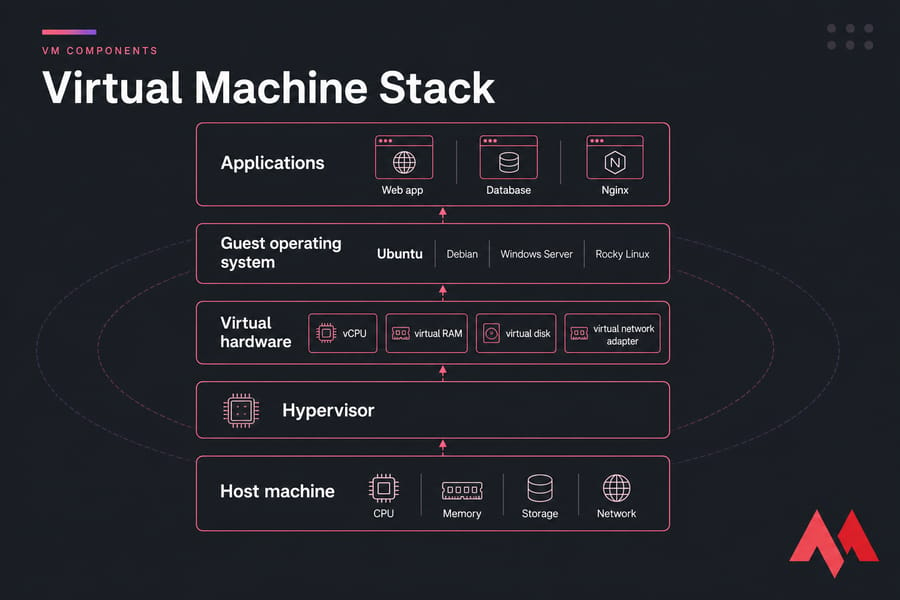
- Host Machine (Physical Hardware): This foundation includes the actual CPU, RAM and storage that provide the raw computing power for all virtual machines.
- Hypervisor: This software layer acts as the controller. Its main role is to isolate VMs from one another and manage how physical resources are allocated to each VM.
- Virtual Hardware: This layer is unique for each VM. It consists of configuration files that simulate hardware components such as virtual disks, virtual graphics adapters and vCPUs for the guest operating system.
- Guest OS and Applications: The guest operating system (such as Windows or Linux) runs on top of the virtual hardware. Your applications run inside this guest OS and remain fully isolated from the host environment.
If you're exploring OS-specific deployments, these pages are useful: what is a Windows virtual machine and what is a Linux virtual machine.
Types of Virtual Machines
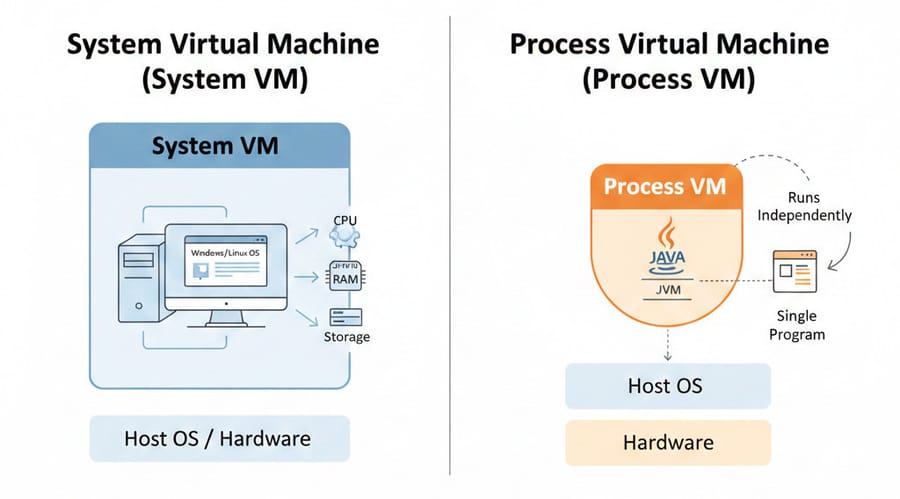
Generally, virtual machines fall into two main categories: process virtual machines and system virtual machines.
1. System Virtual Machine (System VM)
This is the most common type of VM. A system VM provides a full emulation of a physical computer's hardware. It allows you to run an entire operating system (such as Windows, Linux or macOS) inside the host OS. These VMs play a critical role in server virtualization and creating isolated environments.
2. Process Virtual Machine (Process VM)
A process VM is designed to run a single program or process independently of the underlying platform. The best-known example is the Java Virtual Machine (JVM). The JVM interprets bytecode and enables applications written in languages like Java to run on any OS without modifying the code.
3. Cloud Virtual Machines
A cloud VM is a virtual machine delivered through an IaaS platform. You choose an instance size, region, image, network settings, and storage, then deploy it on demand. That's the model behind cloud hosting and cloud servers in general.
Learn more about the different options by checking out Virtual Machine Types.
What Are Virtual Machines Used For?
Server Consolidation and High Efficiency
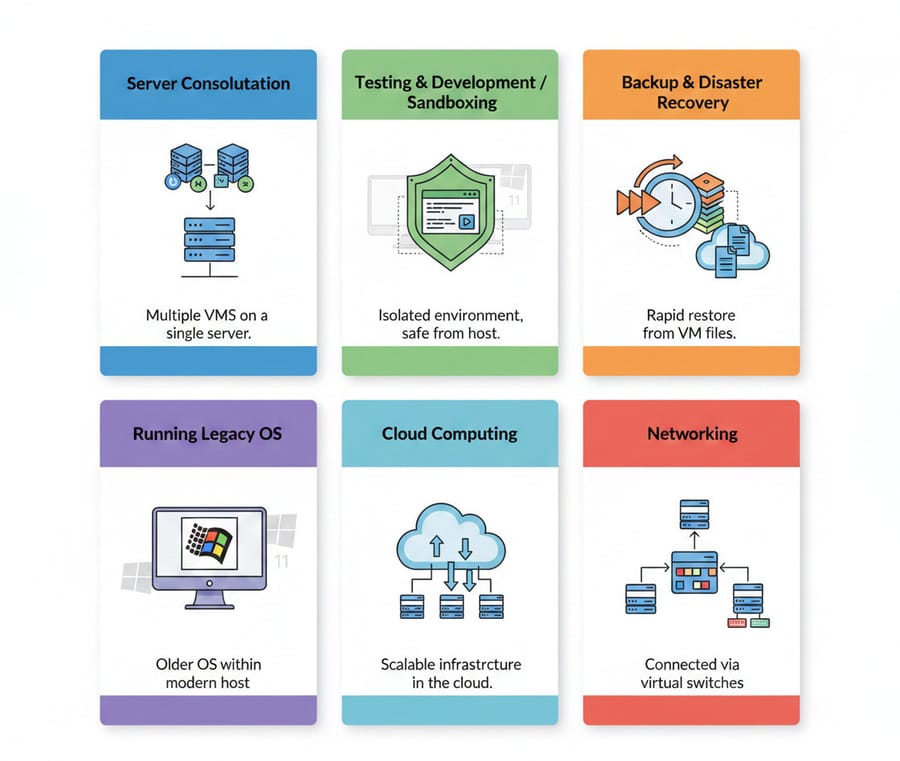
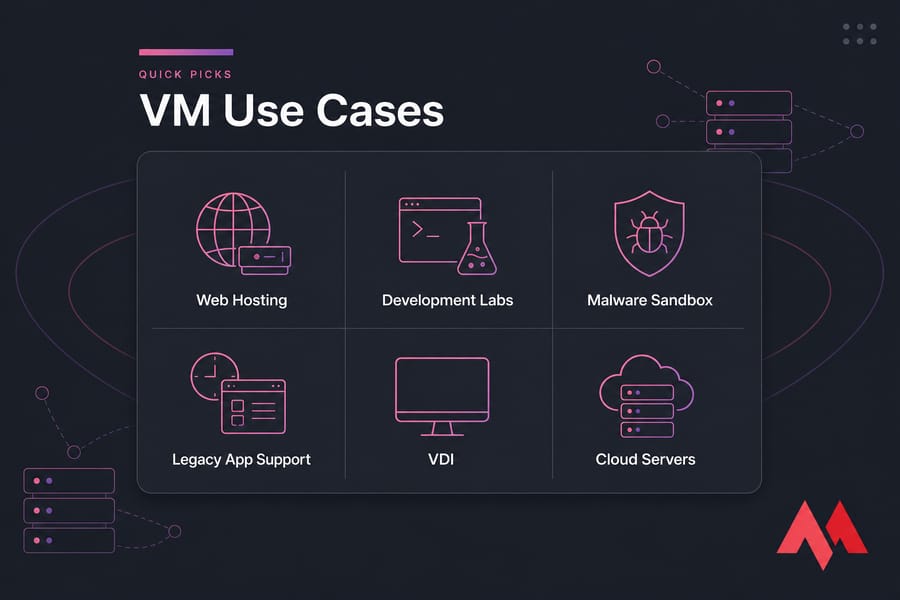
This is perhaps the most important use case for VMs. Virtualization makes it possible to run multiple operating systems and environments on a single powerful physical server, eliminating the need to purchase and manage multiple servers and ensuring far more efficient use of hardware resources.
Testing, Development and Sandboxing
Development teams can quickly create isolated environments that mimic production systems. Security professionals can also use VMs to execute malicious code or perform penetration testing inside a fully controlled environment.
Backup and Fast Disaster Recovery
One of the biggest advantages of VMs is that the entire OS, configuration and data are stored in one or more files. If a physical server fails, restoring a VM from a backup typically takes only a few minutes.
Running Legacy or Incompatible Operating Systems
If you need to run applications that only work on older operating systems, you can run them inside an isolated VM while keeping your main operating system modern and secure.
Virtual Machine in Cloud Computing
Cloud VMs are virtual machines created on top of a cloud provider's large virtualized infrastructure. They can be launched, resized, and replicated on demand, offering fully flexible compute resources.
Virtual Machine in Networking
In networking, a VM uses virtualized network components instead of physical switches and routers. Hypervisors create virtual switches that connect VMs, enabling segmentation and VLAN based isolation.
Virtual Desktops and VDI
Organizations use VMs to deliver remote desktops to staff. If you're comparing those models, VDI vs VM is a useful distinction to understand.
Advantages & Disadvantages of Virtual Machines
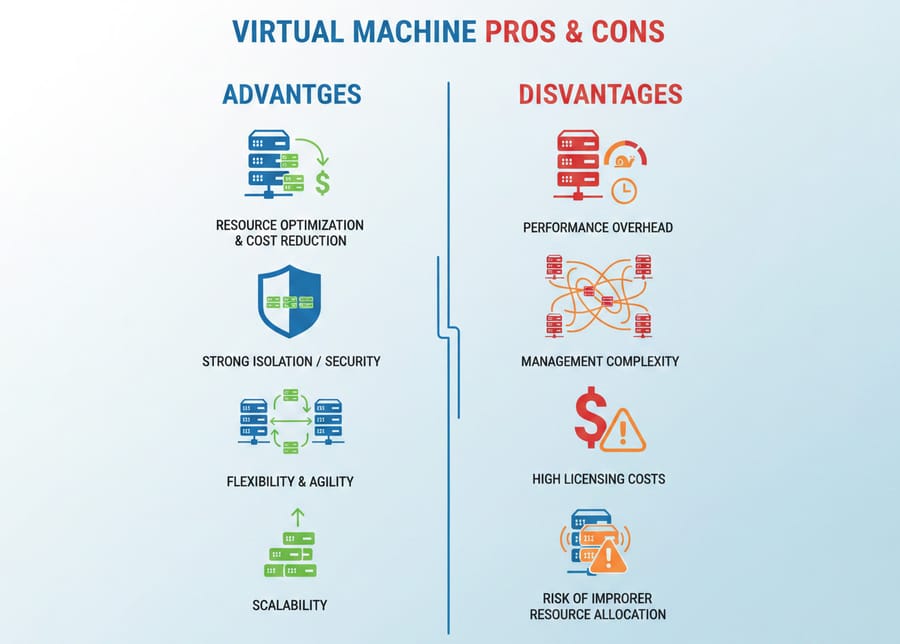
Key Advantages of Virtual Machines
- Resource Optimization and Cost Reduction: The biggest advantage is the ability to maximize the efficiency of a powerful physical server, significantly reducing costs.
- Strong Isolation (Security Isolation): Each VM operates in an independent, fully isolated environment. If one VM encounters a security issue, the other VMs remain unaffected.
- Flexibility and Agility: Creating a VM is much faster than setting up a new physical machine. With live migration, you can move VMs between physical servers without downtime.
- Scalability: You can easily scale your applications by adding more virtual servers.
- Portability: Move or replicate VMs across hosts more easily than physical machines.
- Disaster recovery: Backup and restore workflows are often simpler. For backup planning, this pairs naturally with disaster recovery strategies.
Disadvantages, Limitations and Challenges
- Performance Overhead: The hypervisor introduces an additional software layer, adding processing overhead.
- Management Complexity: Managing a large-scale virtualized infrastructure requires specialized expertise.
- Licensing Costs: Some advanced commercial virtualization platforms come with high licensing fees.
- Risk of Improper Resource Allocation: If resources are not managed properly, the host system may experience performance degradation.
- Security assumptions: Isolation helps, but it does not replace patching or access control.
Virtual Machine Security Best Practices
VMs improve isolation, but they are not automatically secure. That's the mistake beginners make most often.
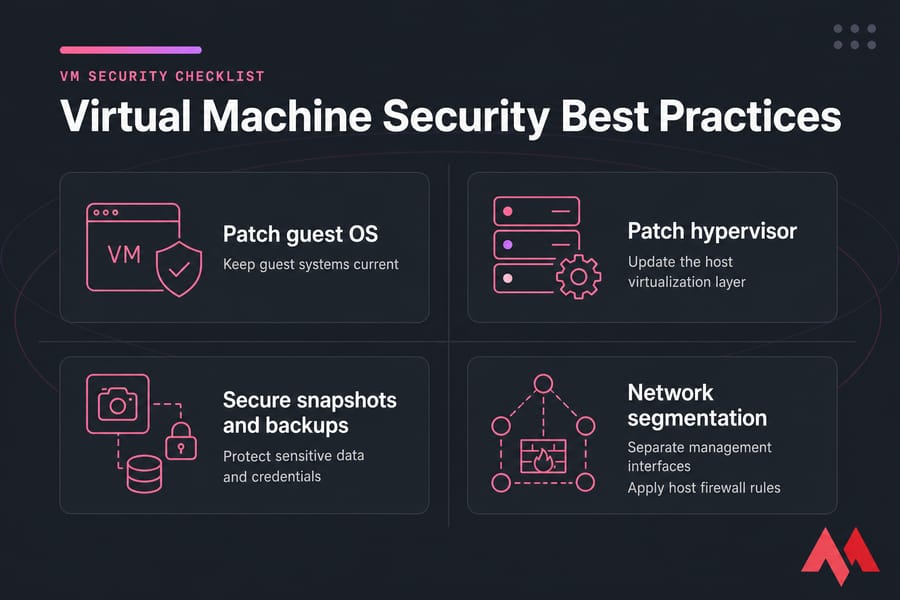
Isolation and segmentation
Use network segmentation so VMs only talk to the systems they actually need. Put management interfaces on separate networks. Apply host firewall rules and least-privilege access wherever possible.
Patch management
Patch both the guest OS and the hypervisor. VM escape vulnerabilities are rare compared with everyday misconfigurations, but they do exist.
Snapshot and backup safety
Snapshots are useful, but they're not a long-term backup strategy. Store them carefully, encrypt backups where possible, and control who can restore or export VM images.
Access control
Restrict admin rights, secure API access, and use MFA on management portals.
Read: Virtual Machine Security Best Practices
Common VM Performance Problems
Most VM performance problems come down to contention, bad sizing, or slow storage. The VM itself usually isn't the villain. The surrounding platform is.
CPU contention
If too many vCPUs are competing for too few physical cores, workloads wait. This can show up as CPU ready time or poor responsiveness under peak load.
Memory pressure
Memory ballooning and swapping are common signs that the host is overcommitted.
Disk bottlenecks
Slow shared storage, low disk IOPS, noisy neighbors, or cheap spinning disks can make a VM crawl.
Network issues
Misconfigured virtual switches, overloaded host NICs, and poor routing design can add latency or packet loss.
Common VM performance problems to watch for
- High CPU ready time
- Excessive memory swapping
- Low disk throughput or high storage latency
- Overcommitment on crowded hosts
- Bandwidth saturation on shared interfaces
Virtual Machines vs Other Technologies
When you choose the right infrastructure to run your applications, the decision is no longer just about using a VM or not. Technologies such as containers, bare metal servers, and platforms like VirtualBox have expanded the options.
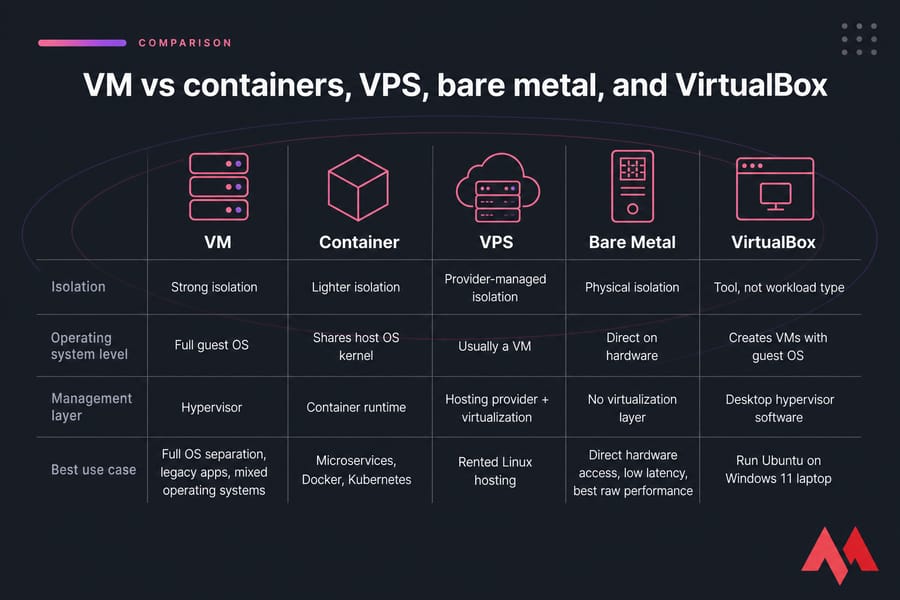
| Feature | Virtual Machine (VM) | Container | Bare Metal Server | VirtualBox |
| Isolation | Very strong, full OS kernel | Medium, shared kernel | Complete, direct hardware access | Strong, similar to VM |
| System Overhead | High, full OS boot | Very low | None | Medium |
| Startup Speed | Seconds to minutes | Extremely fast | Instant after main OS boot | Medium |
| Performance | Medium to high | High | Very high | Low to medium |
| OS Flexibility | Can run multiple different OS types | Limited to the host kernel | Only one OS | Supports multiple OS types |
| Best Use Cases | Multi OS environments, isolated testing, servers | Microservices, DevOps, fast scaling | Heavy workloads, high performance computing | Desktop usage, training, basic testing |
VM vs Containers
A VM contains a complete operating system with its own kernel, which provides stronger isolation. Containers share the host operating system kernel, so they are lighter, faster, and ideal for microservices. Choose VMs when security and OS separation matter most. Choose containers when speed and scalability are important.
For a deeper look, explore VM vs Containers and VM vs Container to see when to choose each.
VM vs Bare Metal
Bare metal servers run the operating system directly on hardware with no virtualization layer. This results in maximum performance. VMs have some overhead but offer greater flexibility and ease of management.
VM vs VPS
A VPS is usually a hosted product built using virtualization. A VM is the underlying technical unit. If you rent a Linux VPS, there's a good chance you're getting a VM running on KVM or another hypervisor under the hood. For the full distinction, read VM vs VPS.
VM vs VirtualBox
VirtualBox is a Type 2 hypervisor used on desktops to create and run VMs. The VM is the environment created by that software — they're not competing technologies.
Popular Cloud VM Services
A cloud VM is a virtual machine delivered as infrastructure-as-a-service (IaaS). You provision compute instances on demand, pay based on size and usage, and deploy them in specific regions for latency, redundancy, or compliance reasons.
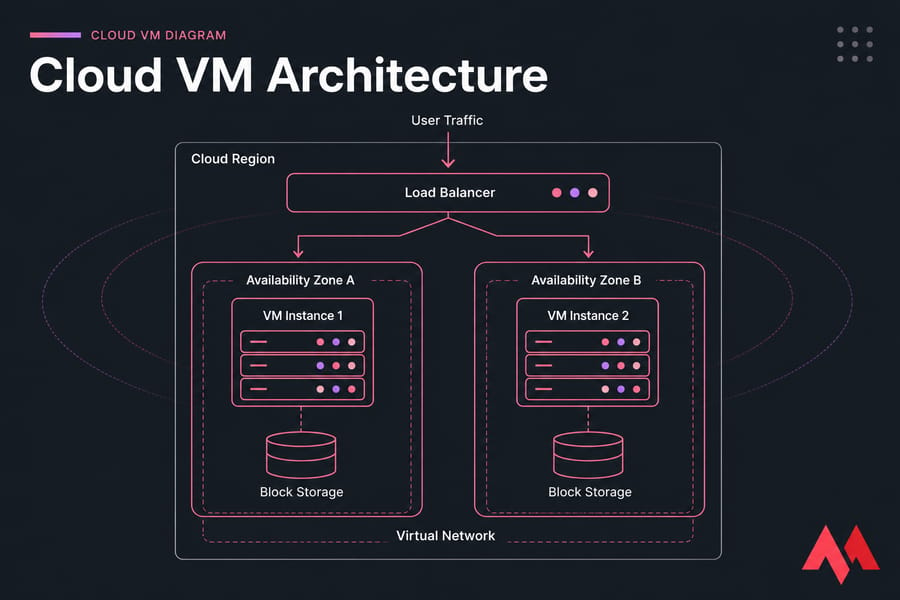
AWS EC2
Amazon EC2 is one of the best-known cloud VM platforms. You choose an instance type, AMI image, region, network settings, storage, and security groups, then launch it as needed.
Azure Virtual Machines
Microsoft Azure Virtual Machines are a strong fit for organizations already invested in Active Directory, Windows Server, or the wider Microsoft stack.
Google Compute Engine
Google Compute Engine provides cloud VMs with custom machine types, persistent disks, and global infrastructure options.
What cloud VM pricing and scaling usually look like
Cloud instances are typically billed by resource size and runtime, with extra charges for storage, bandwidth, and premium features. Autoscaling can add or remove VM instances based on demand. If you're looking at hosted options outside hyperscalers, cloud servers can be a simpler starting point.
Best Virtual Machine Software
Below are the top hypervisor software tools available.
| Software | Host OS Support | Best For | Ease of Use | Notes |
| VirtualBox | Windows, Linux, macOS | Beginners | High | Good free option for labs |
| VMware Workstation | Windows, Linux | Developers and power users | High | Mature desktop VM platform |
| Hyper-V | Windows | Windows admins and SMBs | Medium | Strong Microsoft integration |
| Parallels Desktop | macOS | Mac users | High | Popular for running Windows on Mac |
| KVM | Linux | Enterprise, hosting, advanced users | Medium | Excellent for server virtualization |
How to Create a Virtual Machine in VirtualBox
Now it is time to get familiar with the process of creating a virtual machine. In this guide, we are using Oracle VM VirtualBox, which is free, open source and multi-platform.
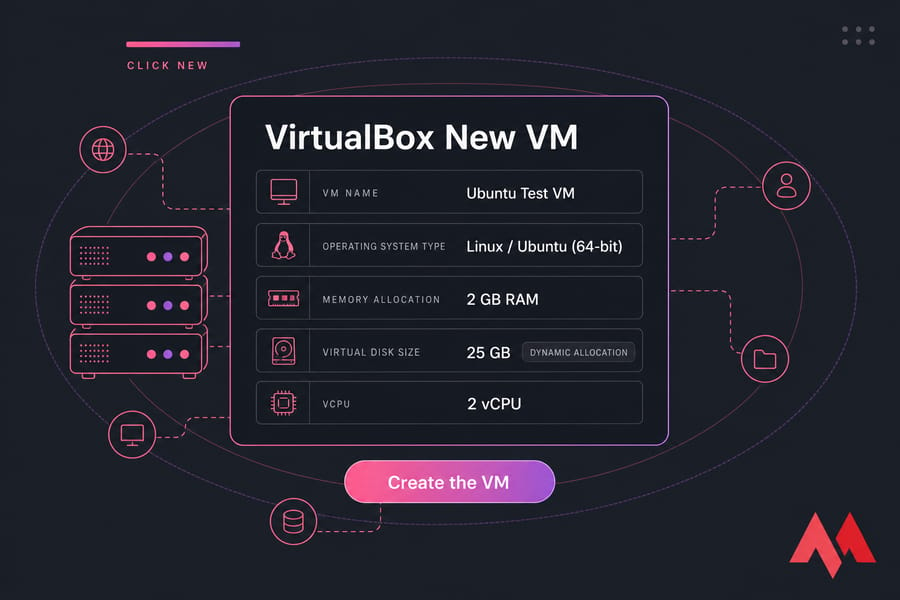
Step 1: Download and Install Oracle VM VirtualBox
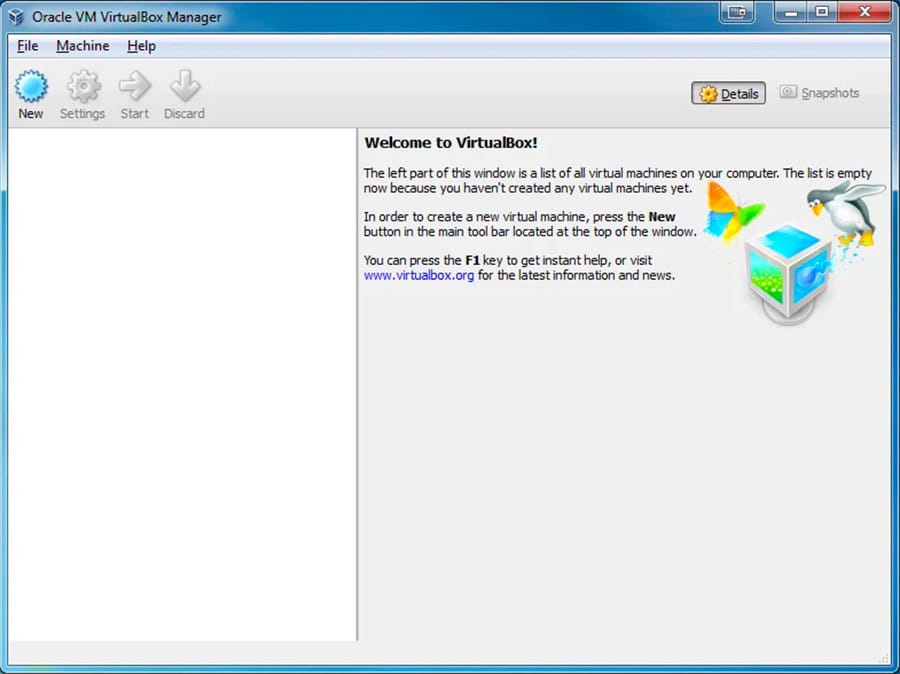
Download the version that matches your operating system and install it. It is best to keep all default settings during installation. After a successful installation, you will see a window similar to the image below.
Step 2: Create a Virtual Machine
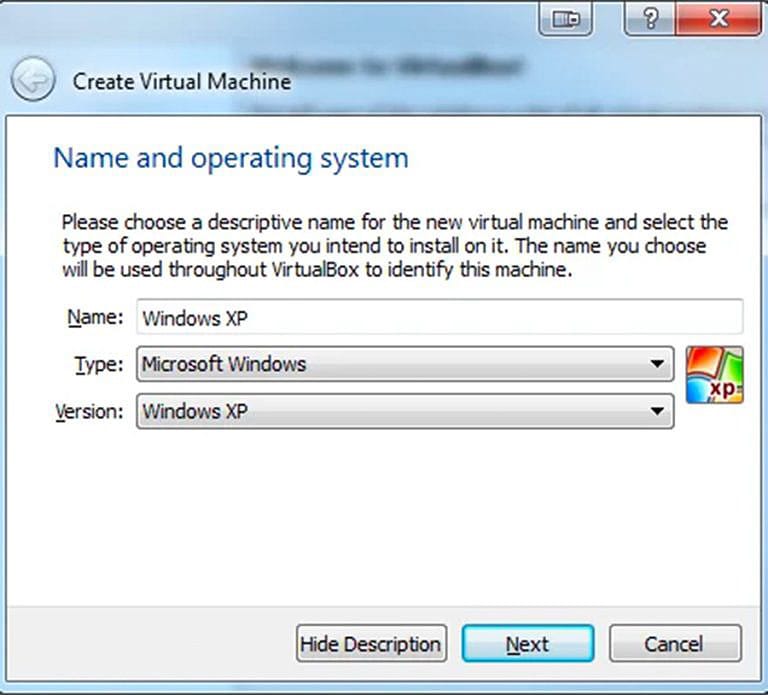
To create a virtual machine, open Oracle VM VirtualBox, choose File > New, and then enter a name for your virtual machine. After entering the name, select the Type and Version based on the operating system you plan to install.
Step 3: Allocate Memory to the Virtual Machine
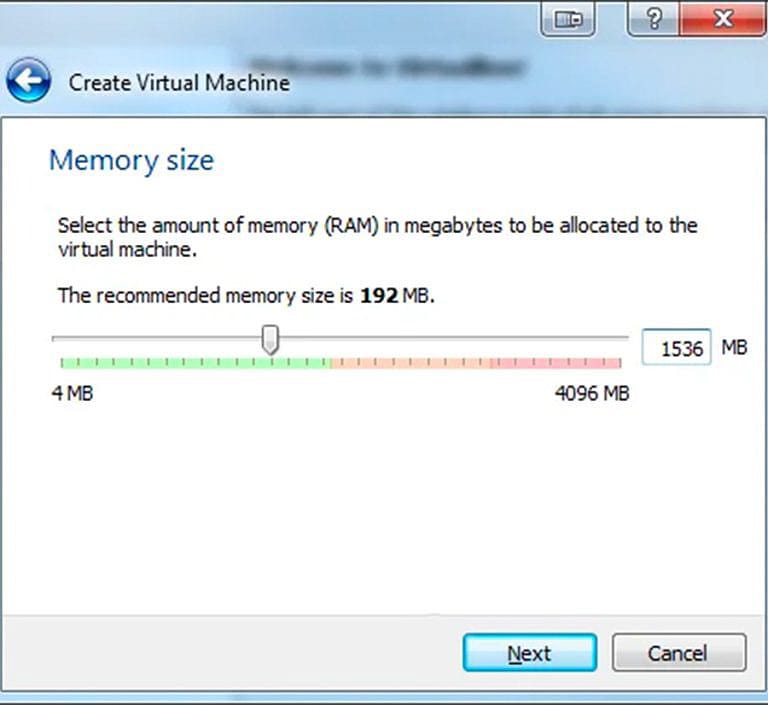
The amount of memory you assign depends entirely on your host system's RAM. It is recommended not to allocate more than half of your host RAM to a virtual machine.
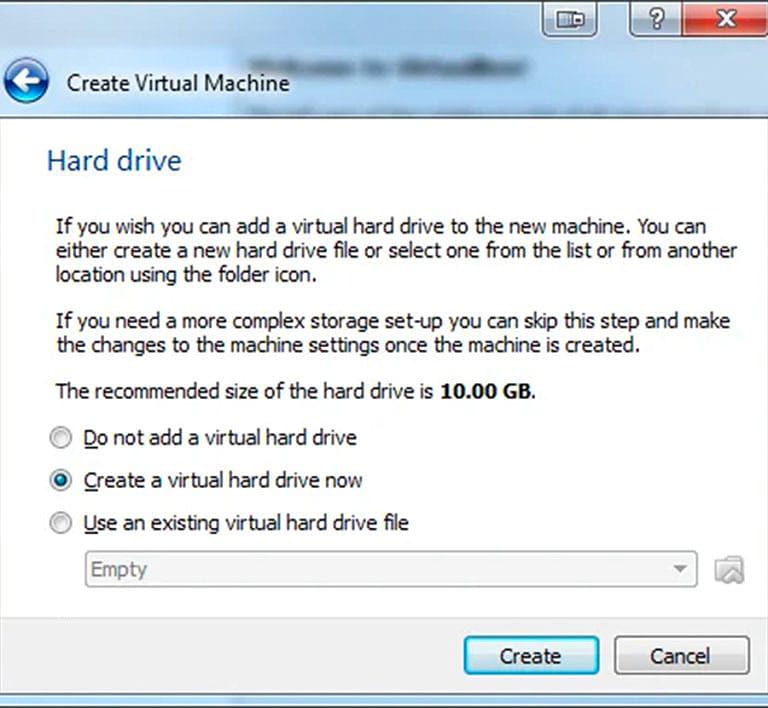
Step 4: Set Up the Virtual Machine Hard Drive
After clicking Next, a window will appear where you can configure the virtual hard disk. Select Create a virtual hard drive now and then click Create.
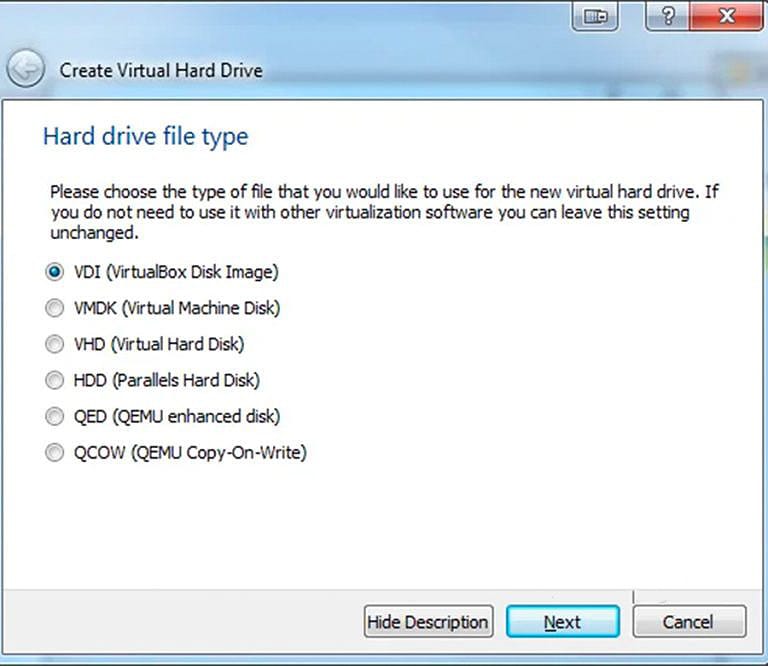
Step 5: Choose the Hard Drive File Type
In the next window, choose VDI. This option usually provides the best performance.
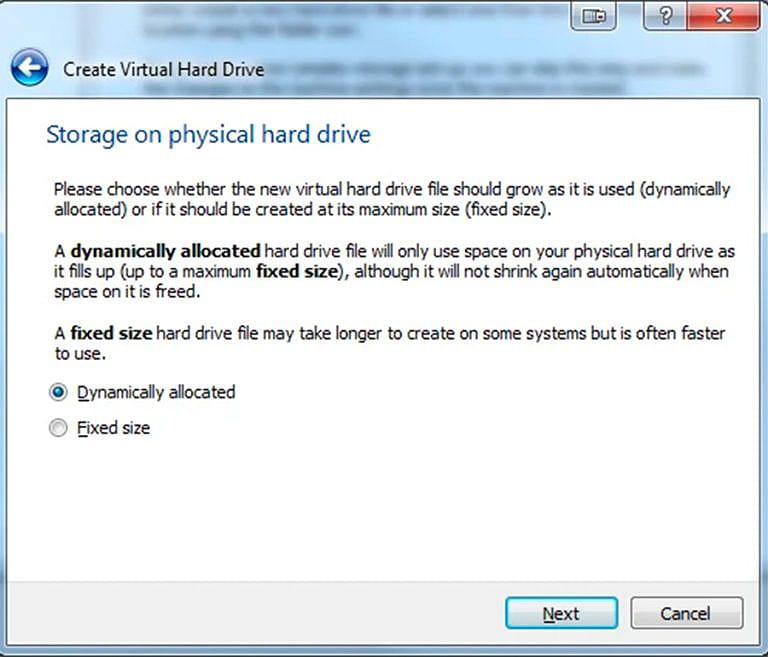
Step 6: Choose Storage on the Physical Hard Drive
We recommend using the Dynamically Allocated option.
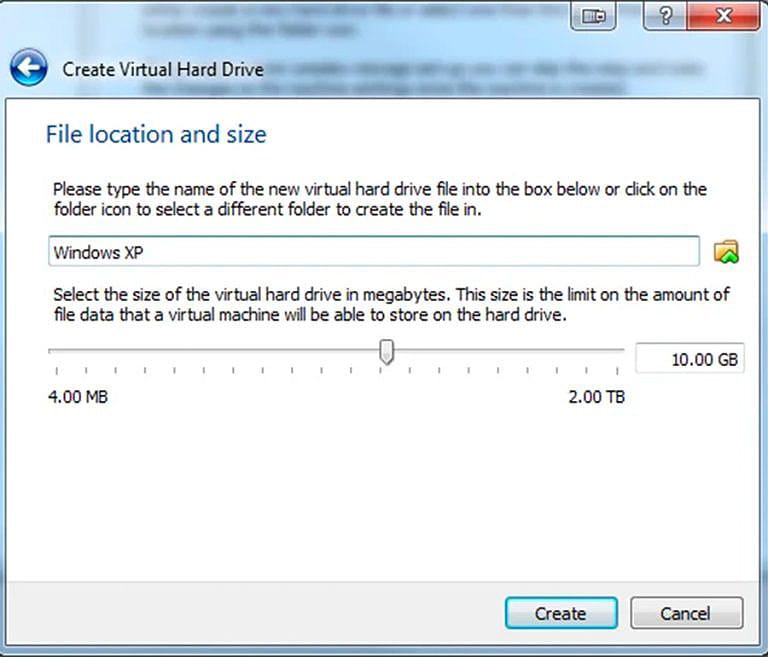
Step 7: Set the File Location and Size
VirtualBox uses the minimum possible size as the default limit. Depending on your needs, you may want to increase this limit.
Step 8: Install the Operating System on the Virtual Machine
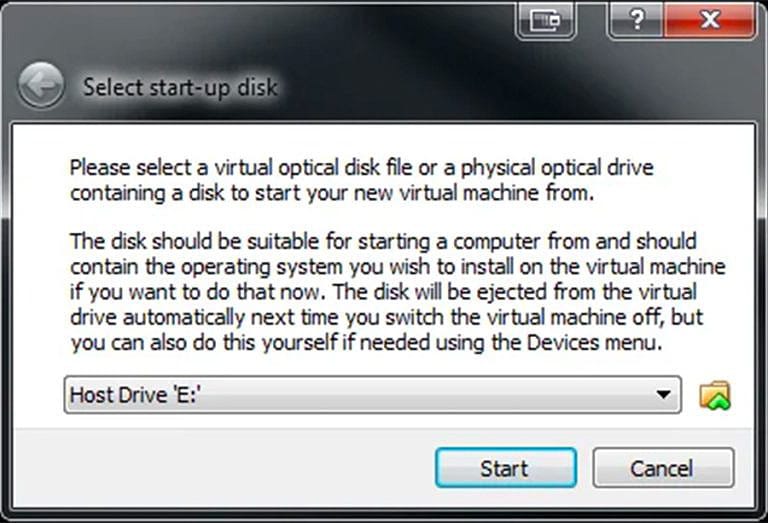
Double click the newly created virtual machine. Now select the ISO file for the operating system you want to install and click Start.
How Much RAM, CPU and Storage Does a VM Need?
The right size depends on the workload, not just the operating system. Most sizing mistakes come from giving the VM too much, not too little.
Minimum specs for Linux VM
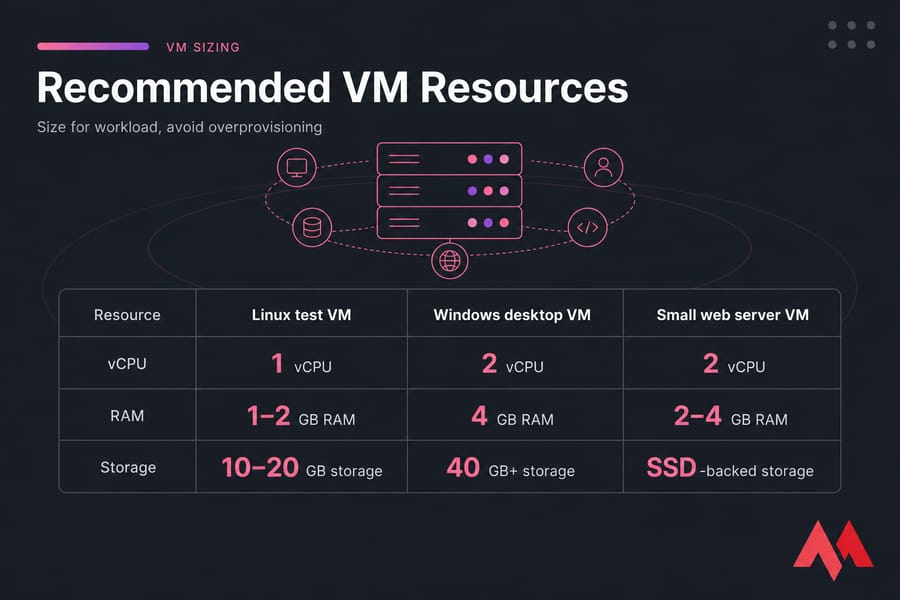
For a basic Linux VM used for testing, 1 vCPU, 1 to 2 GB RAM, and 10 to 20 GB storage can work. For a small web server, start closer to 2 vCPU, 2 to 4 GB RAM, and SSD-backed storage.
Minimum specs for Windows VM
A Windows desktop or Windows Server VM typically needs more breathing room. In practice, 2 vCPU, 4 GB RAM, and 40 GB or more of storage is a more realistic baseline.
Resource planning tips
- Leave enough RAM for the host OS
- Prefer SSD or NVMe over HDD for better responsiveness
- Monitor CPU ready time and memory pressure after deployment
- Don't assign more vCPU than the workload actually uses
- Use snapshots sparingly and clean them up
- Plan for growth, but avoid reckless overcommitment
VM Monitoring & Management
Without active monitoring, you can never determine whether a VM is performing slowly because of its own internal workload or because it is competing with a noisy neighbor. Track these technical indicators:
- CPU Ready Time: Shows how long a VM has to wait before the hypervisor allows it to access physical CPU cores.
- Disk Latency and Network Traffic: Disk I/O bottlenecks are one of the most common causes of VM slowdowns.
- Virtual Machine Lifecycle and Snapshots: Track VM state and manage snapshots carefully — too many can consume significant storage space.
Common Virtual Machine Terminology
- Host OS: the operating system on the physical machine running the VM platform
- Guest OS: the operating system inside the VM
- Hypervisor: software layer that creates and manages VMs
- vCPU: a virtual CPU assigned to a VM
- Virtual disk: the VM's storage presented as a virtual drive
- Snapshot: a point-in-time record of VM state
- Live migration: moving a VM between hosts with minimal downtime
- Virtual appliance: a prebuilt VM image for a specific application or service
- Overcommitment: assigning more virtual resources than the host physically has available
When Should You Use a VM Instead of a Container?
Use a VM when you need full operating system isolation, different kernels, stronger separation, or support for legacy applications. Use containers when you want fast startup, lightweight packaging, and application-level portability. If you need to run Windows and Linux workloads side by side on the same host, VMs are the obvious answer.
Key Takeaways
VM stands for virtual machine. A VM is a software-defined computer that runs a guest OS using virtualized hardware managed by a hypervisor. It's one of the core building blocks behind server virtualization, desktop labs, cloud computing, and many VPS platforms.
When to use a VM
Use a VM when you want operating system isolation, easy cloning, support for multiple OS types, safer testing environments, or efficient server consolidation.
When to choose containers or bare metal instead
Choose containers when speed, density, and app portability matter more than full OS separation. Choose bare metal when you need the best possible raw performance, dedicated hardware control, or highly predictable latency.
If your next step is hosted infrastructure rather than a local lab, compare VPS hosting, cloud vps, and dedicated servers based on your traffic, budget, and management comfort level.
It's Time to Go Virtual
Virtual machines remain one of the core pillars of the digital era thanks to their strong isolation, cost efficiency, and high flexibility. So do not miss the chance to take advantage of this powerful technology. At MonoVM, we provide optimized and scalable VM hosting through our dedicated servers. We manage your infrastructure with top level security and performance standards, and more importantly, our 24/7 support team is always by your side so you never have to worry about performance issues or system instability. Start building your infrastructure with MonoVM today and enjoy uninterrupted support from day one.

An experienced tech and developer blog writer, specializing in VPS hosting and server technologies. Fueled by a passion for innovation, I break down complex technical concepts into digestible content, simplifying tech for everyone.