Buying a remote desktop server shouldn't take an afternoon of tab-hopping. This comparison ranks ten RDP hosting providers on the things that actually decide whether you'll be happy in month three: price, admin access, setup speed, Windows version options, and server locations. I've spent years provisioning Windows boxes for teams that needed them yesterday, and the pattern is always the same — people buy on price, then discover they can't install their own software.
You may need to access your work environment remotely from anywhere in today's digital landscape. The powerful solution is Remote Desktop Protocol (RDP) which helps you to securely connect to your desktop from any device. In this guide, we'll explore the top providers analyzing their features, pros, cons, locations, security protocols, money-back guarantees, and pricing structures. Start with the table. Then jump to the section matching your use case.
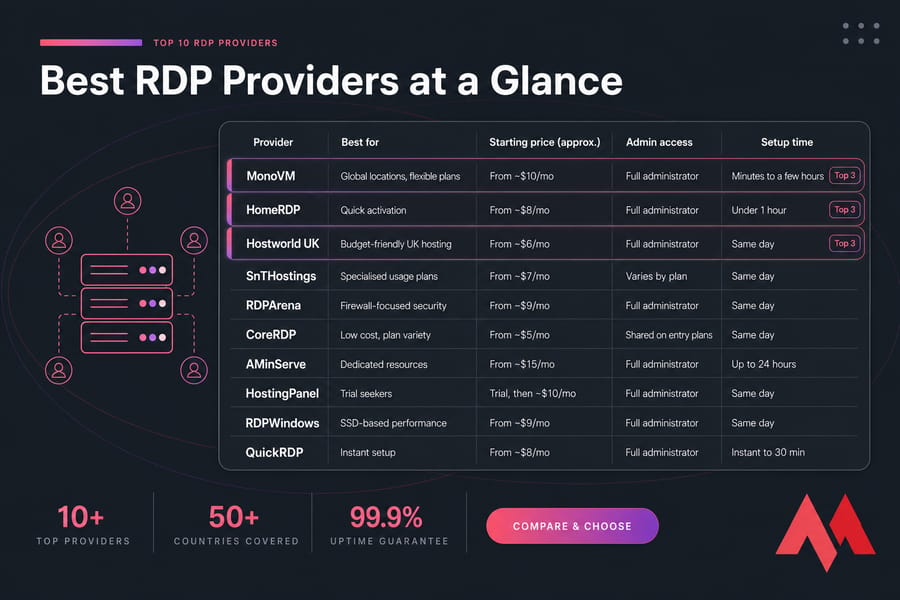
📊 Best RDP Providers at a Glance
| Provider | Best for | Starting price (approx.) | Admin access | Setup time |
| MonoVM | Global locations, flexible plans | From ~$10/mo | Full administrator | Minutes to a few hours |
| HomeRDP | Quick activation | From ~$8/mo | Full administrator | Under 1 hour |
| Hostworld UK | Budget-friendly UK hosting | From ~$6/mo | Full administrator | Same day |
| SnTHostings | Specialised usage plans | From ~$7/mo | Varies by plan | Same day |
| RDPArena | Firewall-focused security | From ~$9/mo | Full administrator | Same day |
| CoreRDP | Low cost, plan variety | From ~$5/mo | Shared on entry plans | Same day |
| AMinServe | Dedicated resources | From ~$15/mo | Full administrator | Up to 24 hours |
| HostingPanel | Trial seekers | Trial, then ~$10/mo | Full administrator | Same day |
| RDPWindows | SSD-based performance | From ~$9/mo | Full administrator | Same day |
| QuickRDP | Instant setup | From ~$8/mo | Full administrator | Instant to 30 min |
🔍 How We Chose the Best RDP Hosting Providers
Transparency first: this article is published by MonoVM, which is one of the providers listed. Rankings weigh objective criteria, and where a competitor does something better, it's stated.
- Performance and uptime — CPU allocation, RAM, NVMe or SSD storage, published uptime targets.
- Security and privacy — firewall rules, DDoS filtering, account isolation, backup options.
- Admin access — whether you get true administrator rights or a locked-down user session.
- Locations and latency — how many regions, and how close to real users.
- Support and setup time — ticket response, live chat availability, provisioning speed.
- Pricing and refunds — entry price, renewal price, money-back guarantee terms.
Plan details were checked against public pricing pages and verified in early 2025. Prices shift, promotions expire — confirm before you buy.
🔄 RDP Servers vs Remote Desktop Software: What's the Difference?
RDP servers and remote desktop software are both tools used for remote access, but they play different roles:
Remote Desktop Software (Client): This is the application you install on your local device like a laptop or tablet to connect to a distant computer. It functions as both a viewer and a controller, transferring your inputs (mouse clicks, keystrokes) to the remote machine and displaying its images on your screen. Popular examples are Microsoft Remote Desktop (RDP client) and TeamViewer.
RDP Server (Host): This is the real computer that you will connect to remotely — a physical machine specific for this task or a virtual server running on an entire system. RDP servers provide the processing power, apps, and desktop environment that you interact with via remote desktop software. In basic terms, the RDP server is the "workstation" that you can access remotely.
Imagine RDP software as a remote control for your TV (the RDP server). The remote lets you change channels and adjust settings, but the actual processing and display happen on the TV itself.
🧭 What Is an RDP Provider?
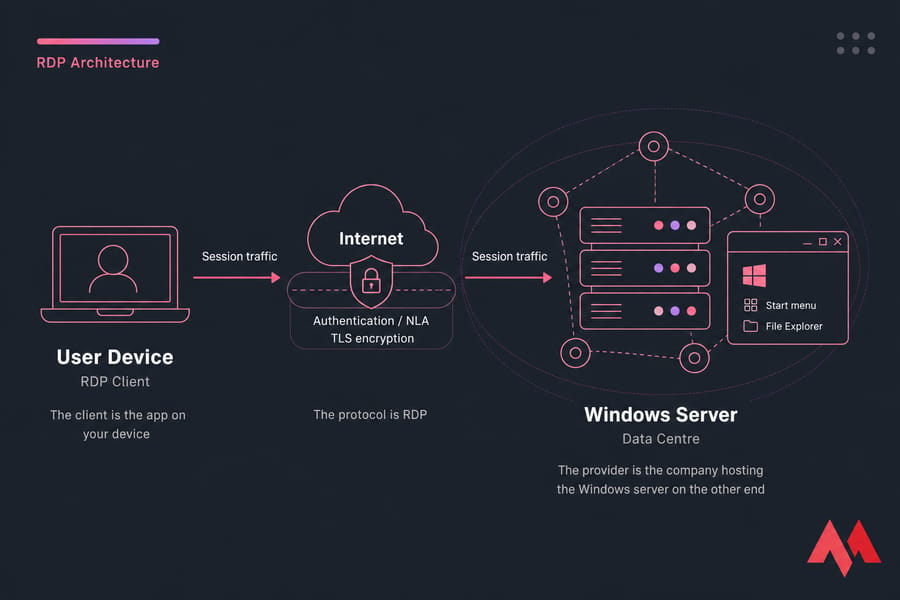
An RDP provider rents you a Windows machine in a data centre that you log into using Microsoft's Remote Desktop Protocol. You get a full desktop — Start menu, File Explorer, the lot — running on hardware that stays online whether your laptop does or not.
Worth separating three things people constantly mix up. The protocol is RDP. The client is the app on your device. The provider is the company hosting the Windows server on the other end. Tools like AnyDesk and TeamViewer replace the protocol and client, not the server — see the breakdown in AnyDesk vs RDP and TeamViewer vs RDP if you're weighing remote desktop alternatives.
💡 Why Do I Need RDP Hosting?
RDP hosting provides various benefits that may be essential for your remote work requirements. Here are some important reasons why you might want to use RDP hosting:
- Enhanced accessibility: With RDP hosting, you can access a robust desktop environment from any device with an internet connection. This means you may work from your home computer.
- Resource scalability: Unlike a personal computer, RDP hosting gives you access to strong hardware resources such as processing power and storage. This is perfect for running demanding software, managing massive databases, and working on complex projects.
- Improved security: RDP hosting providers typically offer robust security features to protect your data. This can include firewalls, encryption, and secure login protocols.
- Cost efficiency: Installing and maintaining your powerful PC might be costly. RDP hosting avoids this requirement by offering access to pre-configured, high-performance workstations for a monthly charge.
- Applications compatibility: Some specialist applications may not work with your device's operating system. RDP hosting allows you to access a desktop that already has the appropriate software installed.
- Disaster Recovery: If your local device fails due to hardware or data loss, your work environment on the RDP server is still intact. This provides a solid backup option while minimizing downtime.
- Easy Remote Management: For businesses with remote employees, RDP hosting offers a centralized platform for managing user access, software installations, and security settings.
🏆 10 Best RDP Server Providers of 2026
We created a list of the best RDP server providers for 2026 to help you and your business choose the best RDP when looking for a reliable and effective RDP server solution. These providers also help to optimize remote work capabilities and support successful cooperation in today's interconnected environment.
1- MonoVM
We provide stable, high-quality RDP plans with dedicated resources, configurable parameters, and limitless bandwidth. Our RDP servers, powered by Intel E5 CPUs, have excellent locations around the world (USA, UK, Netherlands, Germany, Canada, France, and others), ensuring continuous access to your pre-installed applications. Enjoy the versatility of several payment options, such as Bitcoin, credit card, and PayPal. Choose MonoVM for the smoothest, most secure remote desktop experience available.
Advantages:
- Powerful & Reliable: Our RDP uses high-quality environments powered by robust Intel E5 CPUs, ensuring smooth performance for demanding tasks.
- Scalable Resources: Choose a pre-configured plan or customize your dedicated resources to perfectly match your workload.
- Uninterrupted Access: Unlimited bandwidth and strategically located servers around the globe guarantee a seamless remote desktop connection.
- Security & Privacy: Enjoy the peace of mind that comes with secure RDP and a commitment to protecting your data.
- Flexibility & Choice: Pre-installed software, multiple payment options (Bitcoin, credit card, PayPal, etc.), and customizable plans cater to your individual needs.
Disadvantages:
- Mention in the comments and we'll try to fix it.
Price range:
- $13.99 for 1024 MB
- $27.99 for 2048 MB
- $45.49 for 4096MB
- $59.49 for 6144 MB
2- HomeRDP
HomeRDP allows you to access your virtual desktop via a remote desktop connection from your home computer. HomeRDP is not inexpensive, while offering quick activation, 24/7 assistance, and limitless traffic. Their most basic plan with 4GB RAM costs $22.99 per month (restricted to US locales) and quickly rises when you demand more resources for trading platforms or more terminals.
Advantages:
- Instant activation
- 24/7 Support system
- Unlimited Traffic
Disadvantages:
- Expensive prices
- Limited Windows version
- Potential security concern or indicate additional setup steps.
Price range:
- $22.99 for 4 GB
- $39.99 for 8 GB
- $59.99 for 16 GB
🔍 MonoVM vs HomeRDP: Feature, Price & Performance Comparison
| Provider | MonoVM | HomeRDP |
| Available Locations | 35 locations worldwide | 9 Locations |
| 24/7 Support | Yes | Yes |
| Service Offer | 7 days money-back guarantee | 48 Hours Money-Back Guarantee |
| Admin access | Yes | Yes |
| Payment Methods | Credit Cards, PayPal, Bitcoin, WebMoney, Bank Transfer | Mastercard & Visa, PayPal, Cryptocurrencies |
3- Hostworld UK
Hostworld offers low-cost RDP plans for those on a budget. You can adjust hardware resources like RAM and storage to meet your specific requirements, but this will involve additional fees. However, keep in mind that server locations are confined to the United Kingdom and the United States, potentially causing latency issues for users in other regions. Also, it is unknown whether their RDP service is pre-activated, perhaps necessitating further setup steps.
Advantages:
- Affordable Prices
- Customizable Servers
- 24/7 Support System
- Free DDoS Protection
Disadvantages:
- Limited Server Locations
- Potential Extra Charge for Activation
Price range:
- £7.19 for 2 GB
- £11.99 for 4 GB
- £23.99 for 8 GB
- £39.99 for 16 GB
| Provider | MonoVM | Hostworld |
| Available Locations | 35 locations worldwide | 3 Locations |
| 24/7 Support | Yes | Yes |
| Service Offer | 7 days money-back guarantee | 30 Days Money-Back Guarantee |
| Admin access | Yes | Yes |
| Payment Methods | Credit Cards, PayPal, Bitcoin, WebMoney, Bank Transfer | Bitcoin, Ali Pay, PayPal, Visa, Union Pay |
4- SnTHostings
SnTHosting offers a variety of RDP plans categorized by applications (Normal, Jingling, Encoding, Advanced, and Dedicated). This enables consumers to select the best choice for their requirements, such as streaming on Windows and Advanced Encoding plans. However, there is a drawback: most plans limit administrative access and particular activities. Likewise, worldwide server availability is not indicated, and some sites claim only three locations are available.
Advantages:
- Variety of RDP options
- 24/7 Support System
Disadvantages:
- Limited Admin Access
- Restricted Activity
- Unclear Server Availability
Price range:
- $24.99 for 4 GB
- £23.99 for 8 GB
| Provider | MonoVM | SnTHosting |
| Available Locations | 35 locations worldwide | 3 Locations |
| 24/7 Support | Yes | Yes |
| Service Offer | 7 days money-back guarantee | 3 Days Money-Back Guarantee |
| Admin access | Yes | No |
| Payment Methods | Credit Cards, PayPal, Bitcoin, WebMoney, Bank Transfer | No information |
5- RDPArena
While EasyWork advertises itself as a low-cost RDP provider, with plans starting at $17 per month, it is necessary to understand the constraints. They only provide one version of Windows (Windows Server 2008) with a fixed 64GB RAM configuration. This lack of plan variation may not be suitable for users who prefer other Windows versions, lesser RAM possibilities (e.g., 8GB), or more powerful configurations.
Advantages:
- No Server Overloading
- Firewall Security
Disadvantages:
- Limited "Cheap" Plans
- Lack of Plan Variety
Price range: No information
| Provider | MonoVM | RDPArena |
| Available Locations | 35 locations worldwide | 10 Locations |
| 24/7 Support | Yes | Yes |
| Service Offer | 7 days money-back guarantee | No |
| Admin access | Yes | Yes |
| Payment Methods | Credit Cards, PayPal, Bitcoin, WebMoney, Bank Transfer | PayPal, WebMoney, Bitcoin, ePAYZA |
6- CoreRDP
CoreRDP provides a wide range of RDP plans at reasonable pricing, catering to users with varying requirements. However, as with SnTHosting, only a specific, likely more expensive plan provides complete administrative access. Plus, unlike other competitors, most CoreRDP plans do not offer quick setup, potentially resulting in delays of up to 4 hours before you can access your server.
Advantages:
- Affordable Prices
- Service Variety
Disadvantages:
- Limited Locations
- Limited Admin Access
- Up to 4 Hour Setup
Price range:
- $11.99 for 2 GB
- $15.99 for 4 GB
| Provider | MonoVM | CoreRDP |
| Available Locations | 35 locations worldwide | 5 Locations |
| 24/7 Support | Yes | Yes |
| Service Offer | 7 days money-back guarantee | 24 Hours Money-Back Guarantee |
| Admin access | Yes | Limited |
| Payment Methods | Credit Cards, PayPal, Bitcoin, WebMoney, Bank Transfer | PayPal, WebMoney, Bitcoin, ePAYZA |
7- AMinServe
AMinServe sets aside for its RDP solution, which includes dedicated resources, rapid data transfer with unlimited bandwidth, and the possibility to select from eight different server locations. This appeals to users who value performance, control, and worldwide accessibility. However, be prepared for possible greater charges than other providers. Additionally, AMinServe may have limitations in the number of Windows OS versions available.
Advantages:
- Dedicated Resources
- Fast & Unlimited Bandwidth
- Global Server Locations
- Full Admin Access
Disadvantages:
- Expensive Prices
- Limited Windows OS Versions
Price range:
- $26.95 for 2 GB
- $46.95 for 4 GB
- $76.95 for 8 GB
- $129.9 for 16 GB
| Provider | MonoVM | AMinServe |
| Available Locations | 35 locations worldwide | 8 Locations |
| 24/7 Support | Yes | Yes |
| Service Offer | 7 days money-back guarantee | No |
| Admin access | Yes | Yes |
| Payment Methods | Credit Cards, PayPal, Bitcoin, WebMoney, Bank Transfer | PayPal, WebMoney, Bitcoin, Cryptocurrencies |
8- HostingPanel
Because of the limited admin access, using HostingPanel to manage your server can be difficult. They provide user-specific RDP servers, however, they lack administrative access, and upgrading incurs additional expenditures. Plus, their server locations are limited, with only two alternatives.
Advantages:
- 24/7 Customer Support
- Free Trial
Disadvantages:
- Limited Server Locations (only 2)
- Restricted Admin Access (additional cost for full access)
Price range:
- $13 for 4 GB
- $20 for 8 GB
- $30 for 16 GB
| Provider | MonoVM | HostingPanel |
| Available Locations | 35 locations worldwide | 2 Locations |
| 24/7 Support | Yes | Yes |
| Service Offer | 7 days money-back guarantee | No |
| Admin access | Yes | Limited |
| Payment Methods | Credit Cards, PayPal, Bitcoin, WebMoney, Bank Transfer | PayPal, WebMoney, Bitcoin, ePAYZA, Skrill, Wire Transfer, Jazz Cash, TrustPay |
9- RDPWindows
RDPWindows' affordable RDP plans cover important business needs such as quick file transfer. Still, as with other providers, full administrative access comes at an additional expense. You should know that they have limited server locations and a lengthy 6-hour setup time. On the plus side, RDPWindows provides 24/7 customer assistance and uses high-speed SSD disks to boost performance.
Advantages:
- 24/7 Customer Support
- High-Speed SSD Storage
Disadvantages:
- Limited Admin Access (additional cost for full access)
- Limited Server Locations
- Long Setup Time (6 hours)
Price range:
- $14.99 for 4 GB
- $21.99 for 8 GB
- $33.99 for 16 GB
| Provider | MonoVM | RDPWindows |
| Available Locations | 35 locations worldwide | 3 Locations |
| 24/7 Support | Yes | Yes |
| Service Offer | 7 days money-back guarantee | No information |
| Admin access | Yes | Limited |
| Payment Methods | Credit Cards, PayPal, Bitcoin, WebMoney, Bank Transfer | PayPal, Bitcoin, Bitcoin Cash, Mastercard, Visa |
10- QuickRDP
This supplier offers several RDP service types tailored to individual customers. However, as predicted, full administrative control is only available with their "Private RDP" plan.
Advantages:
- Instant Setup
- 24/7 Support
Disadvantages:
- Limited Admin Access (full access only with "Private RDP" plan)
- Limited Server Locations
Price range:
- €20 for 4 GB
- €35 for 8 GB
- €60 for 16 GB
| Provider | MonoVM | QuickRDP |
| Available Locations | 35 locations worldwide | 5 Locations |
| 24/7 Support | Yes | Yes |
| Service Offer | 7 days money-back guarantee | No information |
| Admin access | Yes | Limited |
| Payment Methods | Credit Cards, PayPal, Bitcoin, WebMoney, Bank Transfer | Bitcoin, PayPal, WebMoney |
🆚 RDP vs VPS: What's the Difference?
While RDP and VPS are both tools used for remote access, they have different purposes:
RDP (Remote Desktop Protocol):
- Focuses on remote access to another computer's desktop.
- Provides a graphical interface to see and interact with the remote machine as if you were sitting in front of it.
- Often used for managing, troubleshooting, or working on software on a remote server.
- Typically used with Windows operating systems.
- Limited administrative access by default (may require additional cost for full control).
VPS (Virtual Private Server):
- Focuses on creating a virtualized server environment.
- Acts like a dedicated server with its operating system (OS) and resources (CPU, RAM, storage).
- Used for hosting websites, applications, databases, and other online services.
- Offers full administrative control (root access) over the server environment.
- Supports various operating systems like Windows and Linux.
- Provides a dedicated IP address.
| Factor | Hosted RDP | Windows/Linux VPS |
| Main purpose | Desktop you work inside | Server you deploy apps on |
| Interface | Graphical Windows desktop | GUI or command line |
| Resources | Sometimes shared per user | Dedicated allocation |
| Typical buyer | Traders, remote workers, agencies | Developers, sysadmins, hosting |
The honest short version: a Windows VPS with RDP enabled is an RDP server with more control. The full argument lives in the VPS vs RDP comparison, and if you're leaning toward raw infrastructure, compare VPS hosting options or a dedicated server instead. 📊 Compare the Best Server OS for VPS — learn how different server OSes stack up in performance and reliability.
🎯 Best RDP Providers by Use Case
Best RDP for remote work
MonoVM or HomeRDP. Pick a location near your team, insist on full admin rights, and budget 4 GB RAM per active user minimum.
Best RDP for forex trading
Latency to your broker's server matters more than raw specs. RDPWindows and AMinServe suit MT4/MT5 setups; 2 vCPU and 4 GB RAM handles several charts and an EA comfortably.
Best RDP for developers
AMinServe for dedicated resources, or a Windows Server plan from MonoVM. You need admin rights for IIS, SQL Server, or Visual Studio builds — no exceptions.
Best RDP for small businesses
Look for backups, MFA support, and a real support SLA. HostingPanel's trial is a low-risk way to test workflows first.
Best cheap RDP hosting
CoreRDP and Hostworld UK sit at the bottom of the price range. Just check whether "admin RDP" is included or whether you're on a shared session.
🔐 Key Security Features to Look For
RDP is one of the most attacked services on the public internet. Port 3389 gets scanned constantly. Here's the non-negotiable list.
- Network Level Authentication and TLS encryption — NLA forces authentication before a session is created, cutting off most brute-force noise.
- Multi-factor authentication — a password alone isn't enough.
- Firewall rules and IP allowlisting — restrict 3389 to known addresses, or move it behind a VPN.
- DDoS protection and brute-force lockouts — account lockout policies plus upstream filtering.
- Backups and snapshots — ransomware happens. Ask how often, and how restores work.
- Patch management, access logs, malware scanning — on unmanaged plans, patching is your job.
📋 How to Choose the Best RDP Provider?
If you want to choose the best RDP provider, you should consider some important factors. Here are some steps to help you make an informed decision:
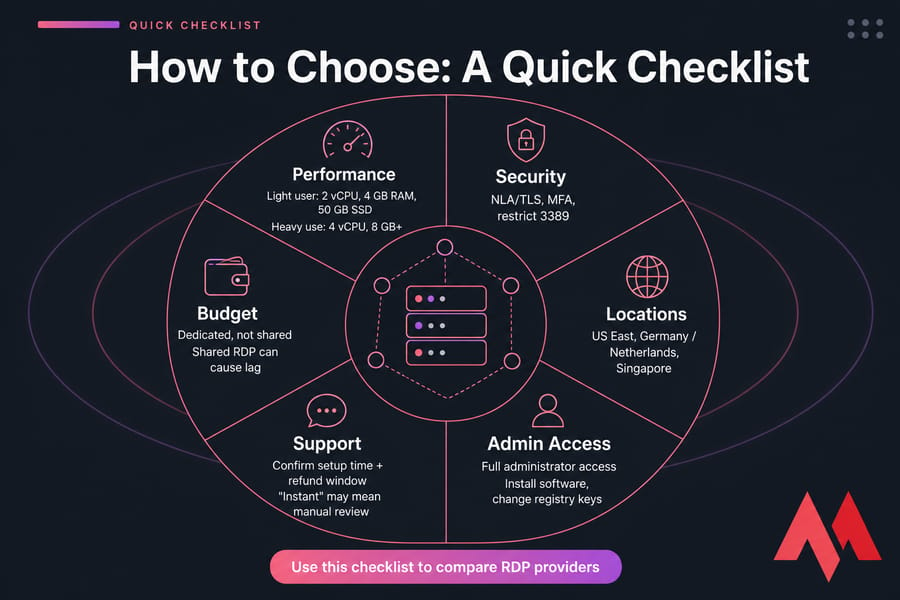
- Performance: Look for providers with high-bandwidth connections, powerful hardware (CPU, RAM), and geographically close servers to minimize latency (delay).
- Security: RDP transmits data, so strong security is essential. Choose providers with two-factor authentication, data encryption, and firewalls to safeguard your connection.
- Admin Access Level: Do you need full control to install software or manage configurations? Some providers offer user-specific access, while others have "Admin RDP" plans with a price bump.
- Server Locations: For optimal performance, choose a provider with servers geographically close to your location or your target audience (if using RDP for work). This reduces latency and improves connection speed.
- Budget: RDP providers offer tiered plans with varying features and resources. Consider your needs and find a plan that balances cost with what you require. Don't be swayed by the cheapest option — prioritize quality and security.
- Customer Support: Reliable and responsive customer support is vital in case of technical issues. Look for providers offering 24/7 support via phone, email, or live chat.
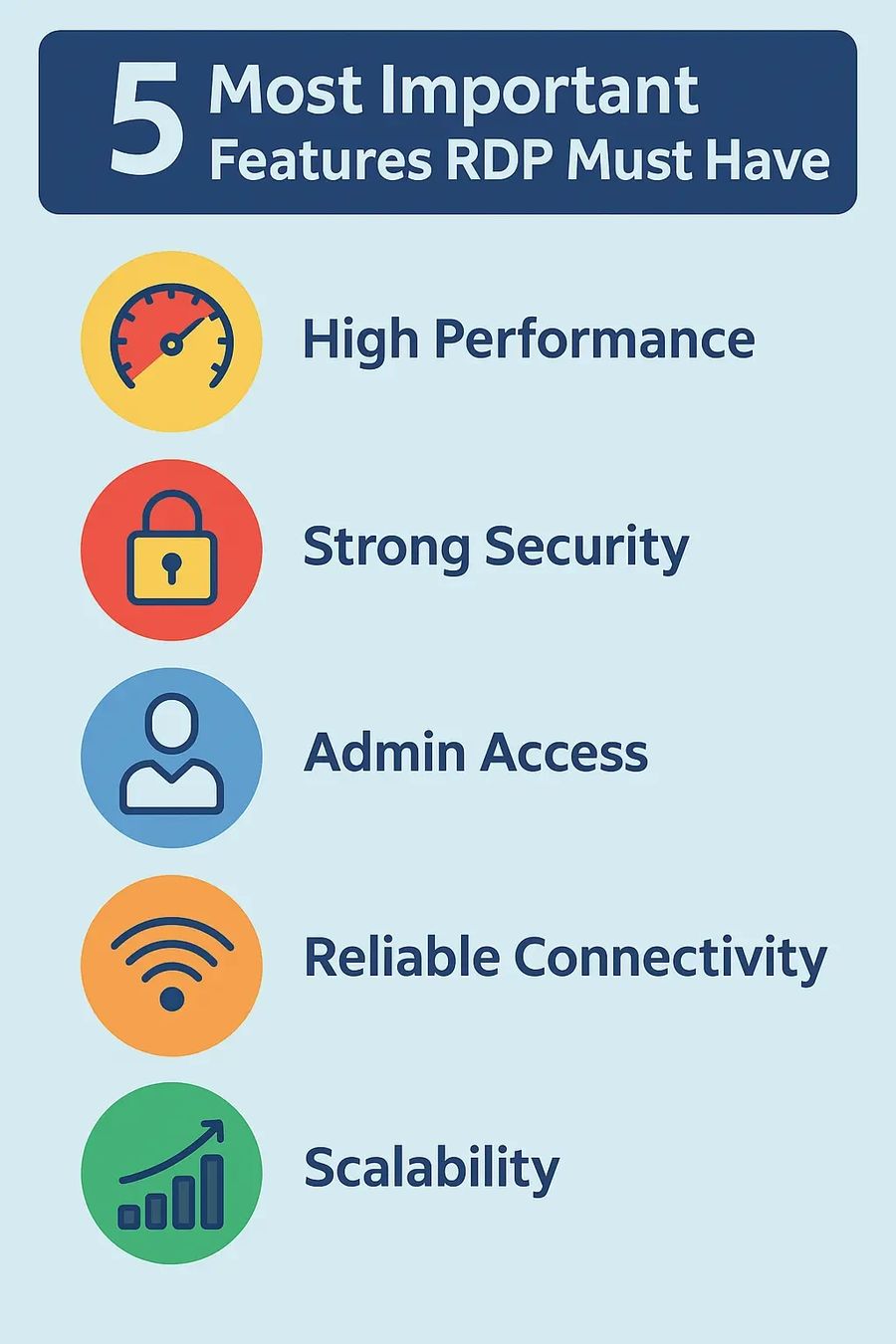
Quick checklist:
- One light user: 2 vCPU, 4 GB RAM, 50 GB SSD. Heavy multitasking or trading bots: 4 vCPU, 8 GB+.
- Multiple concurrent users? Go dedicated, not shared — shared RDP means someone else's CPU spike is your lag.
- Need to install software or change registry keys? You need full administrator access, stated in writing.
- Check Windows version availability before paying. Windows Server 2022 isn't on every entry plan.
- Confirm setup time and refund window. "Instant" sometimes means "after manual fraud review."
💻 Best RDP Operating Systems
- Windows 10 Pro and Windows 11 Pro — Windows operating systems are generally preferred for RDP because they natively support RDP and offer a good set of features and administrative tools. Windows 10 Pro and Windows 11 Pro include built-in support for RDP, which allows for easy remote access. Enhanced security, regular updates, and compatibility with most enterprise software make Windows a proper choice.
- Windows Server Editions (2019, 2022) — For larger organizations or those needing pro features, Windows Server editions provide additional tools like Active Directory, network management, and virtualization. Greater control over user access, integration with other Windows infrastructure, and robust support for enterprise-level deployments.
🌍 Best RDP Locations
Best location for hosting an RDP server depends on many factors:
- User Location: The closer the server to its users, the lower the latency, which results in a smoother and faster RDP experience.
- Data Center: Opt for locations in established data centers known for high uptime, good physical and network security, and reliable connectivity.
Most Popular RDP Locations:
- United States — High-quality infrastructure, multiple data centers across the country, and strong standards of data security. Suitable for businesses operating globally or within North America.
- Europe (Germany, Netherlands) — Strong data protection laws (like GDPR) make European locations favorable for companies needing stringent data privacy. They also offer excellent connectivity to both European and global networks.
- Singapore — A strategic location for Asian markets, as Asia's most important network hub offering robust infrastructure, low latency connections in the Asia-Pacific region.
Choosing the right OS and location depends heavily on the specific requirements of the user, such as the number of users, the geographical distribution of those users, specific compliance needs, and the type of applications that will be run over RDP. If the desktop feels sluggish, distance is usually the culprit, though tweaking display settings via our RDP resolution guide helps too.
🚨 Common RDP Buying Mistakes
- Buying on price alone, then paying twice when the plan can't run your software.
- Assuming admin access is standard. It often isn't on the cheapest tiers.
- Ignoring setup delays when you needed the server live for a Monday launch.
- Leaving default RDP ports and weak passwords exposed.
- Skipping the refund terms. Some "guarantees" exclude Windows licence fees.
🎯 Conclusion
Choosing the right RDP provider can be a daunting task, but this guide has provided you with the knowledge you need to make an informed decision. The best RDP provider is determined by what you need, so prioritize factors such as performance, security, admin access level, server locations, budget, and customer support. By carefully examining all of these factors, you'll be well on your way to selecting an RDP provider that delivers.
Choose by workload, not brand loyalty. MonoVM makes sense if you want breadth of locations and full admin control. CoreRDP and Hostworld UK if budget rules. AMinServe when dedicated resources are non-negotiable. QuickRDP when you need a box in the next ten minutes.
Still unsure which direction fits? Compare RDP hosting plans and locations, or look at remote desktop alternatives if a full Windows server is more than you need.
People are also reading:


Hello, everyone, my name is Lisa. I'm a passionate electrical engineering student with a keen interest in technology. I'm fascinated by the intersection of engineering principles and technological advancements, and I'm eager to contribute to the field by applying my knowledge and skills to solve real-world problems.