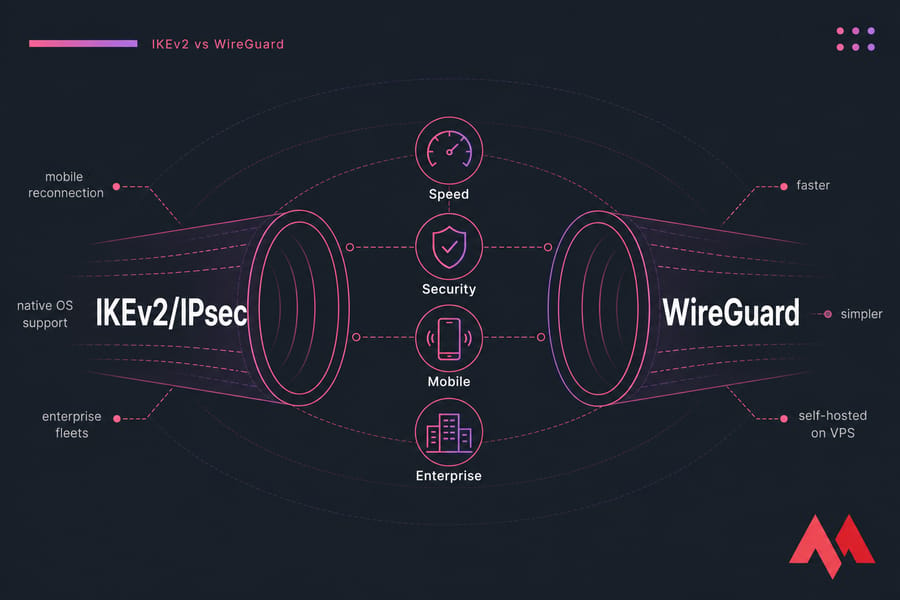
If you're trying to pick between IKEv2/IPsec and WireGuard, here's the short version: WireGuard is usually faster, simpler, and a joy to deploy on a VPS. IKEv2/IPsec is the safer pick when you need rock-solid mobile reconnection, native OS support across an enterprise fleet, or compatibility with existing IPsec gear.
IKEv2 vs WireGuard at a glance
Neither protocol is universally better. The right answer depends on what you're building and who's using it.
| Feature | IKEv2/IPsec | WireGuard | Typical Winner |
|---|---|---|---|
| Raw throughput | Strong with hardware acceleration | Higher in most tests | WireGuard |
| Setup complexity | High (StrongSwan, certs, policies) | Low (keys + peers) | WireGuard |
| Native OS support | Built into Windows, macOS, iOS | Requires client install (improving) | IKEv2/IPsec |
| Mobile roaming | Excellent via MOBIKE | Very good, but stateless | Tie |
| Codebase size | Hundreds of thousands of lines | ~4,000 lines | WireGuard |
| Enterprise ecosystem | Mature, broad vendor support | Newer, growing | IKEv2/IPsec |
| Self-hosted on VPS | Workable but fiddly | Genuinely easy | WireGuard |
If you just want the headline pick for a personal VPN you'll spin up on a Linux box, WireGuard wins almost every time. Want to understand the building blocks first? Start with what a VPN is and how it works, then come back.
Quick verdict for most users
WireGuard for self-hosted, personal, and modern Linux-based deployments. IKEv2/IPsec for managed device fleets, mobile-heavy users, or anywhere IPsec is already entrenched.
When the answer changes by use case
An iPhone fleet inside a corporation? IKEv2. A privacy-conscious developer on a ฿5 VPS? WireGuard. A travelling consultant hopping between hotel Wi-Fi and 5G? Either works — but WireGuard's reconnections feel snappier in my experience.
What is IKEv2/IPsec and how does it work?
IKEv2 — Internet Key Exchange version 2, defined in RFC 7296 — is a key exchange protocol. It's almost always paired with IPsec, which actually handles the encryption and tunneling. When people say "IKEv2 VPN," they mean IKEv2/IPsec. The two are inseparable in practice.
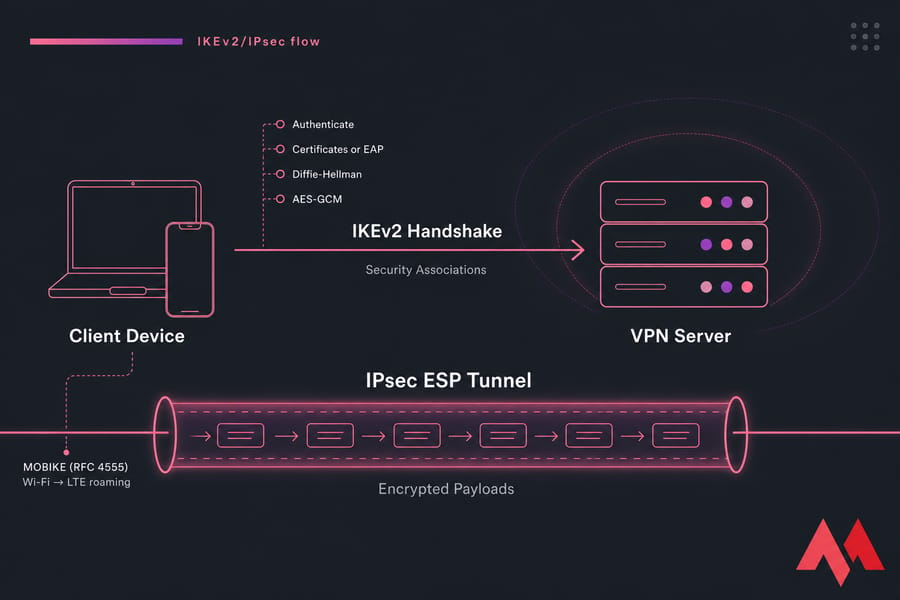
Here's the flow in plain English. Your device kicks off an IKEv2 negotiation with the server. They authenticate (usually with certificates or EAP), agree on a cipher suite — commonly AES-GCM these days — and establish security associations. IPsec then encapsulates your traffic inside an encrypted tunnel.
Why IKEv2 is usually paired with IPsec
IKEv2 negotiates keys. IPsec carries the data. Without IPsec, IKEv2 has nothing to protect. This pairing also gives you a battle-tested cryptographic suite with decades of vendor support — every serious router, firewall, and mobile OS speaks it natively.
How IKEv2 handles key exchange and tunneling
The handshake uses Diffie-Hellman to derive shared secrets, and MOBIKE (RFC 4555) lets the tunnel survive when your client's IP changes — say, going from Wi-Fi to LTE. That's why IKEv2 has a reputation for being the mobile VPN. If you want a refresher on the underlying ideas, see data encryption fundamentals.
The catch? IKEv2/IPsec supports a wide range of cipher suites and authentication modes. Flexibility is power, but it also means misconfiguration is easy. More on that later.
What is WireGuard and how does it work?
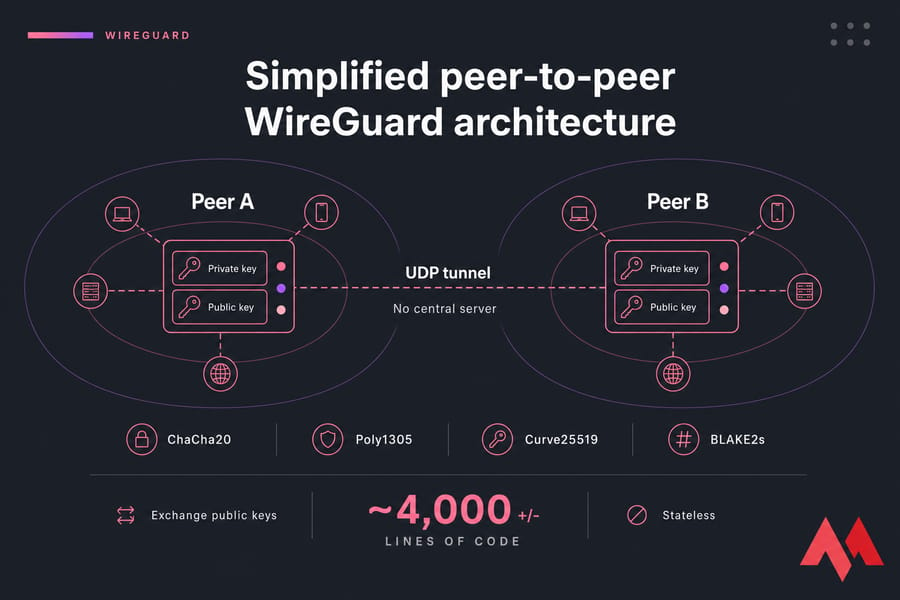
WireGuard is a newer VPN protocol that took the opposite philosophy: lean, opinionated, fast. The entire codebase is around 4,000 lines — compared to hundreds of thousands for OpenVPN or IPsec stacks. Smaller code means a smaller attack surface and an audit you can actually finish in a weekend.
It runs as a kernel module on Linux (and now natively on most platforms), uses fixed modern crypto — ChaCha20 for encryption, Poly1305 for authentication, Curve25519 for key exchange, BLAKE2s for hashing — and ditches the complex negotiation phase entirely.
Why WireGuard is considered a lightweight VPN protocol
No certificate authority. No cipher negotiation. No giant policy databases. You generate a keypair on each peer, exchange public keys, and you're done. The protocol just works at the network layer with minimal fuss.
How WireGuard manages keys and peers
Each peer holds a private key and knows the public keys of peers it trusts. There's no session state in the traditional sense — WireGuard is stateless from the protocol's perspective, which is partly why roaming feels so smooth. Want to actually deploy it? Check the WireGuard VPN on VPS guide.
A small caveat: WireGuard's simplicity comes with tradeoffs. Static public keys mean you have to handle identity management and key rotation yourself if you care about that. It doesn't try to be everything to everyone — and honestly, that's why it's good.
IKEv2 vs WireGuard security comparison
Let's get one thing out of the way. Both protocols are secure when configured properly. The interesting question isn't "which is unbreakable" (neither is, nothing is) — it's how each handles the real-world attack surface.
| Factor | IKEv2/IPsec | WireGuard | Practical Impact |
|---|---|---|---|
| Cipher choice | Configurable (AES-GCM, AES-CBC, etc.) | Fixed (ChaCha20-Poly1305) | WireGuard removes a class of misconfig bugs |
| Codebase size | Hundreds of thousands of LOC | ~4,000 LOC | Smaller surface = easier audit |
| Auditability | Years of scrutiny, but complex | Formally verified components | Both have credibility |
| Identity model | Certs, PSKs, EAP | Static public keys | IKEv2 fits enterprise PKI; WireGuard simpler |
| Forward secrecy | Yes | Yes (via ephemeral handshake) | Equivalent in practice |
| Misconfiguration risk | Higher (more knobs) | Lower (fewer choices) | Operationally significant |
Cryptography differences between IKEv2/IPsec and WireGuard
IKEv2/IPsec is flexible — you can run it with AES-256-GCM and modern Diffie-Hellman groups, or you can foot-gun yourself with weak ciphers from 2005. WireGuard simply doesn't give you that rope. It picks modern primitives and that's that.
Auditability, codebase size, and attack surface
This is where WireGuard genuinely shines. A 4,000-line implementation is something a small team can review end to end. Compare that with StrongSwan plus the Linux kernel's IPsec stack — both excellent, but you're trusting a much larger surface.
What "more secure" really means in practice
Most VPN breaches aren't cryptographic failures. They're misconfigured firewalls, leaked keys, weak authentication, or unpatched servers. If your team is small and your ops discipline is average, WireGuard's "fewer choices" model is honestly a security feature. For more on operational risks, see common cyber security threats and how to mitigate them.
One nuance worth flagging: WireGuard assigns static internal IPs to peers by default and doesn't rotate keys automatically. For privacy-paranoid use cases, that's something to plan around.
IKEv2 vs WireGuard speed and performance
WireGuard typically wins benchmarks. The reasons are structural — it runs in the Linux kernel, uses lean cryptographic primitives well-suited to modern CPUs, and skips the complex multi-phase negotiation that IKEv2 requires. Independent tests routinely show WireGuard pushing higher throughput with lower CPU usage.
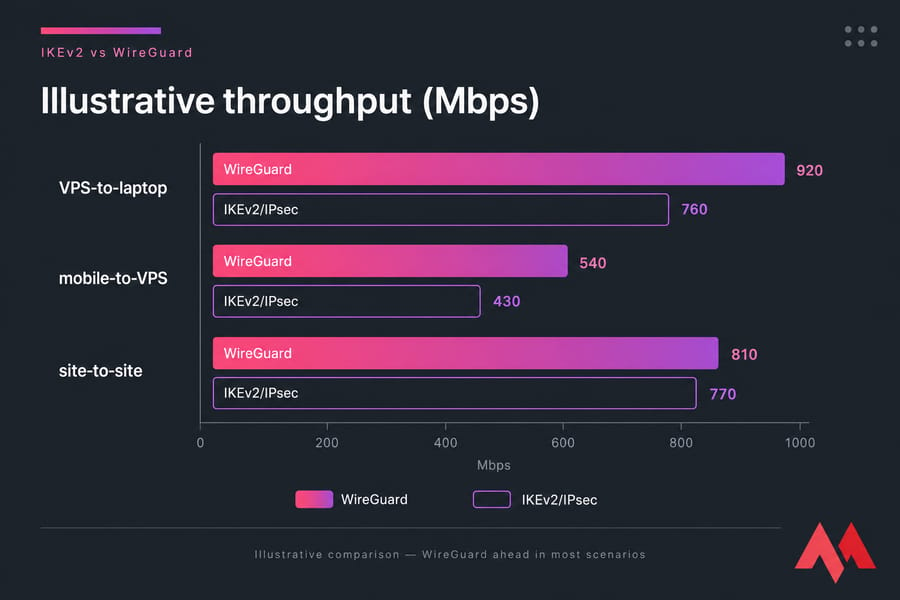
Throughput, latency, and handshake overhead
WireGuard's handshake is a single round-trip. IKEv2/IPsec needs more exchanges before data flows. For long-lived tunnels this rarely matters. For frequent reconnects on a flaky mobile network? It adds up.
Latency-wise, both protocols add minimal overhead once the tunnel is up. If you're chasing every millisecond, also read up on what causes latency and how to reduce it — the protocol is rarely your real bottleneck.
CPU efficiency on VPS and mobile devices
On a budget VPS with limited cores, WireGuard's lower CPU cost lets a small server move more traffic. On phones, that translates into better battery life during active VPN use. Pairing WireGuard with an NVMe VPS gives you a setup that's hard to bottleneck for personal or small-team use.
When IKEv2 can still perform well
IKEv2 with AES-NI hardware acceleration on a beefy server is no slouch. Many enterprise appliances are optimised specifically for IPsec. If your hardware path is tuned for it, the gap narrows considerably.
Performance alone doesn't decide this. Compatibility usually does.
WireGuard vs IKEv2 compatibility and device support
This is where IKEv2/IPsec earns its keep. It's built into Windows, macOS, iOS, and Android out of the box. Push a config profile to a fleet of iPhones, and you're done — no app install required.
| Platform | IKEv2/IPsec | WireGuard | Notes |
|---|---|---|---|
| Windows | Native | Official client | Both work well |
| macOS | Native | App Store client | IKEv2 needs no install |
| iOS / iPhone | Native + MDM profiles | App Store client | IKEv2 wins for managed fleets |
| Android | Native (recent versions) | Official app | WireGuard app is excellent |
| Linux VPS | StrongSwan / Libreswan | Kernel module | WireGuard is dramatically simpler |
| Routers (MikroTik, etc.) | Broad support | Growing support | IKEv2 still ahead for site-to-site |
| Enterprise firewalls | Universal | Limited / via plugins | IKEv2 dominates here |
Native support on Windows, iPhone, Android, and macOS
IKEv2 ships as a first-class citizen across every major OS. WireGuard requires installing a client. For most personal users that's a 30-second job. For an IT team managing 5,000 endpoints, it's a real consideration.
Enterprise firewalls, routers, and VPN appliances
If you've got a MikroTik running site-to-site tunnels, or a Cisco/Fortinet appliance, IKEv2/IPsec is the lingua franca. WireGuard support exists on many devices, but it's not yet ubiquitous.
Self-hosted server support on Linux VPS
On a Linux VPS, WireGuard is honestly a joy. The kernel module is mainline since 5.6. Configuration is one file. If self-hosting is your path, this alone often settles the debate. See the WireGuard setup guide for the actual steps.
IKEv2 vs WireGuard for mobile VPN roaming
Mobile users care about one thing above all: does the VPN stay up when I switch networks? Both protocols handle this well, but differently.
How MOBIKE helps IKEv2 on changing networks
MOBIKE is IKEv2's mobility extension. When your phone's IP changes, MOBIKE updates the existing security association without renegotiating from scratch. The tunnel survives the network swap, often invisibly. That's why corporate iPhone fleets love it.
How WireGuard handles reconnections and IP changes
WireGuard is stateless at the protocol level. When packets start arriving from a new source IP with a valid authenticated handshake, the peer endpoint just updates. There's no formal "roaming" — it's a side effect of the design. In practice it feels instant.
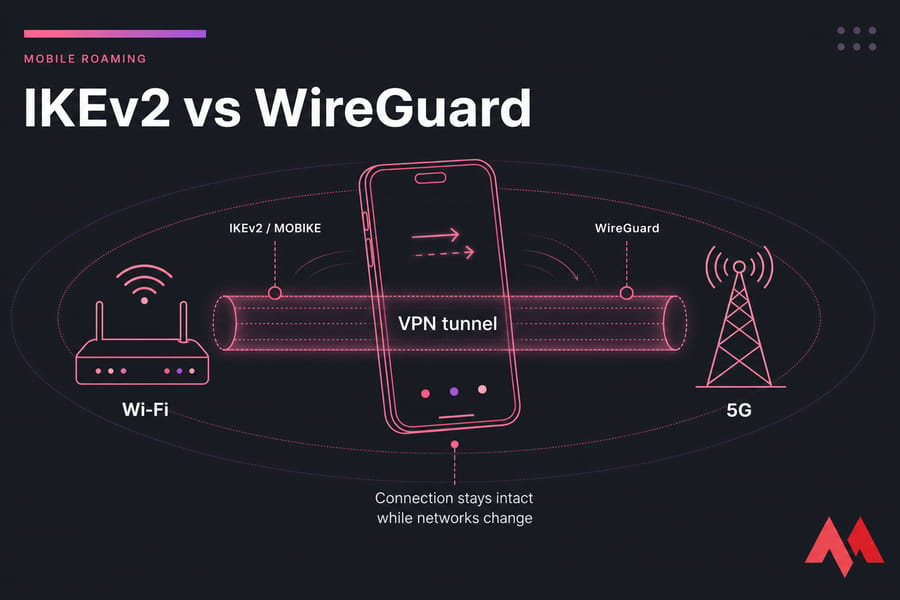
Which protocol feels more stable on the move
Honest answer: both are excellent. IKEv2/MOBIKE is more battle-tested in carrier-grade environments. WireGuard's simpler model means fewer edge cases. If you want to hide your IP reliably while travelling, either will do the job.
IKEv2 vs WireGuard setup and management
This is where most people quietly switch teams to WireGuard.
Server deployment complexity
Setting up IKEv2/IPsec on a VPS with StrongSwan involves config files for the daemon, IPsec policies, certificates (or PSKs), firewall rules for UDP 500 and 4500, NAT traversal handling, and often a separate config for each client. It's not impossible. It's just a lot.
WireGuard? Generate keys, write a 10-line config, open one UDP port. Done. The VPN-on-VPS guide walks through real examples.
Key management and configuration differences
IKEv2 uses certificates or pre-shared keys, often backed by a PKI. WireGuard uses raw public/private keypairs. The PKI approach scales better for large orgs with rotation policies. The keypair approach is faster and easier when you've got fewer than 50 users.
A word of caution: IKEv2/IPsec misconfiguration is genuinely common. Wrong cipher suite, mismatched policies, forgotten NAT-T rules — I've debugged all of these in production. WireGuard's small surface makes troubleshooting more humane. Lock down your server too with secure SSH practices before anything else.
Troubleshooting and long-term maintenance
WireGuard logs are minimal but readable. IPsec logs can be cryptic — the same error can mean ten different things. Long-term, fewer moving parts means fewer 2 AM incidents.
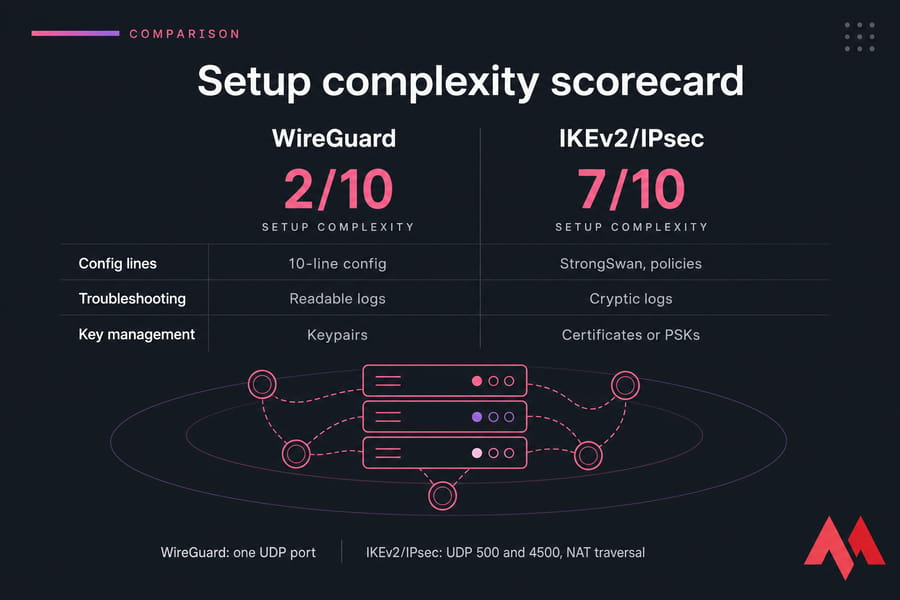
Deploy Your Own Private VPN on a Fast VPS
If you decide to roll your own WireGuard or IKEv2/IPsec server, MonoVM's VPN server hosting gives you the Linux resources, global locations, and root access you need to build it properly. Get started with VPN-ready hosting and skip the procurement headache.
Best use cases for IKEv2/IPsec and WireGuard
Here's the scenario-by-scenario breakdown most articles skip.
| Scenario | Better Choice | Why |
|---|---|---|
| Enterprise remote access (managed iPhone/Windows fleet) | IKEv2/IPsec | Native OS support, MDM profiles, no client install |
| Site-to-site with existing routers/firewalls | IKEv2/IPsec | Universal vendor support |
| Personal VPN on a Linux VPS | WireGuard | Fastest setup, lowest overhead |
| Remote work for a small dev team | WireGuard | Easy onboarding, simple key distribution |
| Travel and public Wi-Fi privacy | Either | WireGuard for self-hosters, IKEv2 if built-in only |
| Highly censored networks | OpenVPN (fallback) | TCP/443 disguise; WireGuard and IKEv2 use distinct UDP ports easier to block |
| Router-based always-on tunnel | IKEv2/IPsec | More widely supported in router firmware |
| Privacy-focused self-hoster | WireGuard | Modern crypto, small audit surface |
Best for enterprise VPNs
IKEv2/IPsec. The ecosystem just wins. Your firewall speaks it, your MDM speaks it, your appliances speak it. Don't fight the current.
Best for personal VPN on a VPS
WireGuard, full stop. If you're spinning up a private tunnel on Ubuntu or Debian, this is the path of least resistance. Read more on self-hosted VPN vs commercial VPN if you're still on the fence about going DIY.
Best for privacy, travel, and remote work
WireGuard for self-hosters, IKEv2 if you only want what the OS gives you natively. Both keep public Wi-Fi sessions secure.
Best for routers and cross-platform environments
IKEv2/IPsec still rules router firmware. WireGuard support is growing fast, but coverage isn't universal yet. Considering the broader picture? Compare VPS vs VPN and OpenVPN vs L2TP for adjacent decisions.
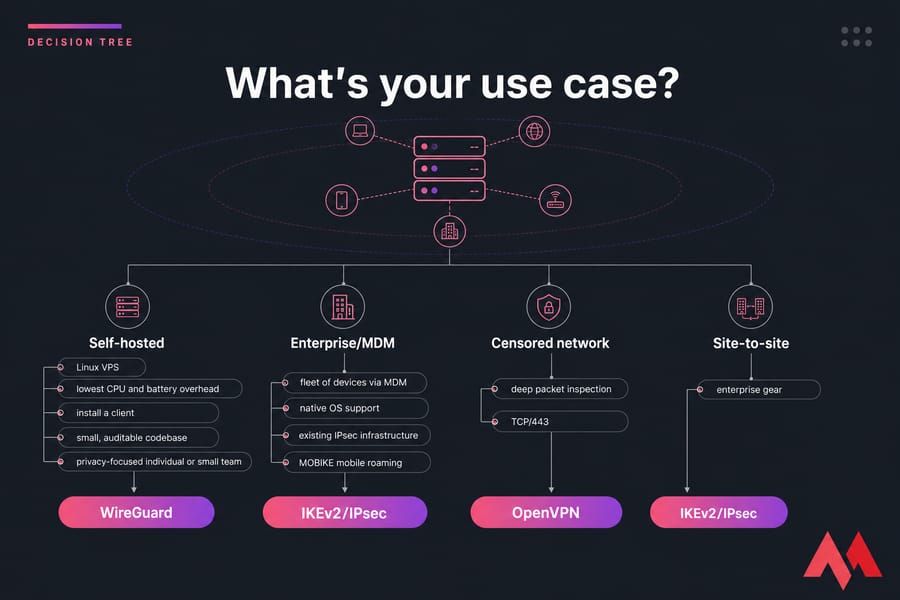
Should you choose WireGuard or IKEv2?
Here's the clean decision framework.
Choose WireGuard if
- You're self-hosting on a Linux VPS
- You want the lowest CPU and battery overhead
- Your users are technical enough to install a client
- You value a small, auditable codebase
- You're a privacy-focused individual or small team
Choose IKEv2/IPsec if
- You manage a fleet of devices via MDM
- You need native OS support without client installs
- You're integrating with existing IPsec infrastructure
- Site-to-site connectivity through enterprise gear is on the menu
- Mobile roaming via MOBIKE is critical for your users
Best alternative if you need broader legacy support
If neither fits say, you're battling deep packet inspection or a network that only tolerates TCP/443 — OpenVPN is the third option worth considering. See WireGuard vs OpenVPN for that comparison, or check the OpenVPN server hosting option and the install guide.
Ready to Build a Secure VPN Server?
Pick a high-performance MonoVM VPN Server and deploy WireGuard, IKEv2/IPsec, or OpenVPN with full root access.

An experienced tech and developer blog writer, specializing in VPS hosting and server technologies. Fueled by a passion for innovation, I break down complex technical concepts into digestible content, simplifying tech for everyone.