![How to choose a Domain Name [Best Tips & Domain Registrar]](/wp-content/uploads/2020/09/12271-main.webp)
A domain name is your website's name, which is used by website users to access your website from any web browser. It is also beneficial to make a specific identity of your website, representing your website on the web platform. Hence it is essential to choose the appropriate domain name that must consist of your website's name. However, it always gets confusing for people to select a proper domain, so if you are one of them and thinking about how to choose a domain name for your business, then read this guide completely, we have included all of the required details that can help you to select the right domain name.
Your domain name is the front door to everything you build online. Get it right, and people remember you, type it correctly, and trust the link when they see it in an email or a Google result. Get it wrong, and you'll spend years explaining the spelling. One thing upfront: a good domain helps SEO indirectly through clicks, trust, and memorability — not because Google rewards keyword-stuffed URLs. That myth needs to die.
Read: What is a Domain Name
Stylised browser bar showing yourbrand.com with cursor over Enter on a dark gradient background
What is a Domain Name?
As Wikipedia states, a domain name is the string of identification letters and digits that define control authority and administrative autonomy on the internet. The domain name is the identification of your business or website. This name is a combination of letters and characters like www.domainname.com, and It is also known as your website address.

In the domain name, WWW means World Wide Web, and .com is the extension that mostly defines your business's nature. The middle part of the address is the name of your business which you want people to look for on the internet. The core of your domain name is most important and think something memorable.
You can choose any combination of digits and letters as your domain name. Most people choose the name according to their business service or their other preferences, and some make up their own words, which also works well as long as it is catchy and easy to pronounce.
How to Choose a Domain Name: Quick Checklist
Before we go deep, here's the short version. If you only remember eight things, remember these:
- Keep it short — under 15 characters is the sweet spot.
- Make it easy to spell and easy to say out loud.
- Skip hyphens, numbers, and double letters.
- Pick the right extension (default to .com if you can).
- Check trademark databases before you buy.
- Check that matching social media handles are free.
- Buy from a trusted registrar with transparent renewal pricing.
- Turn on WHOIS privacy, auto-renew, and registrar lock immediately.
Importance of Domain Name
This name is the identification of your business or your website. It can make you or break you on the internet. It is crucial to choose a domain name that displays personality and gives information to the viewers you want them to attain. The following are some of the explanations to make it clear its importance:
1. Your "First Impression"
Your URL or domain name is the first thing that a visitor will see. A good domain works to create a positive impression, is easily memorable, and increases future retention. A bad domain name is directly related to negative impressions that are long and hard to read, resulting in less retention rate in viewers' minds.
2. It Affects SEO
Search engine optimization is when the search engine ranks your website following the relevance to a particular word search. If you have a word related to your business or service in your domain name, there is a higher chance that your website may be displayed on the first page of Google's top 5 search results, especially if you have implemented all the right SEO and online marketing tactics.
3. It Defines Your Brand
Your domain name provides a branding opportunity, so with the right domain name, you can create a brand out of your web address to obtain amazing advantages and easily attract customers to your website.
What Makes a Good Domain Name?
A good domain name does three jobs at once: it represents your brand, sticks in people's heads, and looks legitimate in a search result. That's it.
Short, simple, and easy to remember
Short names win. Compare buyaffordablecoffeebeansonline.com with roastly.com. Which one would you actually type? Aim for one or two words. If you can keep it under 12 characters, even better.
Easy to spell, type, and pronounce
The "radio test" still applies. Say your domain out loud. If a friend hears it and has to ask "how do you spell that?" — you've got a problem. Avoid words with multiple acceptable spellings (color/colour), silent letters, and anything you couldn't dictate over a phone call.
Relevant to your brand or niche
Your domain should hint at what you do, or be distinctive enough to become a brand on its own. Both work. Shopify meant nothing in 2006 — now it means ecommerce. But it was always easy to say and spell, which matters more than literal relevance.
Flexible enough to grow with your business
This one gets missed constantly. If you call your shop brooklyncoffee.com and later expand to tea, sandwiches, or a second city, the name boxes you in. Pick something that survives a pivot.
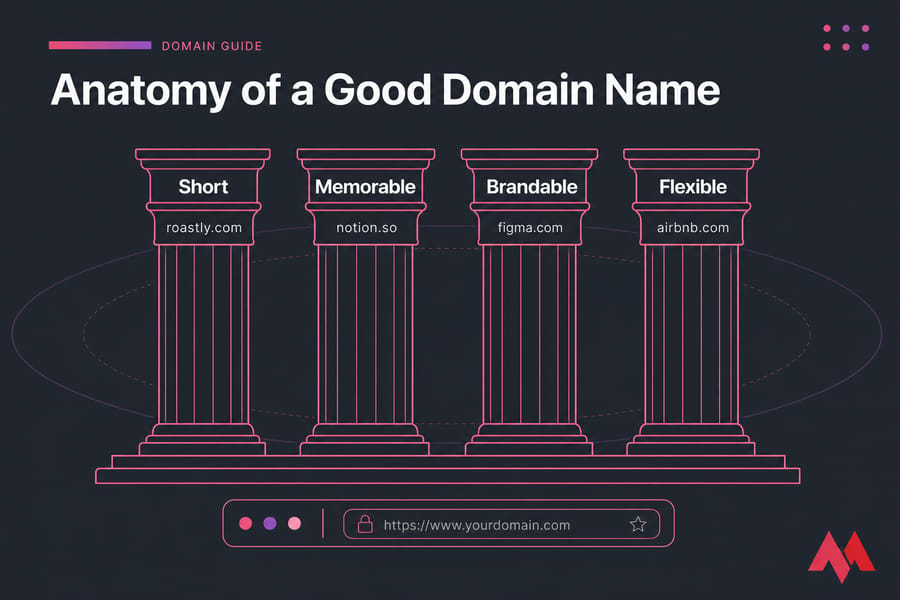
| Trait | Why it matters | Example |
| Short | Easier to type, remember, share | stripe.com |
| Pronounceable | Survives word-of-mouth and radio mentions | notion.so |
| Brandable | You own the term in users' minds | figma.com |
| Future-proof | Doesn't trap you in one niche or city | airbnb.com |
| No hyphens or numbers | Reduces confusion and typos | vercel.com |
Step-by-Step: How to Choose the Right Domain Name
Here's the actual workflow I use when helping someone pick a name. Don't skip steps — each one prevents a specific regret.
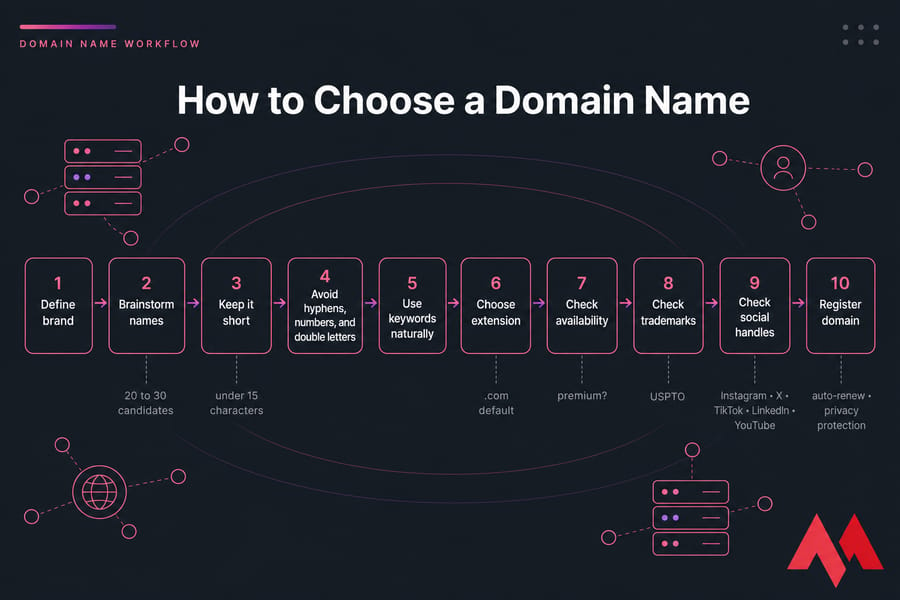
1. Start with your brand and website purpose
Write down what your site does in one sentence. Then write down three feelings you want visitors to associate with your brand. This isn't fluff — it gives your brainstorming direction.
2. Brainstorm several name ideas
Aim for 20 to 30 candidates. Mix invented words, compound words, abstract terms, and one or two descriptive options. Use a domain name generator if you're stuck, but don't let it choose for you. The best names usually come from squishing two real words together or modifying a common one slightly.
3. Keep it short and easy to say
Cross off anything longer than 15 characters or harder to pronounce than "ambulance." Be brutal. A name you love but can't easily say is a name that costs you customers. According to research from DataGenetics.com, the most common name length for famous domain names is approximately 12 characters.
4. Avoid hyphens, numbers, and double letters
Hyphens get forgotten. Numbers create ambiguity (is it "4" or "four"?). Double letters cause typos. If your dream name is flowwriter.com, accept that half your users will type flowriter.com and end up on a competitor's parked page.
5. Use keywords only when they sound natural
Keywords in a domain can subtly help with click-through rate on search results. seattleplumber.com is fine if you're a Seattle plumber. But cheap-best-seattle-emergency-plumber-services.com looks like spam and will hurt trust. If a keyword fits cleanly, great. If you're forcing it, stop.
6. Choose the right domain extension
More on this below, but the default play is .com. If it's gone, then we talk alternatives. Don't pick a weird TLD just because the .com is taken — sometimes that's a signal to rethink the name itself.
7. Check domain availability
Use a domain search tool at any registrar. Search your top five candidates. If a name shows up as "premium" with a four-figure price tag, decide whether the brand fit justifies the spend, or move on.
8. Check trademark and brand conflicts
This step trips up so many founders. Just because a domain is available to register doesn't mean you can legally use it. Search the USPTO trademark database (or your country's equivalent), and run a regular Google search for the name plus your industry. If a company in your space already uses it, walk away.
9. Check matching social media handles
Pop your shortlisted names into Instagram, X, TikTok, LinkedIn, and YouTube. Consistent handles across platforms make your brand look professional. If the .com is free but every social handle is taken, you'll forever be @brandname_official — and that's a downgrade.
10. Register your domain with a trusted registrar
Once you've got a winner, buy it immediately. Don't sleep on it. I've watched people lose names overnight to domain investors who monitor search activity. Register for at least two years, turn on auto-renew, and enable privacy protection. When you are looking to how to buy a domain name, always try to go for the .com extension.
How to Choose the Best Domain Extension
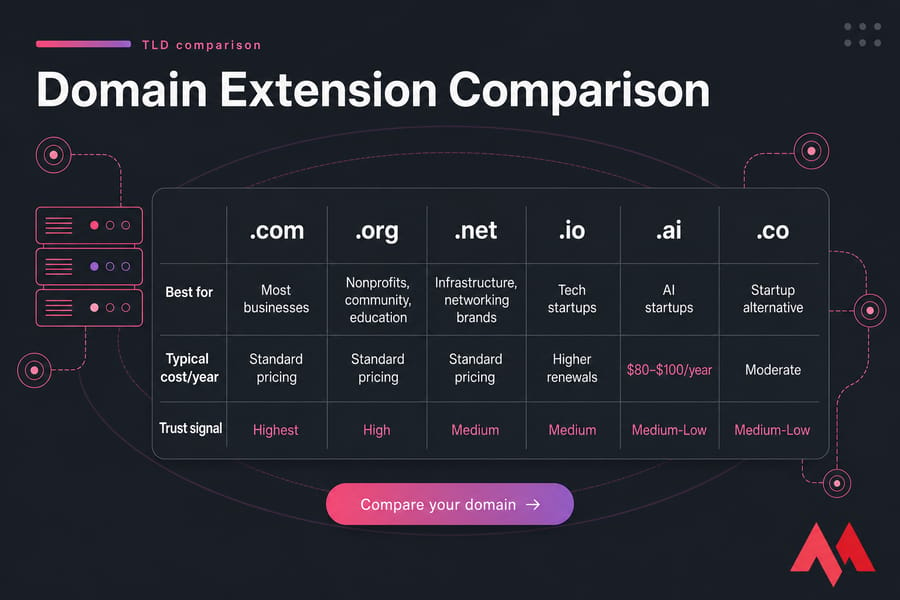
There are now over 1,500 top-level domains available, which is great in theory and overwhelming in practice. Most of them you'll never need.
Use the Right Extensions (.com, .org, .net)
The one thing which comes to mind when you talk about a domain name is its extension, and the most obvious extension is .com. .com was launched in the early days of the internet, and it is still at the top because 43% of all domain names have a .com extension.
When .com is the best option
For most businesses, .com is still the default. It's what people type when they forget which extension you use. Trust scores are higher. Email deliverability tends to be slightly better. If your .com is available at standard pricing, take it.
When .org, .net, or country-code domains make sense
.org reads as nonprofit or community-driven — perfect for charities, open-source projects, and educational sites. .net feels dated, honestly, but it works for infrastructure or networking brands. ccTLDs make sense when your business is geographically locked: a UK-only legal firm should grab .co.uk alongside the .com. Want to dig deeper? Here's a full breakdown of ccTLDs vs gTLDs.
Newer TLDs: .io, .ai, .co, .store
Tech startups love .io and .ai. Ecommerce stores sometimes use .store or .shop. These can work, but two caveats: renewals are often expensive (.ai runs $80–$100/year), and some users will still mentally append ".com" when typing. If you go this route, consider buying the matching .com as a defensive purchase.
Should you buy multiple extensions?
If you can afford it and the variations are cheap, yes. Buy the .com and the most relevant ccTLD at minimum. This blocks typosquatters and protects your brand. You don't need every TLD — just the ones a confused customer might type.
Brandable vs Keyword-Rich Domain Names
The truth about exact-match domains and SEO
Years ago, stuffing keywords into a domain gave a measurable ranking boost. Google patched that loophole over a decade ago. Today, exact-match domains can actually look spammy and hurt click-through rates. Branding, content quality, backlinks, and user experience drive rankings — not your URL.
When a brandable name is better
If you're building something you want to grow, go brandable. Made-up words (Spotify, Zappos, Xerox) become assets. You own them in users' minds, and they're typically easier to trademark. A brandable name is unique, stands out from the competition, and is easy to remember. How to find brandable domain names: create new words, use existing words, or use domain name generators.
When keywords help
For hyper-local services where the customer searches by location, a keyword domain can work. denverdogwalking.com is fine. It's clear, it's targeted, and the business probably isn't planning to franchise globally. Just don't sacrifice naturalness for SEO that won't materialize.
How to Check Domain Name Availability
Three quick checks before you pull the trigger:
- Domain search: any registrar's search bar will do. Try a few candidates at once.
- WHOIS lookup: if a domain is taken, you can sometimes find out who owns a domain name and make an offer.
- Trademark search: USPTO, EUIPO, or your country's IP office. This is non-negotiable.
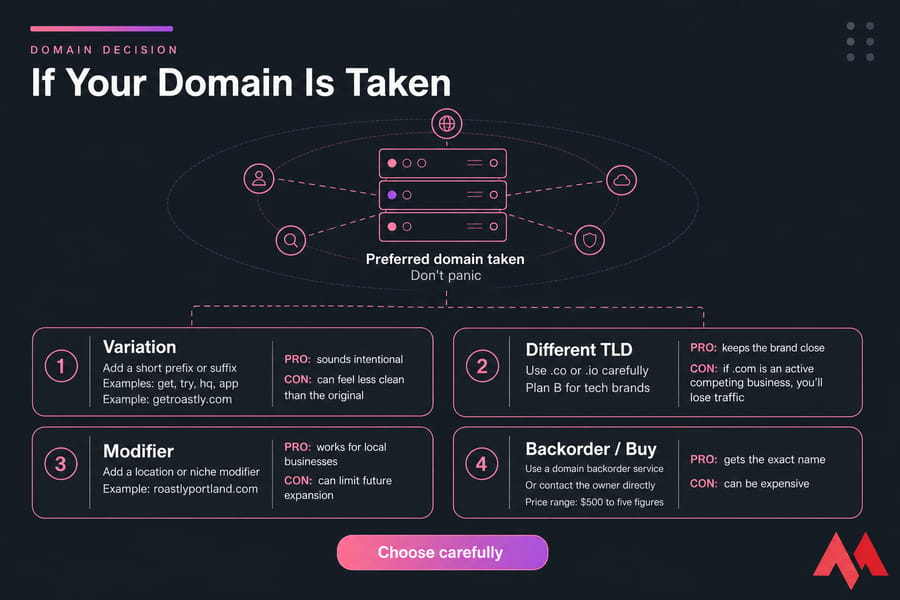
What to Do If Your Preferred Domain Name Is Taken
This happens to almost everyone. Don't panic, and don't settle for something awful.
Try a brand variation
Add a short prefix or suffix that fits the brand. get, try, hq, app, or io-style word endings work well. getroastly.com sounds intentional, not desperate.
Use a different TLD carefully
If the .com is parked and clearly unused, .co or .io can be a reasonable Plan B — especially for tech brands. But if the .com is an active competing business, pick a different name. You'll lose traffic to them forever.
Add a location or niche modifier
For local businesses, adding a city or service modifier works: roastlyportland.com. Just make sure the modifier matches your actual market.
Consider a domain backorder or purchase offer
If the name is critical, you can use a domain backorder service to grab it the moment it expires, or contact the current owner directly with a reasonable offer. Expect to pay anywhere from $500 to five figures for desirable names on the premium domain market.
How to Choose a Domain Registrar
Where you buy matters more than people realize. A cheap first-year deal often becomes a painful renewal bill, and bad support during a domain emergency can cost you the brand entirely.
Compare renewal pricing, not just first-year discounts
I've seen domains promoted at $0.99 for year one then jump to $22 on renewal. Always check the renewal price before you commit. Over five years, that "deal" costs you more than the registrar charging a flat $12 from day one.
Check privacy, security, and DNS features
Free WHOIS privacy should be standard. Two-factor authentication is a must. DNS management should be fast and offer all standard record types (A, AAAA, CNAME, MX, TXT, SRV). DNSSEC support is a bonus.
Review support and transfer policies
Test their support before buying — open a chat or ticket with a basic question. Slow or templated answers tell you what you'll get when something actually breaks. Also check transfer policies. Some registrars make leaving deliberately painful.
| Criterion | What to look for |
| Pricing transparency | Renewal cost shown clearly at checkout |
| WHOIS privacy | Included free, not upsold |
| DNS management | Full record types, fast propagation |
| Security | 2FA, registrar lock, DNSSEC |
| Support | 24/7 live chat, real humans |
| Transfer policy | No artificial barriers, clear auth code process |
For a deeper look at options, check Domain Registration and learn how to register a domain name step by step.
Domain Privacy, Security, and Ownership Tips
WHOIS privacy
Every domain registration is recorded in a public WHOIS database. Without privacy protection, your name, address, email, and phone number are visible to anyone. That's a spam magnet and a privacy risk. Enable domain privacy protection on day one most reputable registrars include it free.
Auto-renew and registrar lock
Auto-renew prevents accidental expiration. I've watched a friend lose a five-year-old domain because his credit card expired and the renewal email went to spam. Two days later, a domain investor scooped it up. Don't let that happen — turn on auto-renew and keep your payment method current.
Registrar lock (sometimes called transfer lock) prevents anyone from moving your domain to another registrar without your explicit approval. Turn it on. Always.
Why business owners should control the domain account
This one's personal experience talking. Never let a freelancer, agency, or employee register your domain under their personal account "for convenience." When they leave, the domain leaves with them, and recovery can take months — or court. The business owner registers and controls the domain. End of discussion.
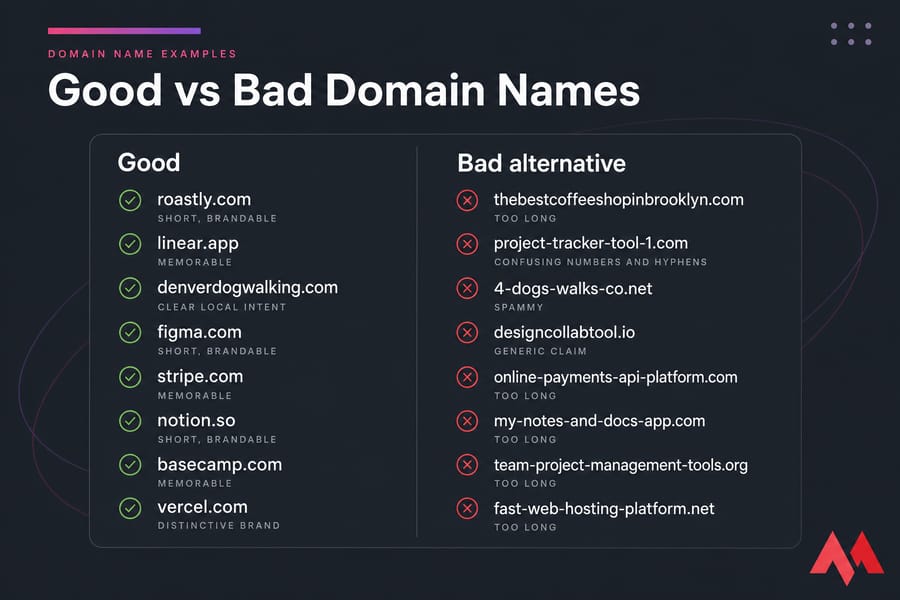
Examples of Good and Bad Domain Names
Concrete examples beat theory every time.
| Good | Bad alternative | Why |
| roastly.com | thebestcoffeeshopinbrooklyn.com | Short, brandable, no location lock-in |
| linear.app | project-tracker-tool-1.com | Memorable; the bad version is forgettable spam |
| denverdogwalking.com | 4-dogs-walks-co.net | Clear local intent vs confusing numbers and hyphens |
| figma.com | designcollabtool.io | Distinctive brand vs generic descriptor |
| stripe.com | online-payments-api-platform.com | Two syllables vs unreadable mouthful |
| notion.so | my-notes-and-docs-app.com | Concept name vs literal description |
| basecamp.com | team-project-management-tools.org | Metaphor brand vs keyword soup |
| vercel.com | fast-web-hosting-platform.net | Coined word vs generic claim |
Common Domain Name Mistakes to Avoid
After watching this go wrong dozens of times, here are the patterns that hurt people most:
- Chasing exact-match keywords — outdated SEO advice that now looks spammy.
- Using hard-to-spell words — if you have to spell it out, the name fails the radio test.
- Hyphens and numbers — typo magnets and trust killers.
- Ignoring trademarks — could cost you the entire brand and a legal bill.
- Trendy names that age badly — anything with "2024" or a fad reference dates fast.
- Cheap first-year pricing trap — check renewal costs before celebrating the deal.
- Low-trust registrars — if you've never heard of them, dig deeper before buying.
- Skipping social handle checks — a great domain with terrible matching handles is a half-built brand.
Final Thoughts: Pick a Domain Name You Can Grow With
The best domain name is the one you can still proudly say on a podcast ten years from now. It's short, brandable, easy to spell, and protected by the right security settings on a registrar that won't hold you hostage at renewal.
Don't agonize forever — but don't rush either. Run your top three names through the radio test, the trademark check, and the social handle check. Buy the .com if you can. Lock it down with privacy and auto-renew. Then go build something worth typing into a browser.
Always make sure you purchase a domain name from an authorized platform for better security, privacy, and options. There are hundreds of domain registration websites that offer services at lower prices, but there can be issues regarding the security and privacy of visitors. Monovm provides so much more in their hosting package, and you get a domain name and free business email all in one package with polite and responsive customer support.
Ready to make it official? Buy a domain name through a registrar that gives you transparent renewal pricing, free WHOIS privacy, and real human support when you need it.


I'm fascinated by the IT world and how the 1's and 0's work. While I venture into the world of Technology, I try to share what I know in the simplest way with you. Not a fan of coffee, a travel addict, and a self-accredited 'master chef'.