
Choosing the best forex brokers is essential to trading success, especially in 2026 as global markets evolve and regulations tighten. This exhaustive guide will compare the top forex brokers based on regulation, trading platforms, spreads, account types, and withdrawal speeds. Whether you're a newcomer looking for an easy-to-use platform or an advanced trader looking for ultra-tight spreads, our latest reviews and comparison table will ensure you locate a secure and reliable broker that fits your needs.
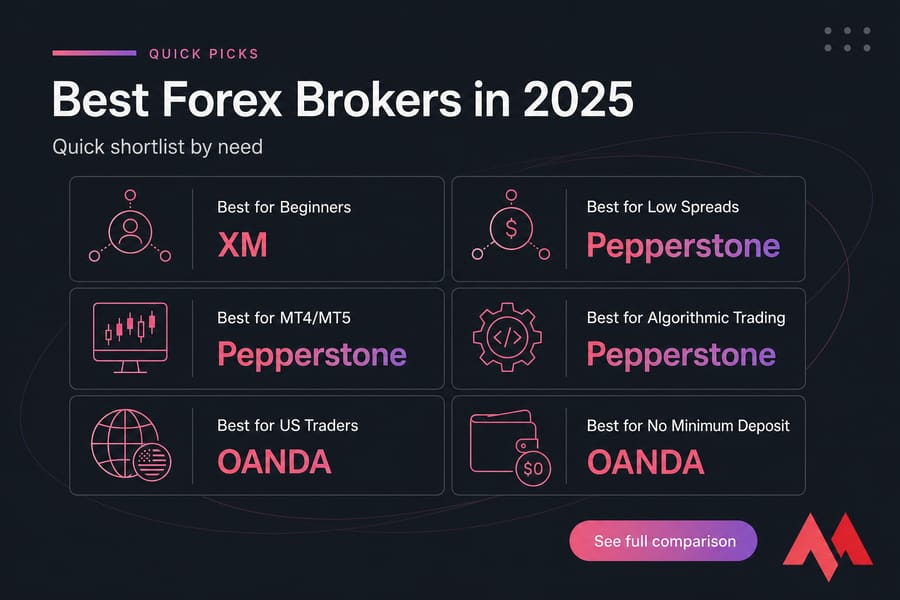
My quick take: OANDA is the safest practical pick for many US traders, Pepperstone stands out for low spreads and algo-friendly trading, XM works well for beginners with a low entry point, IG Markets is strong for platform depth and research, AvaTrade is solid for ease of use, and FxPro fits active traders who care about platform choice. One warning up front: broker conditions, investor protections, leverage limits, and even platform access can change by legal entity and country. That's not a minor footnote — it changes the deal.
🔍 How We Ranked the Best Forex Brokers in 2026
We reviewed these brokers using broker websites, fee pages, platform pages, and regulator registers where available. We prioritized brokers operating under known regulators such as the FCA, ASIC, CySEC, CFTC/NFA, FSCA, and DFSA. We also looked for client fund segregation, negative balance protection where offered, and clear legal-entity disclosures. We compared advertised EUR/USD spreads, commission models, swap or overnight fees, inactivity fees, and funding costs. If you're still deciding between MetaTrader versions, see MT4 vs MT5.
📊 What is a Broker?
A broker is a financial intermediary facilitating asset purchases and sales for individual traders or institutions — whether currency, stocks, or commodities. In the case of forex trading, a broker gives you access to the foreign exchange market to trade different currency pairs via an online trading platform. Brokers make a profit through spreads (the difference between the bid and ask prices) or by charging commissions per trade.
It is of utmost importance to choose a broker that will be regulated by some reputable financial authority, as it will give you confidence in transparency, security, and fair practice. A good broker must provide user-friendly trading platforms for executing trading strategies, dedicated customer support, several account options, and rapid deposits and withdrawals. You'll also see account models like ECN, STP, market maker, Standard, Raw, or Razor — some accounts bake cost into the spread, while others show tighter pricing and charge commission separately.
Related Article: What Is Forex Expert Advisor?
Related Article: What is a Forex VPS?
📋 Comparison Table of the 10 Best Forex Brokers
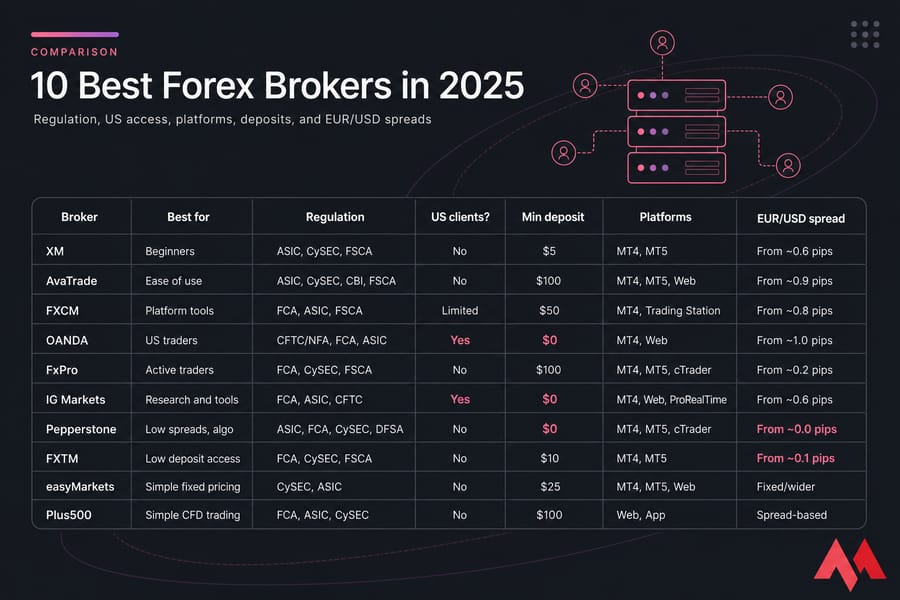
| Broker | Best For | Regulation | US Clients? | Min Deposit | Platforms | EUR/USD Spread | Account Types | Demo |
|---|---|---|---|---|---|---|---|---|
| XM | Beginners | ASIC, CySEC, FSCA | No | $5 | MT4, MT5 | From ~0.6 pips | Standard, Ultra Low | Yes |
| AvaTrade | Ease of use | ASIC, CySEC, CBI, FSCA | No | $100 | MT4, MT5, Web | From ~0.9 pips | Retail | Yes |
| FXCM | Platform tools | FCA, ASIC, FSCA | Limited | $50 | MT4, Trading Station | From ~0.8 pips | Standard | Yes |
| OANDA | US traders | CFTC/NFA, FCA, ASIC | Yes | $0 | MT4, Web | From ~1.0 pips | Standard, Core | Yes |
| FxPro | Active traders | FCA, CySEC, FSCA | No | $100 | MT4, MT5, cTrader | From ~0.2 pips | Standard, Raw+ | Yes |
| IG Markets | Research and tools | FCA, ASIC, CFTC | Yes | $0 | MT4, Web, ProRealTime | From ~0.6 pips | CFD, DMA in some regions | Yes |
| Pepperstone | Low spreads, algo | ASIC, FCA, CySEC, DFSA | No | $0 | MT4, MT5, cTrader | From ~0.0 pips | Standard, Razor | Yes |
| FXTM | Low deposit access | FCA, CySEC, FSCA | No | $10 | MT4, MT5 | From ~0.1 pips | Micro, Advantage | Yes |
| easyMarkets | Simple fixed pricing | CySEC, ASIC | No | $25 | MT4, MT5, Web | Fixed/wider | Standard | Yes |
| Plus500 | Simple CFD trading | FCA, ASIC, CySEC | No | $100 | Web, App | Spread-based | CFD account | Yes |
Trading conditions can vary by region, entity, and account type.
🔟 Detailed Reviews of the Best Forex Brokers
1. XM Group
Best for: beginners who want MT4/MT5 and a low minimum deposit. XM is recognized for its low $5 minimum deposit and access to over 1,500 tradable instruments. The broker is regulated by reputable authorities and provides robust MetaTrader 4 and MetaTrader 5 platforms with fast execution, negative balance protection, and multilingual 24/7 customer support.
Pros: Very low minimum deposit ($5), wide range of tradable instruments, strong global regulation, supports MT4 and MT5. Cons: Not available for US clients, some account types have wider spreads. Who should avoid it: traders who need US regulation or cTrader.
2. AvaTrade
Founded in 2006, AvaTrade is a well-established broker offering a broad range of tradable assets, including forex, cryptocurrencies, stocks, and commodities. With a $100 minimum deposit, AvaTrade supports both MetaTrader platforms and its proprietary AvaTradeGO app. The broker is regulated globally and known for its advanced educational resources and 24/7 support. Fees are usually built into spreads, which is convenient, though not always cheapest for high-frequency trading.
Pros: Broad asset selection including crypto, supports multiple platforms (MT4, MT5, AvaTradeGO), strong global regulation, good educational resources. Cons: Inactivity fees apply, limited advanced account customization.
3. FXCM
FXCM stands out as a trusted broker with a long history and over 200,000 clients worldwide. The company provides tight spreads on major currency pairs and features the Trading Station platform alongside MetaTrader 4. With a minimum deposit of $50, FXCM is popular for algorithmic trading and reliable market research. The catch is that availability differs by jurisdiction.
Pros: Long-established trustworthy brand, great for algorithmic and automated trading, solid educational resources, supports MT4 and Trading Station. Cons: Spreads can be higher than ECN brokers, product range is smaller than some competitors.
4. OANDA
OANDA is a top choice for beginner traders, thanks to its easy-to-use trading platform and the option to trade in mini lots. The broker has no minimum deposit requirement and is highly regarded for its transparent pricing and strong regulatory background, including US oversight. OANDA's 24/7 customer support and comprehensive educational resources appeal to traders of all levels. I personally like it for straightforward pricing, though raw-spread hunters may prefer other options.
Pros: No minimum deposit, strong US and international regulation, user-friendly platform, transparent pricing. Cons: Limited number of tradable instruments, no MetaTrader 5 support.
5. FxPro
FxPro is an award-winning broker that boasts over 15 years of experience and a global reputation. It offers a wide selection of tradable instruments, competitive spreads, and supports MetaTrader 4, MetaTrader 5, and cTrader platforms. With a $100 minimum deposit, FxPro is favored by advanced traders who seek reliable execution and multiple account types. That's useful if you're testing workflows or moving toward algorithmic trading in forex.
Pros: Multiple account types and platforms (MT4, MT5, cTrader), well-regulated in several jurisdictions, good for advanced/professional traders, fast execution speeds. Cons: Higher minimum deposit than some competitors, not available in the US.
6. IG Markets

IG Markets is one of the largest forex brokers, serving over 190,000 clients globally and regulated in several top jurisdictions. The broker offers a powerful proprietary trading platform alongside MetaTrader 4, with competitive spreads and advanced charting tools. IG requires a $0 minimum deposit and provides professional-level resources and 24/7 customer support. Great toolkit, steeper learning curve.
Pros: Very broad range of markets (17,000+), highly regulated and trusted, powerful proprietary trading platform, excellent educational and research tools. Cons: Complex fee structure for some markets, interface can feel heavy for beginners.
7. Pepperstone
Pepperstone, based in Australia, is well-known for its low spreads and rapid execution, ideal for scalpers and algorithmic traders. It supports MetaTrader 4, MetaTrader 5, and cTrader, and has no minimum deposit. Pepperstone is highly rated for its customer service, regulation, and wide range of tradable instruments. It's especially relevant if you're using a forex VPS or looking for the best VPS for forex trading.
Pros: Tight low spreads (especially with Razor account), ECN-like execution and fast order processing, supports MT4, MT5, and cTrader, strong regulation in multiple regions. Cons: Limited non-forex instruments, no proprietary trading platform.
8. FXTM
FXTM (ForexTime) is a global broker with over a million clients, offering tight spreads and multiple account options to fit various trading styles. With a minimum deposit as low as $10, it's accessible for beginners, while advanced traders can benefit from ECN account types. FXTM is known for quick withdrawals and strong international regulation. Just pay attention to which entity you're opening under.
Pros: Low minimum deposit, high-leverage options available, fast withdrawal processing, multiple account types including ECN. Cons: Fee structure can be confusing, limited product selection outside of forex.
9. easyMarkets

easyMarkets is favored by beginners for its intuitive platform, fixed spreads, and the ability to trade mini lots with a low minimum deposit. The broker offers unique risk management features such as deal cancellation and guaranteed stop-loss orders. Its simpler model can be reassuring, but serious scalpers will probably outgrow it.
Pros: Low minimum deposit, fixed spreads for easy cost management, unique risk management features (deal cancellation), beginner-friendly interface. Cons: Fewer instruments than leading brokers, fixed spreads can be higher in volatile markets.
10. Plus500

Plus500 is a leading CFD broker with low spreads, known for its simple web-based trading platform and extensive CFD offering. The minimum deposit is $100, and Plus500 stands out for its tight spreads and reliable order execution. The broker is regulated in multiple countries and offers 24/7 multilingual customer support. But no MT4 or MT5 means it's a poor fit for EA traders.
Pros: User-friendly web-based platform, wide range of CFDs available, competitive spreads, regulated in multiple regions. Cons: No support for MetaTrader platforms, limited research and educational resources.
🎯 Best Forex Brokers by Trader Type
- Beginners: XM and AvaTrade.
- Scalping: Pepperstone and FxPro.
- Algorithmic trading: Pepperstone, FxPro, and OANDA. If you're running EAs, read up on best algo trading platforms.
- MT4 users: XM, OANDA, Pepperstone.
- MT5 users: XM, FxPro, Pepperstone.
- Fast withdrawals: Pepperstone and IG often get shortlisted.
- US traders: OANDA and IG are the names to check first.
💰 Forex Broker Fees Explained
Spreads are only part of the bill. A broker with a 0.0 pip raw spread can still cost more if commission is high, swaps are ugly, or conversion fees stack up. Watch these fees: spreads vs commissions, swap or overnight fees on held positions, deposit and withdrawal charges, inactivity fees after dormant periods, and currency conversion on non-base-account funding. Always check the fee schedule, not the homepage banner.
🧭 How to Choose the Right Forex Broker in 2026
Match the broker to how you actually trade, not how you imagine you'll trade next year. Swing trader? Swap fees matter. Scalper? Execution and latency matter more. Beginner? Demo access and clear support beat fancy extras. Test the platform first. Check withdrawals second. Regulation comes before both. Key factors to evaluate:
- Regulation: Only use brokers licensed by reputable authorities (FCA, ASIC, CySEC, CFTC).
- Trading Platforms: Check for platforms you're comfortable with — MT4, MT5, or cTrader.
- Spreads and Fees: Compare typical spreads and commission structures; low costs matter.
- Account Types: Look for account options that fit your budget and experience level.
- Leverage: Make sure the broker's leverage options suit your risk tolerance.
- Deposit and Withdrawal: Favor brokers with fast, transparent, and low-fee payment options.
- Customer Support: 24/7 multilingual support can be invaluable.
- Education and Research: Extra tools help you grow as a trader.
- Reputation: Read independent reviews and check community feedback.
Related Article: Secure your forex trading.
🛡️ How to Verify a Forex Broker License
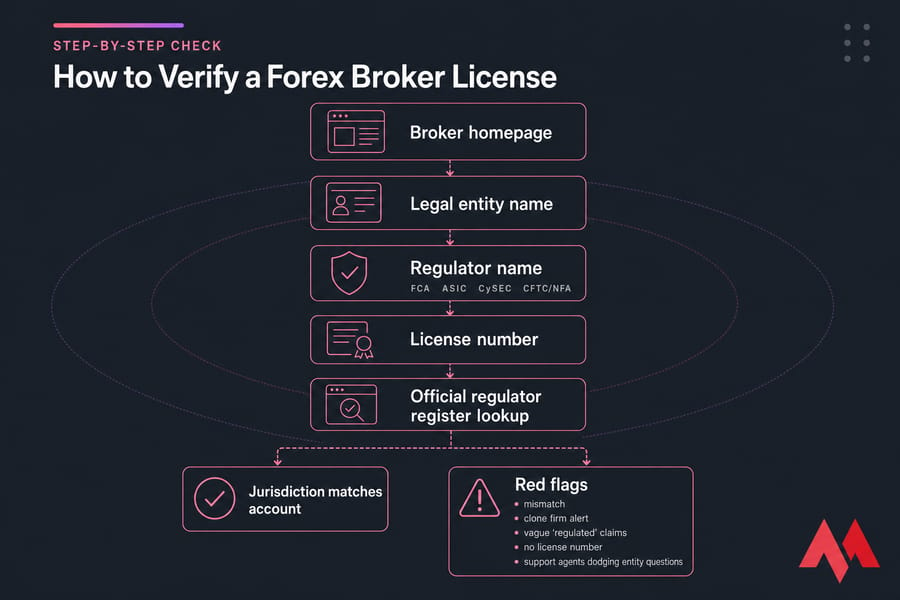
Start with the broker's legal entity name, not just the brand. Then search the official FCA, ASIC, CySEC, CFTC/NFA, or other regulator register for the exact entity and license number. Confirm the jurisdiction matches the account you're opening. Red flags include vague "regulated" claims, no license number, clone firm warnings, and support agents dodging entity questions.
⚠️ Forex Broker Red Flags to Avoid
- Unclear regulation or missing license number
- Guaranteed profits claims
- Repeated withdrawal complaints
- Aggressive bonus schemes with strings attached
- No demo account and vague fee pages
🌍 Is Forex Trading Legal in My Country?
Usually yes, but the rules differ a lot. In the US, forex trading is tightly regulated and broker choice is narrow. The UK and EU have clearer retail protections but leverage limits. Australia remains active, while MENA and parts of Asia can vary by local licensing and product type. Check your local rules before signup. If your country has very strict regulations or a plain ban on online forex, consult the local regulatory body for approval before you open an account.
💻 Forex VPS: Why It Matters for Broker Selection
If you trade manually once a week, you probably don't need a VPS. If you run MT4, MT5, copy systems, or automated strategies 24/7, it's a different story. A good VPS helps reduce disconnect risk, keeps EAs online, and can help reduce slippage in forex when placed closer to broker servers. If you're new to it, start with what is a forex VPS, then look at VPS for MT4/MT5. Pair that with tested forex trading strategies and you'll make better infrastructure choices.
🏁 Final Verdict: Which Forex Broker Is Best for You?
The best forex brokers for you in 2026 will depend on your trading style, experience, and requirements for regulation and support. If you want the short version: choose OANDA for US access, Pepperstone for low spreads and automation, XM for beginner-friendly onboarding, and IG for research-heavy trading. No single broker wins every category. That's normal.
This guide aims to assist you in evaluating the leading forex brokers based on their regulation, spreads, platforms, and other distinguishing features to ensure your trading can be both safe and confident. Always read the terms and conditions for each broker before signing up, and consider starting a demo or low-risk account while you get the hang of forex trading. The smarter move is to pick the broker that fits your platform, region, and trading style — then pair it with the right infrastructure. You can keep your MetaTrader online by using the forex VPS server.
.jpg)
Co-founder with 13+ years of experience, I have played an integral part in our company's growth and success. Having developed strategic plans, secured funding, and managed teams. My involvement extends to overseeing operations, product development, and industry representation, reflecting my versatile role in the business and commitment to its continued prosperity.