
Sometimes, to avoid fraud or harmful content on the Internet, you need to block or restrict access to specific websites. However, blocking pages on social media may not be as easy. If you use modern browsers like Chrome, you can block or unblock websites easily — all you have to do is follow the steps below, depending on the device you use. For a device-agnostic walkthrough that covers Windows, Mac, iOS, and Android in one place, see our guide on how to block a website.
Quick answer: If you're a personal user, Google Chrome doesn't have a built-in "block this site" button. Which workaround you should use depends on who you're blocking for. For your own focus, use an extension. For a child, use Google Family Link or Apple's Screen Time. To block a site on every device in the house, set it up on your router or DNS. On work or school computers, IT admins can use Chrome's URLBlocklist policy.
Every method below has gaps, and those gaps matter more than most guides admit. Here's how each works and where it falls short.
| Method | Desktop | Mobile | Blocks Incognito | Blocks All Browsers | Best For | Difficulty |
| Chrome extension | Yes | No | Only if enabled | No | Personal focus | Easy |
| Google Family Link | Chromebook / signed-in Chrome | Android | Incognito is turned off for supervised accounts | No | Kids | Easy |
| Screen Time | Mac | iPhone / iPad | Yes | Most browsers | Apple households | Easy |
| Hosts file | Yes | No | Yes | Yes, on that machine | Blocking without an extension | Medium |
| Router / DNS filtering | Yes | Yes | Yes | Yes, on the network | Whole home | Medium |
| Chrome Enterprise policy | Yes | Managed devices | Yes | No | Schools and businesses | Advanced |
🤔 Why Should I Block Websites on Chrome?
People block or restrict websites on Chrome for various reasons, including:
- Protect children from certain contents. Parents usually filter or block adult websites to protect their children or limit their access.
- Avoid scammers or malicious websites. Sometimes, users suspect certain websites are scams or contain malware that may affect their devices. In that case, blocking the website will help restrict their access to your device.
- Have more focus during work hours. If you find it hard to focus at work because of various websites or Internet content, you can temporarily block them. Not getting distracted during work can increase your performance. In addition, you can always unblock those websites when needed.
🚫 Can Chrome Block Websites by Itself?
Only when it's managed. On a personal, unmanaged copy of Chrome, there's no setting anywhere that blocks a domain.
Managed Chrome is different. On enterprise and education devices, admins can push a URLBlocklist policy, which is a list of URL patterns Chrome won't load. They can also push a URLAllowlist policy that adds exceptions. The allowlist overrides the blocklist. So you can block * (everything) and then allow just a handful of sites. Google's documentation caps each list at 1,000 URLs.
That's why home users end up with extensions or OS-level controls. Chrome just doesn't give them the setting. For a broader comparison of how Chrome's approach compares with other browsers, see our roundup of types of web browsers.
🎯 Best Method to Block Websites on Chrome by Use Case
- For personal focus: a website blocker extension like BlockSite or StayFocusd. It takes 30 seconds to set up and is just as easy to switch off. That's the point.
- For parents: Family Link for Android and Chromebooks. Screen Time for iPhone, iPad, and Mac.
- For schools and businesses: Chrome Enterprise URLBlocklist/URLAllowlist through the Google Admin console or Group Policy.
- For every device at home: router parental controls or DNS filtering.
🖥️ How to Block Websites on Chrome Desktop
You can use multiple methods and tools to block websites on Chrome. For example, you can use Chrome extensions to block specific content, or do it manually using Parental Control.
Method 1: Use a Chrome Extension
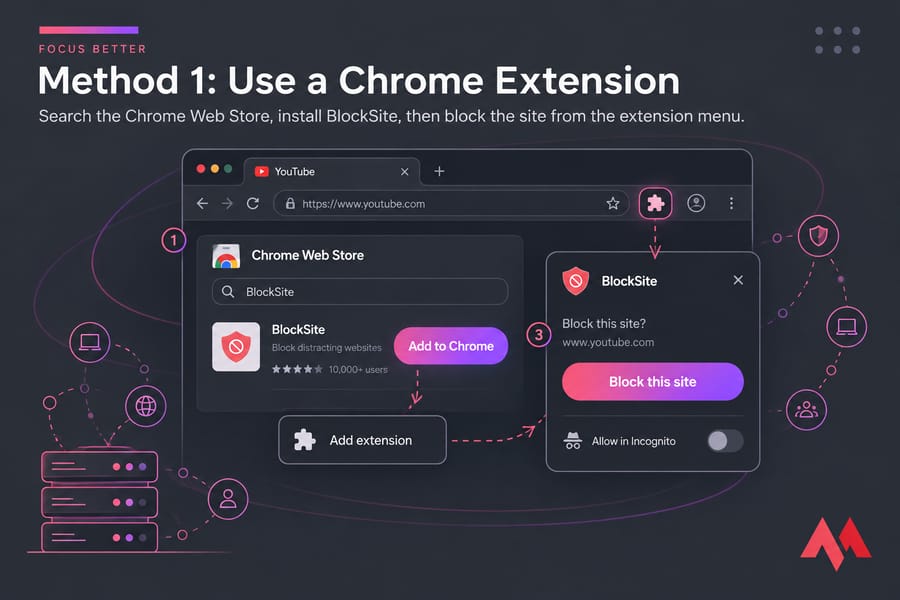
If you want to block websites on Windows, Linux, or macOS, certain extensions will make your job easier. There are many different website-blocking extensions available in the Chrome Web Store. Most of these tools manage your sites and allow or block access based on your preference. We recommend BlockSite — free, with over three million downloads.
Why BlockSite works for most people:
- Block websites temporarily with a timer or schedule (Work Mode). After the restriction hours are over, the tool unblocks the site automatically.
- Block sites that contain certain words in their URL.
- Block sites by category (e.g., all news sites).
The free plan caps you at three blocked sites; more requires the premium tier.
Here's how to set it up:
- Open the Chrome Web Store and search for a website blocker such as BlockSite.
- Click Add to Chrome, then confirm with Add extension.
- Go to the site you want to block, click the extension icon, and choose Block this site.
- To cover private windows, go to
chrome://extensions, open Details for the extension, and turn on Allow in Incognito.
You can also block a website directly from your search results — right-click the link and choose Block Site. Or open the extension's dashboard, click More Options → Options, paste the URL, and click Add item. If your main goal is blocking ads and trackers rather than whole sites, our guide on how an ad blocker works covers the difference between content filtering and URL blocking.
Free plans often cap how many sites you can block, and those limits change, so check the current store listing before you commit. Also remember that anyone with access to the browser can remove an extension in two clicks. It's fine for self-discipline. It won't stop a determined teenager.
Method 2: Use Parental Control
Parental Control allows you to limit the time and the web content your children can access, but this feature only works on Windows devices. On Mac, you can set a timer for each app on the Screen Time feature, but you can't restrict or block websites. Therefore, if you are using macOS, you'll need third-party tools like Appcrypt.
Here's how to block websites on Chrome on Windows 11:
- Head to the Settings app, select Accounts on the left side of the window, then choose Family & other users.
- Click Add a family member, then choose Add account to create a child account.
- On the following window, choose Create one for a child under the blank section.
- After creating an account, open the Microsoft account page and choose your new account.
- On the left pane, choose Content Filter.
- Paste or type the URL of the site you want to restrict under the Blocked site section, then click the plus sign to add the site to your block list.
Finally, head to the child's account and make sure it works properly.
Method 3: Use the Hosts File to Block Sites System-Wide
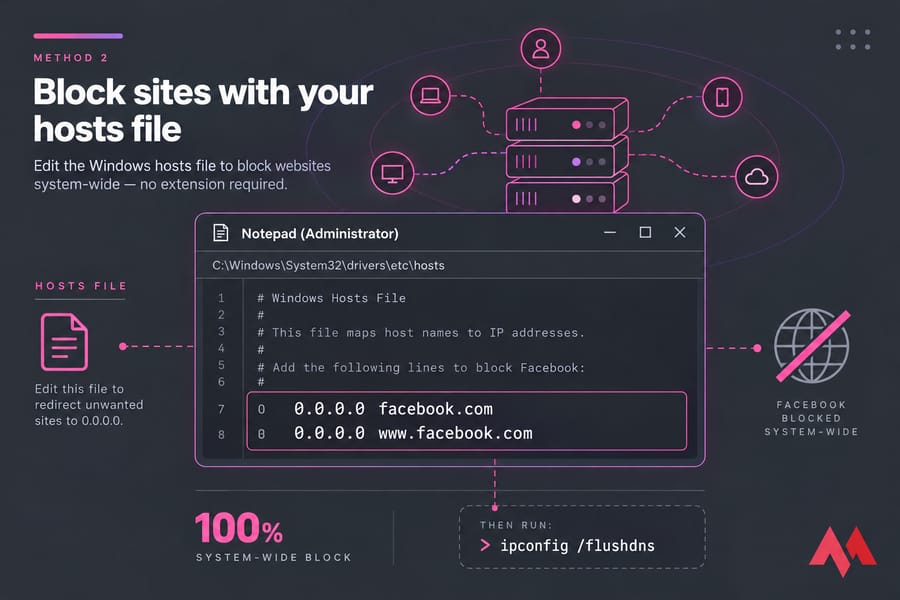
This is the classic way to block sites without an extension. It also works in every browser on the machine. Back up the file before you edit it.
On Windows 10/11, open Notepad as Administrator. Then open C:\Windows\System32\drivers\etc\hosts. On Mac or Linux, run sudo nano /etc/hosts. Add lines like these at the bottom:
0.0.0.0 facebook.com
0.0.0.0 www.facebook.com
Save the file, then flush the DNS cache. On Windows, run ipconfig /flushdns. On macOS, run sudo dscacheutil -flushcache; sudo killall -HUP mDNSResponder. Restart Chrome. If the site still loads, Chrome may be holding a cached copy, so clear your browser cache and try again.
Blocked sites usually show a "can't be reached" error. It looks a lot like the one in our ERR_CONNECTION_REFUSED guide. That's expected, so don't spend time troubleshooting it.
Method 4: Use Chrome Enterprise URLBlocklist on Managed Devices
Admins set this up in the Google Admin console (Devices → Chrome → Settings → URL blocking) or through Group Policy / registry templates on Windows. Enter one pattern per line. For example, example.com blocks the domain and its subdomains. To confirm the policy actually reached a machine, open chrome://policy on it.
📱 How to Block Websites on Chrome Mobile
On Android and iOS devices, you can use third-party apps to block content on Chrome. However, iPhone has a built-in web content-restricting option, allowing you to block websites on all browsers. The following methods are separated by OS.
Block Websites on iPhone
You can use apps like BlockSite, Zero Willpower, or Site Blocker on iOS devices to block content on the web. However, the iPhone has a built-in feature that does the same job.
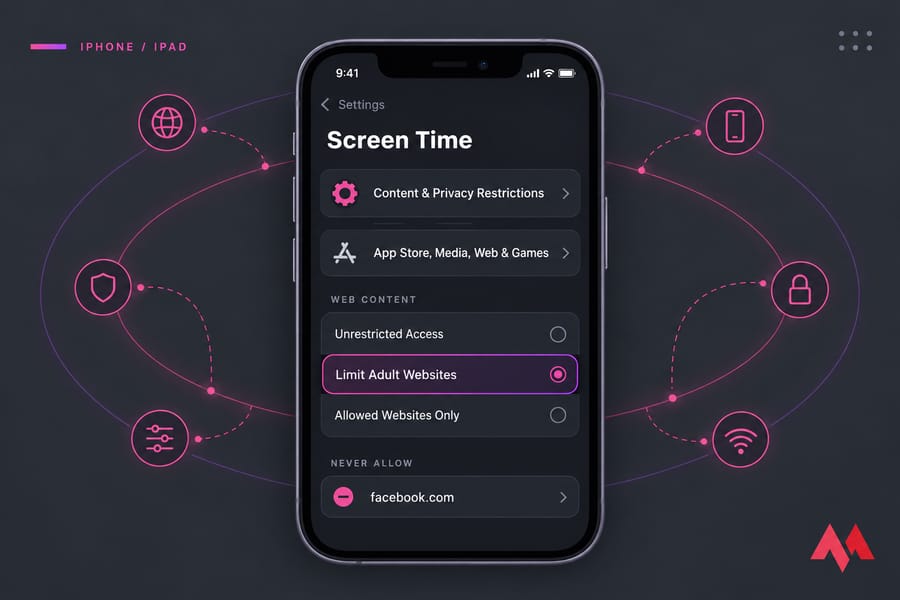
Screen Time on iPhone will not only allow you to restrict the time you use apps but also restrict or block certain sites on Chrome and other browsers on the phone. The only drawback of this feature is that you can't choose a specific browser for blocking a website. Once you enter a URL, Screen Time will restrict access in all browsers, including Safari.
So, only use this feature if you want to block a certain website on your device. Here's how:
- Go to Settings → Screen Time → Content & Privacy Restrictions and turn it on.
- Tap App Store, Media, Web & Games → Web Content.
- Choose Limit Adult Websites, then tap Add Website under Never Allow.
You can easily bypass this method by searching a blocked website and clicking the access option. If you want to make it harder, set a Screen Time passcode. That way, you'll have to enter the password whenever you want to access the restricted websites.
Mac: some older guides claim you can't block websites on a Mac with Screen Time. You can. Go to System Settings → Screen Time → Content & Privacy, turn on web content restrictions, choose Limit Adult Websites, click Customize, and add sites to the Restricted list. The exact menu labels vary a little between macOS versions.
Block Websites on Android
You can also use the BlockSite app on Android devices by downloading and installing it from the Google Play Store. Similarly, Google's parental control works if you are using this option for your children. The Google Family Link app will allow you to block sites or set time for browsing the Internet for your children.
Android Chrome doesn't support extensions, so for a child, Family Link is the tool to use:
- Open the Family Link app and select your child.
- Tap Controls → Google Chrome and Web.
- Under Manage sites, open Blocked and add the URL.
You can also choose "Only allow certain sites" for younger kids. If a child hits a blocked page, they can send you an access request. Now, your child's Google account is protected no matter which device they use.
🌐 How to Block Websites on Chrome Across All Devices
Router Parental Controls or URL Filtering
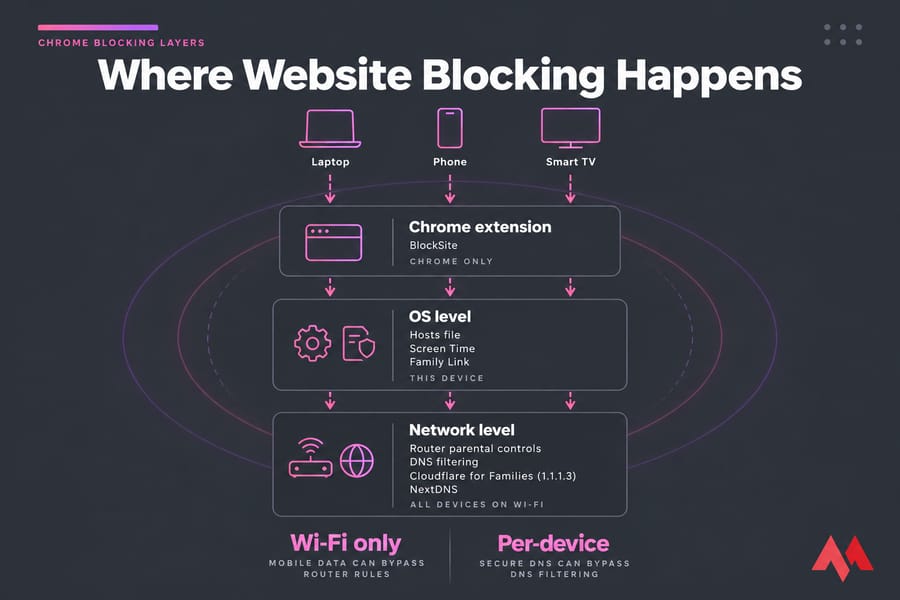
Most modern routers have a URL or keyword filter under Parental Controls or Security. Add a domain there and every phone, laptop, and smart TV on your Wi-Fi is blocked. The catch is that it stops working once a device switches to mobile data.
DNS Filtering
Set a filtering DNS service on your router. Cloudflare for Families (1.1.1.3) blocks malware and adult content. NextDNS lets you build a custom blocklist. DNS filtering is easier to manage than router filters and survives router resets. One caveat: Chrome's Secure DNS setting can bypass it on individual devices. On a managed machine, lock that setting down.
🔍 How to Block a Specific Website or Page in Chrome
This is where most people get tripped up.
Block an Entire Domain
Most extensions and Family Link treat reddit.com as covering the whole site. The hosts file doesn't. It needs every hostname listed: reddit.com, www.reddit.com, old.reddit.com, and so on.
Block a Subdomain or Single Page
Want to block one page, like youtube.com/shorts, and leave the rest alone? Use an extension that supports path or keyword rules, or a managed URLBlocklist entry. The hosts file and DNS filtering only work on whole hostnames.
Allow Exceptions with an Allowlist
An allowlist carves exceptions out of a broader block. Block google.com but allow docs.google.com, for example. In managed Chrome, URLAllowlist always wins over URLBlocklist.
🔓 How to Unblock a Website on Chrome
- Extension: open its dashboard and delete the entry, or disable the extension.
- Screen Time: swipe left on the site under Never Allow (iPhone) or remove it from Restricted (Mac).
- Family Link: Controls → Google Chrome and Web → Manage sites → remove it from Blocked.
- Hosts file: delete the line or comment it out with
#, then flush DNS. - Managed policy: ask your admin. You can't override it locally.
🩺 Troubleshooting: Why Website Blocking May Not Work
Incognito Mode Is Still Allowed
Extensions are off in Incognito by default. Turn on "Allow in Incognito," or switch to hosts, DNS, or Screen Time, which don't depend on Chrome at all.
Subdomains and Alternate URLs Aren't Covered
Mobile versions (m.), country domains, and short links can slip through. Add every variant you find.
The Site Opens in Another Browser or Device
Extensions and Family Link controls only apply to Chrome. If Edge or Firefox still loads the site, move the block down to the OS or network level. And if a change doesn't seem to take effect, restart the browser, give sync a few minutes, and clear the cache.
🎯 Final Thoughts
Learning how to block websites on Chrome can help you restrict your access during work hours or create a better and safer environment for your child to explore the Internet. Although all devices have built-in features to restrict access, they are not as effective as third-party apps or extensions.
Match the method to the person you're blocking. An extension is enough to keep you off Twitter during work hours. For kids, use parental controls built into the OS, and add DNS filtering as a backstop. Admins should use Chrome policies. Every single-layer setup gets bypassed eventually, so if it really matters, use two methods together.
Managing this on a server rather than a home PC? A Windows VPS gives you admin rights and full control over hosts files, firewall rules, and browser policies — so you can enforce blocks across a team or a whole environment.
People also read:


I'm fascinated by the IT world and how the 1's and 0's work. While I venture into the world of Technology, I try to share what I know in the simplest way with you. Not a fan of coffee, a travel addict, and a self-accredited 'master chef'.