
You installed Anaconda. The installer said it finished. You open a terminal, type conda --version, and get slapped with bash: conda: command not found. Frustrating, but almost never serious.
Your shell isn't saying Conda is missing. It's saying it looked through every directory listed in your PATH variable and didn't find an executable called conda. Those are two very different problems. Conda is a package management system for multiple Operating Systems, installed automatically with Anaconda.
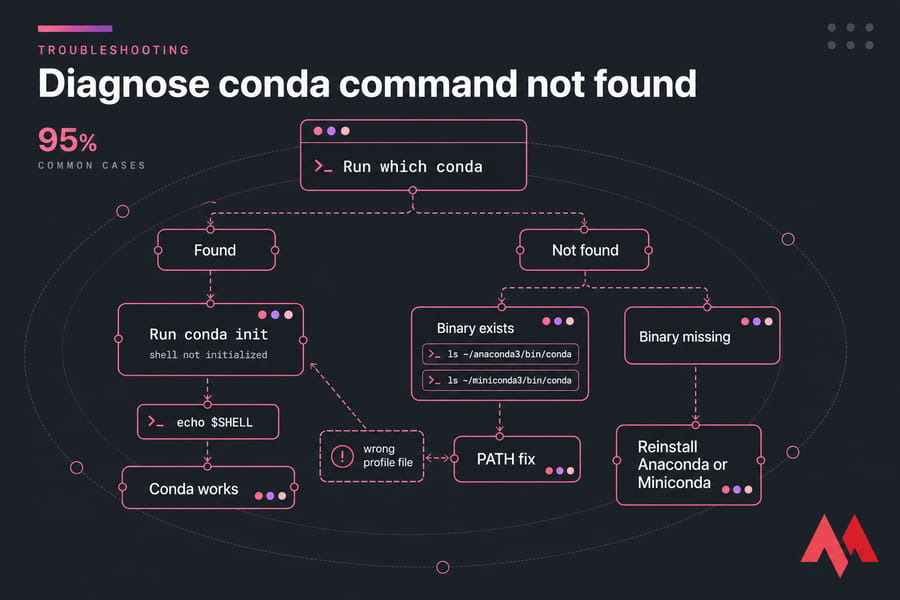
Four root causes account for maybe 95% of the cases:
- Conda isn't installed — the installer failed, or you ran it as another user.
- Conda is installed but missing from PATH — you answered "no" when the installer asked to run
conda init. - Your shell was never initialized — the init block exists for Bash but you're using Zsh (or Fish, or PowerShell).
- The wrong profile file is being read — you edited
.bashrcbut your terminal loads.bash_profile, or you're in a non-login shell like cron, Docker, or a CI runner.
Same error text, same fix pattern, regardless of whether you installed Anaconda or Miniconda.
📌 What is Conda? [Definition]
Conda is a command-line utility and an open-source package management system, or a package manager, for Windows, Linux, and Mac. It can simply install, configure, and update packages and their dependencies on your machines. It can also swiftly swap between different environments. It was designed with Python in mind — see what is the use of Python — although it can install and manage software packages for any programming language.
🌟 Unlock Your Conda Potential! 🌟
📄 Get the Complete Conda Commands Cheat Sheet Now!
🔍 Before You Fix Anything, Check Whether Conda Is Installed
Don't start editing config files until you know the binary exists. This takes ten seconds.
Linux and macOS
which conda
echo $SHELL
ls ~/anaconda3/bin/conda
ls ~/miniconda3/bin/conda
If which conda returns nothing but the ls finds the binary, congratulations — it's purely a PATH problem. Note what echo $SHELL prints. That tells you which profile file matters.
Windows
where condaBefore you touch environment variables, open Anaconda Prompt from the Start menu and run conda --version there. If it works in Anaconda Prompt but not in CMD or PowerShell, Conda is fine — only your regular terminals lack the PATH entries.
Common Install Locations
- Linux:
~/anaconda3/bin,~/miniconda3/bin,/opt/anaconda3/bin - macOS Intel:
~/opt/anaconda3/bin,~/miniconda3/bin - macOS Apple Silicon:
~/miniconda3/bin, or/opt/homebrew/Caskroom/miniconda/base/binif installed via Homebrew - Windows:
C:\Users\USERNAME\Anaconda3
🛠️ How to Fix Conda Command Not Found Error?
Method 1: Initialize Conda Properly
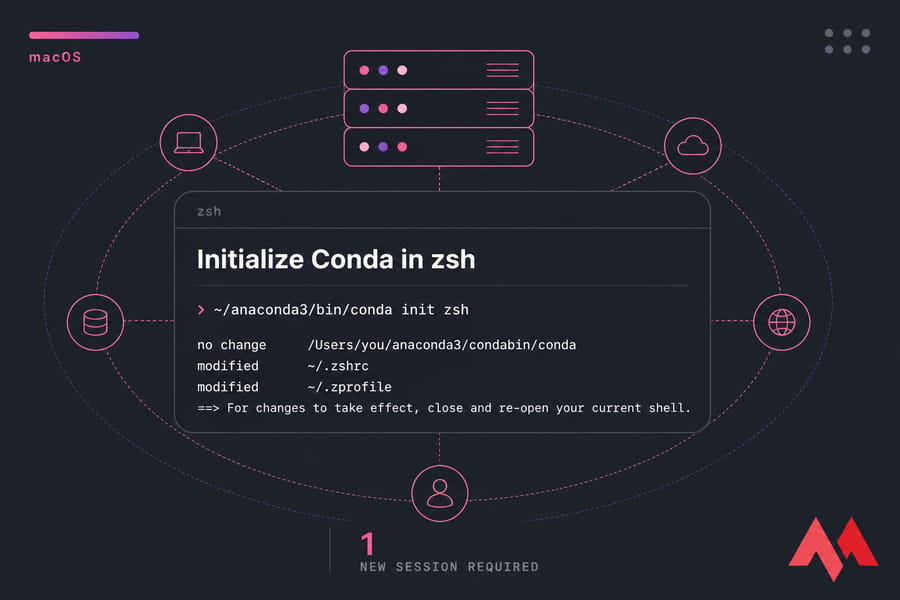
Here's the thing most tutorials get backwards. Manually exporting PATH works, but it's the second-best answer. conda init writes a proper block into your shell profile that also enables conda activate. Manual PATH edits don't.
Run the command using the full path to the binary, since conda isn't callable yet:
~/anaconda3/bin/conda init bash
~/anaconda3/bin/conda init zsh
~/anaconda3/bin/conda init fish
Initialize Conda on Linux server:
$ ./anaconda3/bin/conda initInitialize Conda on Mac OS:
$ ./anaconda3/bin/conda init zshInitialize Conda in Windows server:
$ ./anaconda3/Scripts/conda.exe initOn Windows, from Anaconda Prompt:
conda init powershell
conda init cmd.exe
Then close the terminal completely and reopen it. Not a new tab — a new session. This step gets skipped constantly, and then people assume the fix didn't work.
Method 2: Add Conda to PATH Manually
Use this route when conda init can't run — restricted shells, shared servers, or scripted environments.
Temporary (current session only)
export PATH="$HOME/anaconda3/bin:$PATH"Great for testing. Gone the moment you close the terminal.
Permanent in .bashrc or .zshrc
Run the following command in Linux:
$ export PATH=/path/to/anaconda3/bin:$PATHThe above command will only persist for the current session. To execute with every session:
$ echo 'export PATH=/path/to/anaconda3/bin:$PATH' >> ~/.bashrcSwap ~/.bashrc for ~/.zshrc on Zsh, and anaconda3 for miniconda3 if that's what you installed. On macOS, login shells read ~/.bash_profile instead of ~/.bashrc — a classic gotcha.
How to fix in Windows?
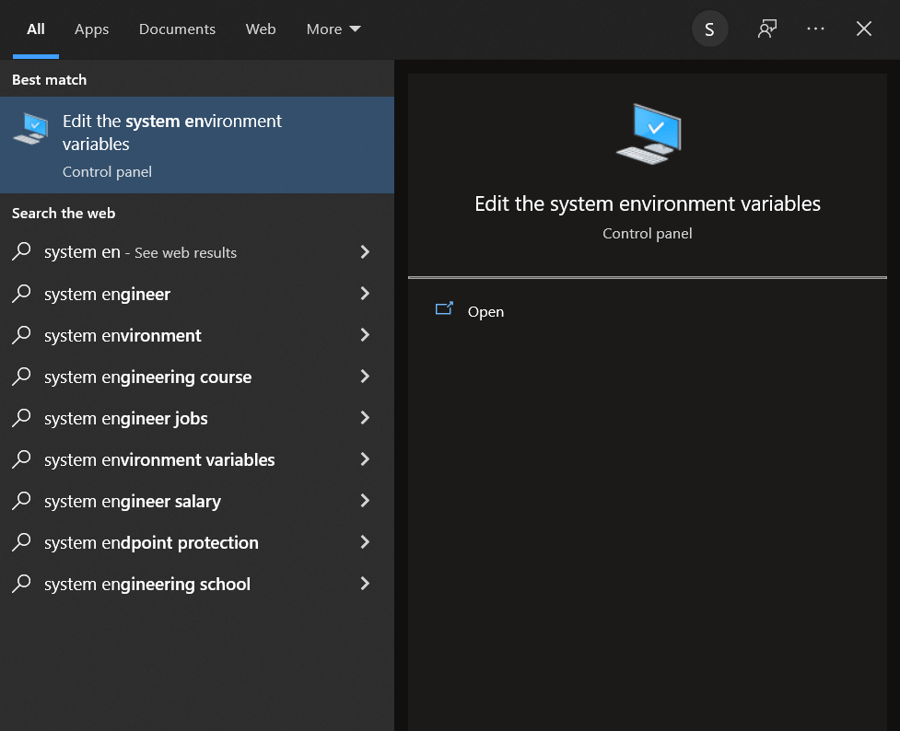
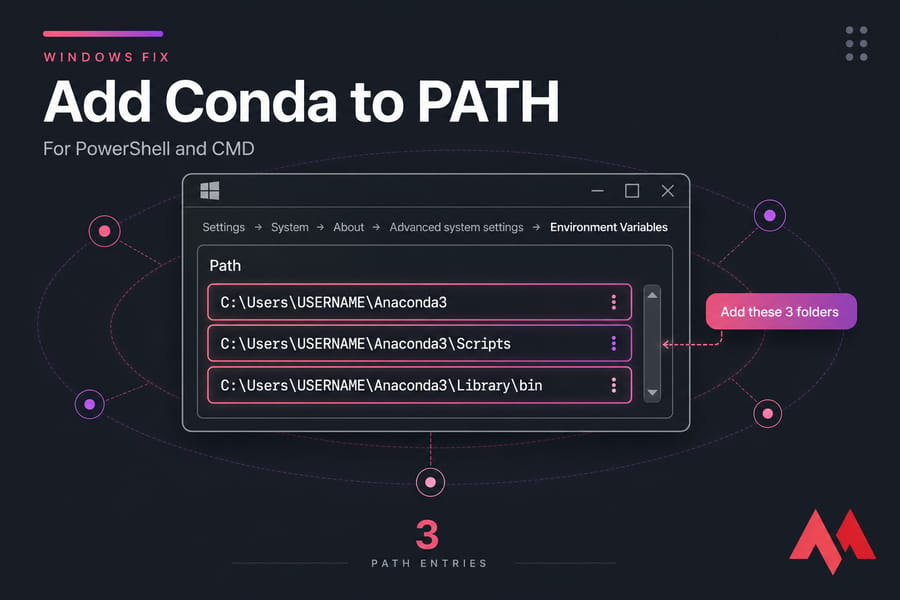
Search for 'Edit the system environment variables' and click on 'Environment Variables...'
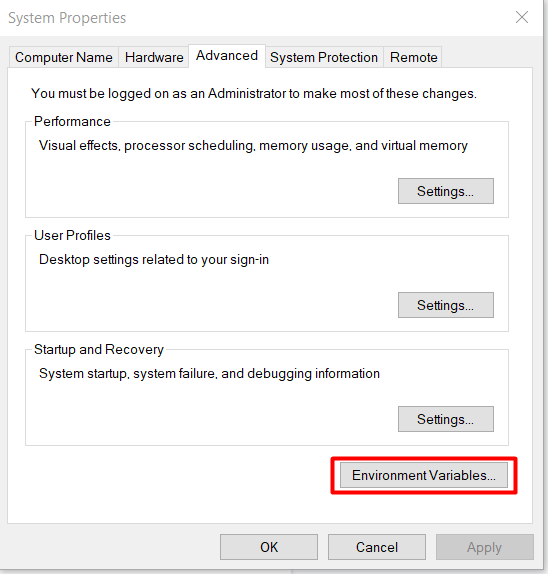
In the 'System Variables' section, click on 'Path' and then click 'Edit'. Add these three folders:
C:\Users\USERNAME\Anaconda3C:\Users\USERNAME\Anaconda3\ScriptsC:\Users\USERNAME\Anaconda3\Library\bin
Then reopen your terminal. PATH changes don't apply to already-open windows. You only need administrator rights if Conda was installed to C:\ProgramData for all users.
Method 3: Run as Administrator
You can right-click on the Anaconda Command Prompt in Windows and choose 'Run as Administrator'. This is because Windows 11 releases do not presume you have administrator credentials to install or update.
🐧 Fixing Conda on Linux
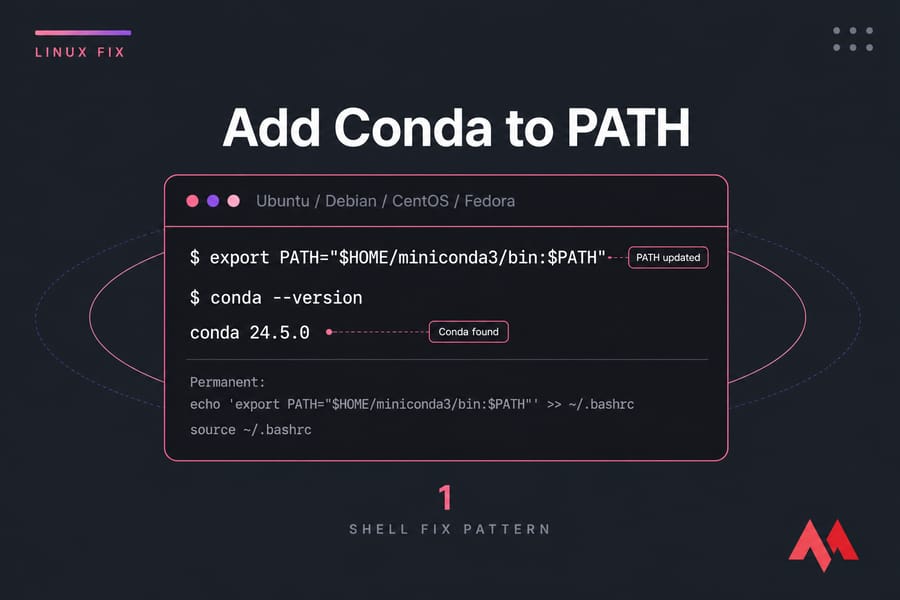
Ubuntu, Debian, CentOS, Fedora — the commands are identical, because this is a shell problem, not a distro problem.
export PATH="$HOME/miniconda3/bin:$PATH"
echo 'export PATH="$HOME/miniconda3/bin:$PATH"' >> ~/.bashrc
source ~/.bashrc
conda --version
If you installed system-wide to /opt/anaconda3, point at that path instead and make sure your user can actually read it.
🍎 Fixing Conda on macOS
Since Catalina, macOS defaults to Zsh. So if you installed Conda years ago under Bash, or followed a Bash-oriented guide, the init block landed in the wrong file. That's why you see zsh: command not found: conda.
~/miniconda3/bin/conda init zsh
source ~/.zshrc
conda info
Intel Macs typically install to ~/opt/anaconda3. Apple Silicon machines usually land in ~/miniconda3, and Homebrew installs go under /opt/homebrew/Caskroom/miniconda/base.
Fixing Conda on Windows
Try Anaconda Prompt first. Seriously. If your work is happening inside Jupyter or an IDE anyway, you may not need to touch system settings at all. If you want conda in PowerShell and CMD, follow the PATH steps in Method 2 above.
⚠️ Still Not Found? Advanced Troubleshooting
| Symptom | Likely Cause | Fix |
| Works in system terminal, fails in VS Code | VS Code launched a non-login shell or different interpreter | Reload VS Code, set default terminal profile |
| Works interactively, fails over SSH or cron | Non-interactive shells skip .bashrc |
Source Conda explicitly: source ~/miniconda3/etc/profile.d/conda.sh |
| Fails inside Docker | Container shell has its own PATH | Add ENV PATH=/opt/conda/bin:$PATH in Dockerfile — or run on a VPS server with full system control |
| Works in Windows but not WSL | WSL is a separate Linux filesystem | Install Miniconda inside WSL separately |
| Wrong Conda version launches | Duplicate installs | Run which -a conda and remove stale PATH entry |
| Binary missing entirely | Broken or partial install | Reinstall Miniconda from official installer |
One more thing: a typo in your shell config can silently kill everything after it. Run bash -n ~/.bashrc to catch syntax errors.
✅ How to Confirm the Fix Worked
conda --version
conda info
conda env list
conda activate base
You want a version string (something like conda 24.9.2), a config dump showing your base environment path, and a prompt that now displays (base). If conda --version works but conda activate fails, you added PATH manually and skipped conda init. Run the init command and restart.
🤔 Anaconda vs Miniconda: Does It Change the Fix?
No. Both ship the same conda binary and the same init mechanism. The only practical difference is the default install directory — anaconda3 versus miniconda3 — and the size of what came with it. Substitute the correct folder name in every command above and you're set. Official install paths are documented in the Conda installation docs and the Anaconda documentation.
🏁 Conclusion
We hope that this above-listed quick fix will help you to get rid of the Conda command not found error. We saw how to fix this error by adding conda to the path variable, initializing it, or running it as an administrator. All major operating systems are supported by the solutions discussed in this article. Also, this article is applicable to fix bash: conda: command not found error.
Three fixes solve nearly every instance of this error, in this order: confirm Conda is actually installed, run conda init for your shell, and only then edit PATH by hand if init isn't an option. Restart the terminal after each attempt. Once conda --version answers cleanly, build your first environment with conda create -n myproject python=3.12 and get on with the actual work. Setting up a remote environment? Here's how to install Python on VPS.


I'm fascinated by the IT world and how the 1's and 0's work. While I venture into the world of Technology, I try to share what I know in the simplest way with you. Not a fan of coffee, a travel addict, and a self-accredited 'master chef'.