Changing a MAC address through the Windows registry is one of those classic "power user" moves — a little tedious, occasionally finicky, but genuinely useful when you need it. If you're running Windows 10 or Windows 11 and want to override the MAC address your network adapter broadcasts, editing the NetworkAddress value in the registry is the most universal method. No third-party software. No drivers to trust. Just you, Registry Editor, and a network adapter that will (hopefully) cooperate.
I'll walk you through the whole thing — how it works, the exact steps, the format rules that trip people up, verification, troubleshooting, and rollback. Fair warning: not every adapter honors this registry change. We'll cover what to do when that happens too.
What Does Changing a MAC Address Through the Registry Do?
Before you start clicking around in regedit, it helps to understand what this method actually does — and what it doesn't.
What a MAC address is
A MAC address (Media Access Control address) is a 12-character hexadecimal identifier burned into your network interface card (NIC). It's how devices identify each other on a local network. Every Ethernet adapter and Wi-Fi adapter has one, and the first half of it (the OUI) points back to the manufacturer.
MAC address vs IP address
People confuse these two all the time. A MAC address operates at the hardware level and doesn't change as you move between networks. An IP address is assigned by the network (usually by DHCP) and changes whenever you join a different network or your lease expires. If you want a deeper dive on IPs, here's a good read on the IP address.
Why users change a MAC address
Common reasons I see:
- Privacy on public Wi-Fi networks that track devices
- Lab and network testing environments
- Getting around a router or ISP that's bound service to a specific MAC
- Resolving a duplicate MAC conflict (rare, but it happens)
- Virtual machine and network simulation scenarios
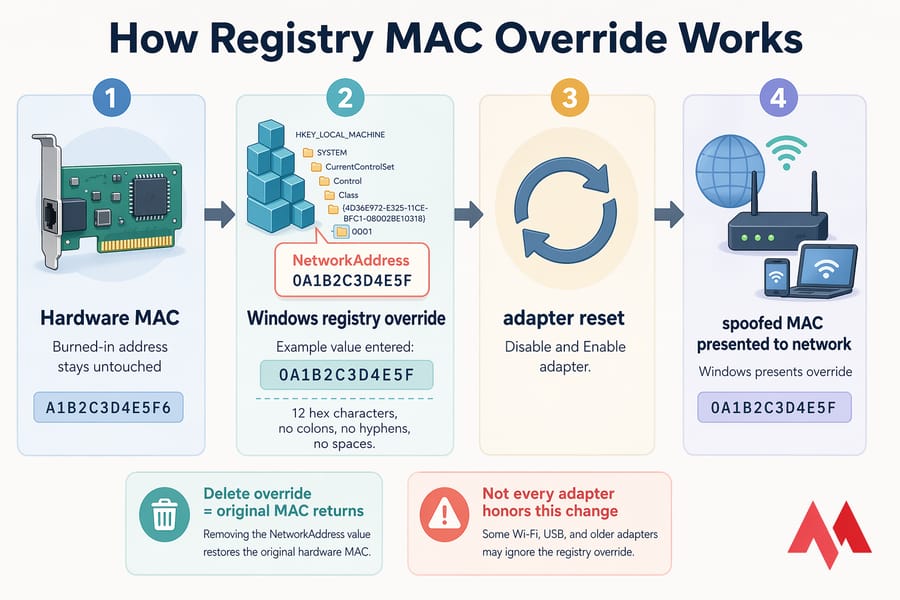
Here's the key thing: the registry method doesn't physically rewrite the hardware MAC. It just tells Windows to present a different address to the network. The burned-in address stays untouched. When you delete the override, the original comes right back.
Before You Start
A few housekeeping items. Skip these and you'll regret it eventually.
Back up the registry first
Open Registry Editor, click File → Export, and save a copy of the full registry (or at least the branch you're editing). Microsoft's own guidance is pretty firm about this — editing the registry incorrectly can cause serious problems. A restore point via System Protection is also a smart move.
Make sure you have administrator access
You can't edit the adapter class key without admin rights. If you're on a managed corporate laptop, you may be locked out entirely — and attempting to spoof a MAC on a corporate network could violate your acceptable use policy. Just something to keep in mind.
Check whether your adapter supports MAC address override
This is the part most tutorials gloss over. Not every NIC driver respects the NetworkAddress value. Many Wi-Fi adapters in particular ignore it outright. Intel, Realtek, and Killer NICs usually work. Some USB adapters and older chipsets? Hit or miss. If the registry method fails later, that's likely why.
Before editing the registry, you need to know your current MAC address. If you're unsure how to locate it, check out our guide on how to find MAC address on Windows.
How to Change a MAC Address in Registry Editor
Here's the core procedure. Follow it in order — skipping steps usually means starting over.
Step 1: Open Run and launch regedit
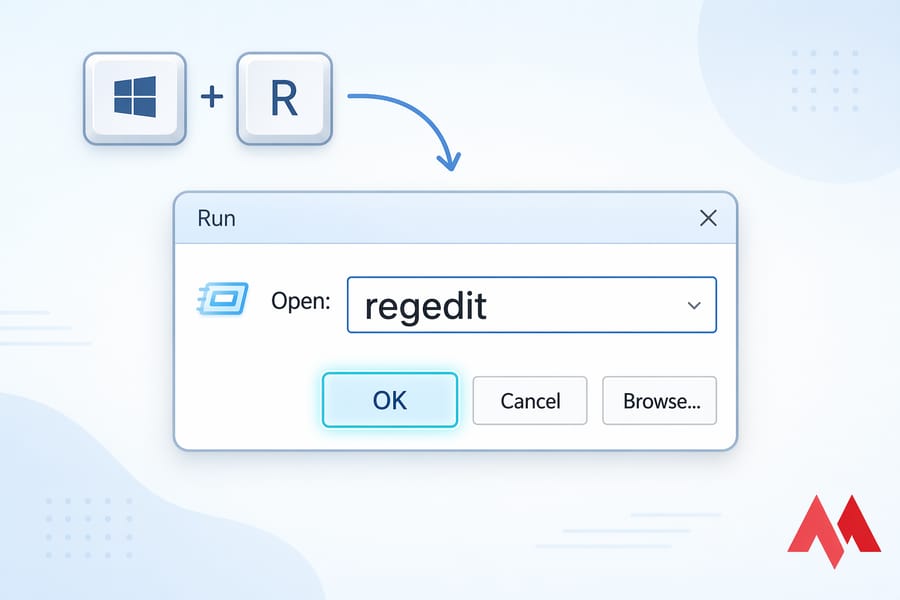
Press Windows + R, type regedit, and hit Enter. Click Yes on the UAC prompt. This works identically on Windows 10 and Windows 11.
Step 2: Go to the network adapter class key
Navigate to:
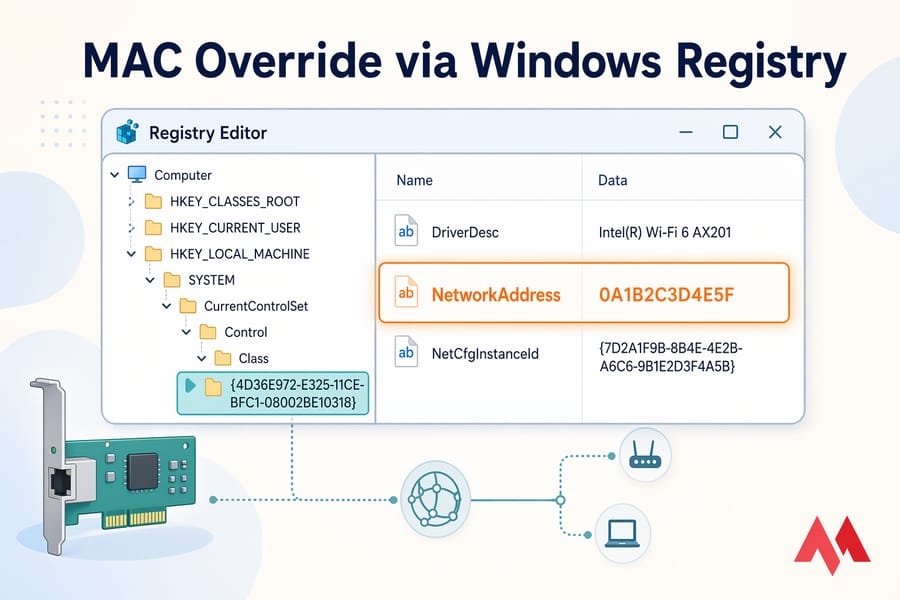
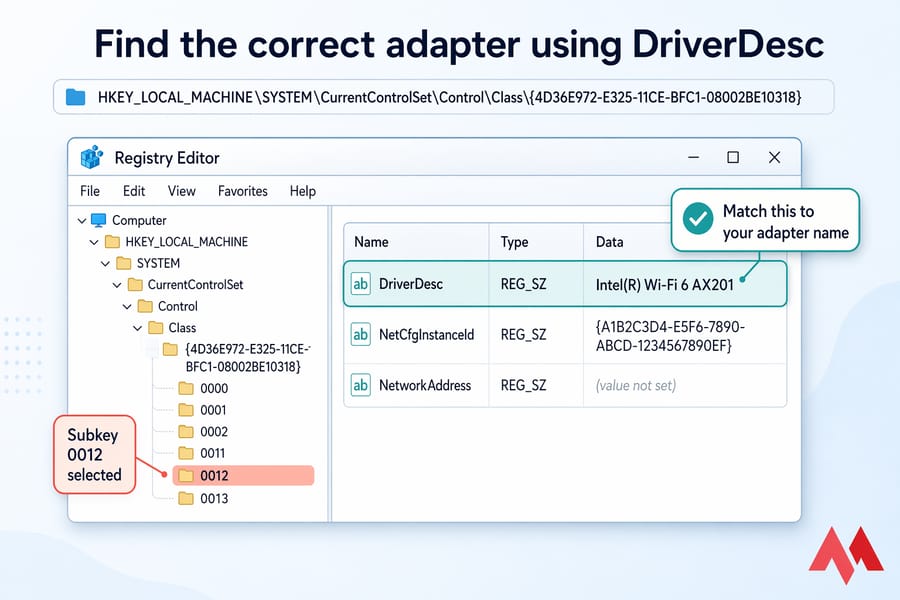
HKEY_LOCAL_MACHINE\SYSTEM\CurrentControlSet\Control\Class\{4D36E972-E325-11CE-BFC1-08002BE10318}That long GUID is the network adapter class key. Every network adapter Windows knows about lives as a numbered subkey underneath — 0000, 0001, 0002, and so on.
Step 3: Find the correct adapter using DriverDesc
This is where people mess up. Click through each numbered subkey (0000, 0001, etc.) and look at the DriverDesc value on the right. That tells you which adapter each key represents. Match it to the name you see in Device Manager or Network Connections — something like "Intel(R) Wi-Fi 6 AX201" or "Realtek PCIe GbE Family Controller."
You can also cross-check with NetCfgInstanceId, which matches the adapter's GUID shown in ipconfig /all.
Step 4: Create the NetworkAddress string
With the correct subkey selected, look for a value named NetworkAddress in the right pane. If it exists, skip to Step 5. If not, right-click an empty area → New → String Value → name it exactly NetworkAddress (case matters for readability, though Windows is forgiving).
Step 5: Enter the new MAC address in the correct format
Double-click NetworkAddress and enter your desired MAC. Twelve hex characters. No colons. No hyphens. No spaces. Example:
0A1B2C3D4E5FClick OK. More on format rules in the next section — read them before you commit.
Step 6: Disable and re-enable the network adapter
The registry change doesn't take effect until the adapter reloads. Open Network Connections (run ncpa.cpl), right-click your adapter, click Disable, wait a few seconds, then right-click again and Enable. A reboot also works, but it's overkill.
What Format Should the New MAC Address Use?
Format rules are where this whole process falls apart for most people. Get it wrong and the adapter just silently ignores you.
Use 12 hexadecimal characters
Only 0-9 and A-F. No lowercase versus uppercase drama — both work. Just 12 characters, no more, no fewer.
Do not use colons or hyphens
This one catches everyone. When Windows shows you a MAC, it usually looks like 0A-1B-2C-3D-4E-5F or 0A:1B:2C:3D:4E:5F. But in the registry, you strip all separators out. Windows rejects anything with punctuation.
Example of valid and invalid MAC address values
Valid:
0A1B2C3D4E5F02AABBCCDDEEDE55AD77BEEF
Invalid:
0A-1B-2C-3D-4E-5F(hyphens)0A:1B:2C:3D:4E:5F(colons)0A1B2C3D4E(only 10 characters)GG1B2C3D4E5F(G is not hex)
One quick note on conventions: the second hex character of the first byte controls whether the address is locally administered. Setting it to 2, 6, A, or E marks the MAC as locally administered — which is the "correct" approach when spoofing. It avoids collisions with real vendor-assigned addresses. And avoid values where the first byte is odd (like 01, 03) — those are multicast addresses and most switches will drop your traffic.
How to Verify the MAC Address Change
Don't just assume the change worked. Verify it.
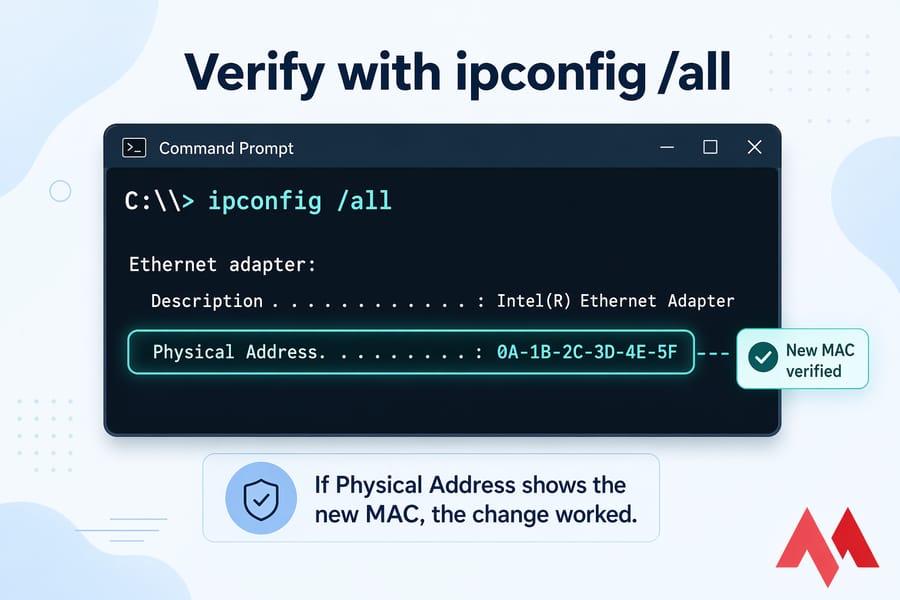
Check with ipconfig /all
Open Command Prompt and run:
ipconfig /allScroll to your adapter and look at the Physical Address line. If it shows your new MAC, you're done. If it shows the original — the adapter ignored the override.
Check with getmac
A cleaner way:
getmac /v /fo listThis gives you a tidy per-adapter list with connection name and physical address.
Confirm in adapter settings
You can also open Network Connections → right-click your adapter → Status → Details. The physical address shows there too.
What to Do If the MAC Address Change Is Not Working
Honestly, this is where most people get stuck. If your new MAC isn't showing up, one of these is usually the culprit.
The adapter driver does not support NetworkAddress
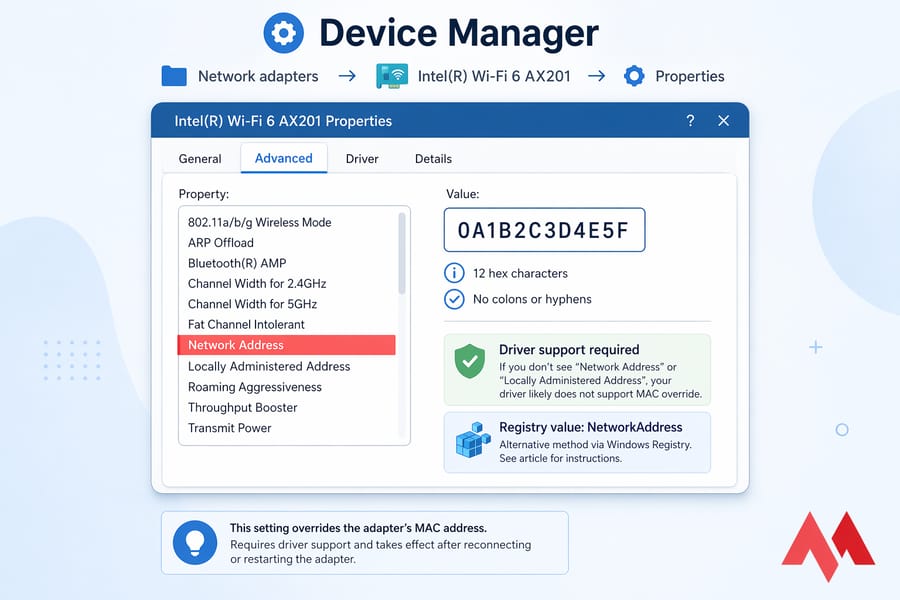
Some drivers simply ignore the registry value — especially on Wi-Fi cards. Try Device Manager instead: right-click the adapter → Properties → Advanced tab. If there's no "Network Address" or "Locally Administered Address" entry there either, the driver likely doesn't support it at all.
The wrong adapter key was edited
Go back to the registry. Double-check DriverDesc matches the adapter you actually use. It's easy to edit 0011 when you meant 0012.
The new MAC address format is invalid
Revisit the format rules. Twelve hex characters. No separators. If you've got 11 or 13 characters, Windows silently drops the value.
The driver reset the value after restart
Driver updates sometimes wipe custom registry values. If your MAC reverts after a Windows Update, just reapply the change. Some enterprise NICs also push the hardware MAC back on every cold boot — in which case, the registry method won't hold.
How to Restore the Original MAC Address
Undoing the change is genuinely simple.
Delete the NetworkAddress value
Go back to the same registry subkey. Right-click the NetworkAddress value → Delete. You can also just clear the data field (leave it blank), but deleting is cleaner.
Restart the adapter or reboot Windows
Disable and re-enable the adapter as before. Run ipconfig /all to confirm the burned-in hardware MAC is back. That's it — no permanent changes, no residue.
Alternative Ways to Change a MAC Address on Windows
The registry isn't the only game in town. Here's how the three main methods compare.
| Method | Difficulty | Reliability | Best For |
|---|---|---|---|
| Registry Editor | Medium | Works on most Ethernet NICs; inconsistent on Wi-Fi | Manual control, no software install |
| Device Manager | Easy | Works only if driver exposes "Network Address" field | Non-technical users |
| Third-party tools (TMAC, SMAC) | Easy | Depends on underlying method used | Frequent MAC switching, batch tasks |
Use Device Manager
Open Device Manager → expand Network adapters → right-click your adapter → Properties → Advanced tab. Look for Network Address, Locally Administered Address, or MAC Address. Enter 12 hex characters (no separators), click OK. Same format rules apply.
Use a MAC address changer tool
Tools like Technitium MAC Address Changer do essentially the same thing under the hood — they write to NetworkAddress — but with a cleaner UI and one-click randomization. I generally avoid third-party tools on production machines, but for a testing laptop? Fine.
When the registry method is best
Go with the registry when Device Manager doesn't show a Network Address field, when you want precise control over which adapter is changed, or when you're scripting the change across multiple machines via reg add. For a full breakdown of options across other operating systems, check our guide on how to change your MAC address on any device.
Is Changing a MAC Address Legal and Safe?
In most places, changing your own device's MAC address is perfectly legal. It's your hardware. The issues show up when you use a spoofed MAC to bypass access controls — dodging a hotel Wi-Fi time limit, evading a corporate network block, or impersonating another device. That's where policy violations and, in some cases, laws come into play.
On the safety side: a bad value can break connectivity, but it's fully reversible. Delete NetworkAddress, restart the adapter, and you're back to normal. The only real risk is editing the wrong registry subkey and breaking something unrelated — which is why the backup step at the beginning matters.
If you need a reliable environment to host your website, a Windows VPS gives you full control over your server configuration along with dedicated resources for better performance.