![Best DNS Servers to Use [Fastest DNS Servers]](/wp-content/uploads/2021/12/92336089_3893493504024276_1886613433294520320_n748-847xAuto825-main.webp)
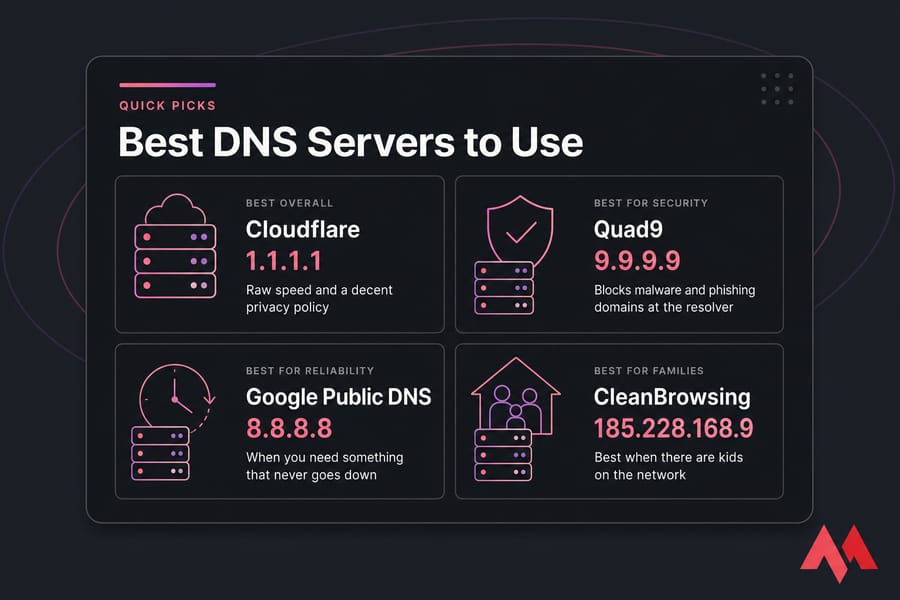
If you want the short version: use Cloudflare (1.1.1.1) for raw speed and a decent privacy policy, Quad9 (9.9.9.9) if you want malware and phishing domains blocked at the resolver, Google Public DNS (8.8.8.8) when you just need something that never goes down, and CleanBrowsing (185.228.168.9) if there are kids on the network. That's it. Everything below is the reasoning, the IPs, and the setup steps.
When surfing the world wide web, we tend to type the website's domain into the address bar without thinking of the background processes. As you may already know, to connect to a website's server, you must enter its IP address. So how do we connect to the site by just entering its name? Best DNS servers (Domain Name Servers) help us with doing it. They match the text we enter into the address bar to the server's IP address.
Your ISP (Internet Service Provider) will automatically assign you DNS servers when connecting to the internet. However, it does not mean that the ones assigned to you are the best DNS. At times, switching to a different DNS might significantly improve your browsing experience. It could also do the opposite if you choose the wrong one. Slow DNS servers can cause lag before a website even starts to load.
📌 What Is DNS?
DNS, or the Domain Name System, is a system that helps to convert human-readable domain names (such as www.example.com) into IP addresses (such as 192.0.2.1). This system is important because it helps to ensure that people can access websites using their chosen domain name, regardless of where the website is hosted. Several different DNS servers are available, and it can be helpful to choose the best one for your needs. When choosing a DNS server, you may consider factors like speed, security, and privacy.
⚙️ How Does a DNS Work?
A Domain Name System (DNS) server is a computer that connects to the Internet and resolves (translates) human-readable domain names into IP addresses. DNS servers run special software and communicate with each other using well-defined protocols.
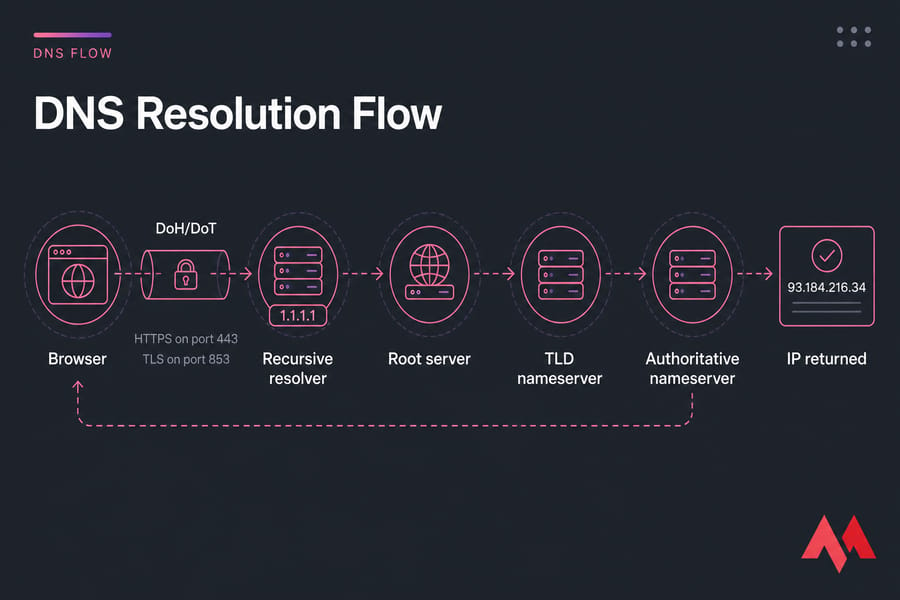
Your ISP usually provides a DNS server, but you can also use public DNS servers such as Google Public DNS and Cloudflare DNS. When you type a domain name into your web browser, your computer will first contact a DNS server to resolve the domain name into an IP address. The DNS server will then contact the web server associated with that IP address and request the page you want to view.
The DNS system is organized into hierarchically distributed databases called zones. A zone is a collection of records for a single domain or subdomain. Each zone is stored on one or more authoritative DNS servers. Authoritative DNS servers are responsible for providing accurate information about their zones to other DNS servers.
The root zone of the DNS hierarchy is served by 13 root servers operated by 12 different organizations. These root servers are the ultimate authority for all domains in the DNS system. Below the root zone are Top Level Domains (TLDs), which include familiar domains such as .com, .org, and .net. Most TLDs are managed by ICANN, which oversees the global Domain Name System.
DNS servers use caching to improve performance. When a DNS server receives a query for a domain name, it will cache the answer to that query in case it receives another query for the same domain name. This way, the DNS server doesn't have to repeatedly look up the same information. Caching can sometimes cause problems if DNS servers have stale cache data for a domain. For example, if you change the name servers for your domain, it may take up to 48 hours for DNS servers worldwide to update their caches with the new information.
The DNS system is a critical part of the Internet infrastructure, and it is essential for everyone who uses the Internet to understand how it works.
🗂️ Types of DNS Servers
There are four types of DNS servers: recursive, authoritative, root, and hybrid.
A recursive DNS server is responsible for resolving a DNS query. It contacts other DNS servers on behalf of the client to find the answer to the query.
An authoritative DNS server is responsible for storing DNS records for a zone. A zone is a portion of the DNS namespace managed by a specific organization or administrator.
A root DNS server is responsible for storing the address of top-level domains (TLDs). TLDs are the last part of a domain name, such as .com or .org.
A hybrid DNS server combines a recursive and authoritative DNS server. It can resolve queries and store records for zones.
✅ Benefits of DNS
Before discussing the best DNS servers, let's have a quick look at the benefits of DNS:
- A DNS server provides excellent internet dependency by saving all the IP addresses you use on the system.
- By eliminating suspicious activities, DNS improves the internet speed for better surfing.
- DNS blocks phishing and malicious attacks to provide top-notch security.
- DNS offers more stability due to the appropriate privacy features.
📊 Best DNS Servers Compared
| Provider | Primary / Secondary | Best for | Logging | Malware blocking | Adult filter | IPv6 | DoH / DoT |
| Cloudflare | 1.1.1.1 / 1.0.0.1 | Speed, everyday use | 24-hour logs, no IP retention | Optional (1.1.1.2) | Optional (1.1.1.3) | Yes | Both |
| Google Public DNS | 8.8.8.8 / 8.8.4.4 | Reliability, uptime | Temporary + permanent anonymised | No | No | Yes | Both |
| Quad9 | 9.9.9.9 / 149.112.112.112 | Security | No IP logging | Yes | No | Yes | Both |
| OpenDNS (Cisco) | 208.67.222.222 / 208.67.220.220 | Filtering, business | Yes, account-linked | Yes | Optional (FamilyShield) | Yes | DoH |
| CleanBrowsing | 185.228.168.9 / 185.228.169.9 | Parental controls | Minimal | Yes | Yes | Yes | Both |
| Comodo Secure DNS | 8.26.56.26 / 8.20.247.20 | Malware filtering | Yes | Yes | No | Partial | No |
| DNS.Watch | 84.200.69.80 / 84.200.70.40 | No-log privacy | No logs | No | No | Yes | No |
| Alternate DNS | 76.76.19.19 / 76.223.122.150 | Ad blocking | Minimal | Partial | No | Yes | DoH |
| UncensoredDNS | 91.239.100.100 / 89.233.43.71 | Unfiltered access | No logs | No | No | Yes | DoT |
| Yandex DNS | 77.88.8.8 / 77.88.8.1 | Tiered filtering | Yes | Yes (Safe mode) | Yes (Family mode) | Yes | Partial |
🔬 How I Evaluated These DNS Resolvers
No honest article can tell you which public DNS is fastest for you. Resolver performance depends on your ISP, your physical location, and which anycast point of presence you land on. A provider that resolves in 11 ms in Frankfurt might take 90 ms in Lagos.
So the ranking here leans on four things: published provider documentation and privacy policies, third-party benchmark data (DNSPerf-style monitoring), feature depth like DNSSEC validation and encrypted transport, and setup friction. I haven't invented lab numbers. Run your own benchmark — I'll show you how further down.
What actually matters when choosing
- Latency and lookup speed — anycast networks with a node near you win.
- Uptime — Cloudflare and Google both run at effectively 100%; smaller resolvers occasionally wobble.
- Query logging — read the policy, not the marketing page.
- Malware and phishing blocking — Quad9 pulls from multiple threat feeds.
- Content filtering — useful for families, annoying if you value an uncensored resolver.
- IPv6 and DoH/DoT support — non-negotiable in 2026, honestly.
- DNSSEC validation — protects against forged responses.
📋 Public DNS Server IP Addresses (Copy These)
IPv4:
Cloudflare      1.1.1.1          1.0.0.1
Cloudflare+Sec  1.1.1.2          1.0.0.2
Google          8.8.8.8          8.8.4.4
Quad9           9.9.9.9          149.112.112.112
OpenDNS         208.67.222.222   208.67.220.220
CleanBrowsing   185.228.168.9    185.228.169.9
Comodo          8.26.56.26       8.20.247.20
DNS.Watch       84.200.69.80     84.200.70.40
Alternate DNS   76.76.19.19      76.223.122.150
UncensoredDNS   91.239.100.100   89.233.43.71
Yandex          77.88.8.8        77.88.8.1
IPv6:
Cloudflare      2606:4700:4700::1111   2606:4700:4700::1001
Google          2001:4860:4860::8888   2001:4860:4860::8844
Quad9           2620:fe::fe            2620:fe::9
OpenDNS         2620:119:35::35        2620:119:53::53
CleanBrowsing   2a0d:2a00:1::2         2a0d:2a00:2::2
🏆 10 Best DNS Servers in Detail
1. Cloudflare
Although Cloudflare is best known for its CDNs (Content Delivery Networks), they also offer a new public DNS service named 1.1.1.1. It might not provide fancy add-ons others do, such as anti-phishing, content filtering, or ad-blocking. Instead, pure performance is their primary focus.

Independent testing shows that 1.1.1.1 is the fastest public DNS server available. Along with speed, they promise privacy. According to Cloudflare, it will never write querying IP addresses to disk, and any logs that get created will be deleted within 24 hours.
Pros:
- It is free to use the tool.
- Faster than other DNS servers.
- It never reads the browsing data.
Cons:
- Reported dashboards are not good enough.
- Inappropriate support system for free users.
2. Google Public DNS
Anyone reading this article knows Google. The web giant enjoys having a role in any web-related services, and it does not exclude DNS servers. Although they do not provide the highest speeds or the most privacy, we have observed that Google's Public DNS provides overall good service quality.
It logs the full IP address info of the querying device for 48 hours, and any permanent logs are rid of personally identifiable information. You can also use all these DNS servers in VPS servers and dedicated servers.
Pros:
- It is free to use.
- It can improve speed.
- It can protect the system from DDoS and phishing.
Cons:
- It logs the user's browsing history.
3. OpenDNS
Owned by Cisco after being in the market for nearly 15 years, OpenDNS is one of the biggest and most recognizable names in public DNS. OpenDNS is well-known for its high speeds and 100% uptime. However, they also offer automatic anti-phishing and blocking sites by content type.

Most importantly, it is designed to withstand failure because it has a self-healing technology that prevents the system from disrupting customers.
Pros:
- The free version is best for personal use
- Free for personal use
- Brings speed enhancements
- Protects against phishing attacks, malware attacks, and cloned websites
Cons:
- Logs the DNS traffic that it receives
4. Comodo Secure DNS
Comodo Secure DNS always ensures user security through the malware domain filtering option. They claim that their services are smarter in detecting attempts to visit parked domains and then automatically forward the information to you.

As we all know, malware attacks have increased, so having adequate security assures that we can easily browse websites without any issues. Comodo is always a great choice when a user wants an extra layer of web filtration and fantastic support to set up the service on Windows, routers, Macs, and Chromebooks.
Pros:
- It is free for personal use
- It provides service on 5 continents
- It protects the system from malware, spyware, and phishing attacks.
Cons:
- Not compatible enough with specific devices.
- It has performance-related issues.
5. DNS.Watch
DNS.Watch is an excellent third-party DNS server that offers a mapping feature for the domain name to the IP address for the device connected to your internet, as it is essential for the internet. This DNS server is free, and it doesn't need any installations.
Other DNS servers are also beneficial in opening geo-restricted content, but DNS.Watch also believes in the user's privacy. Therefore, it doesn't log any DNS queries sent by the devices.
Pros:
- It is free to use
- It has DNS Neutrality
- It doesn't log the queries
- It doesn't share or sell the data
Cons:
- It doesn't protect the system from websites and attacks.
6. Quad9 DNS
Quad9 DNS is a free DNS server that emphasizes performance, privacy, and security. Users have to configure this DNS server, and it will route the DNS queries by the secured network of servers worldwide.

The system of Quad9 DNS uses threat intelligence from different industry-leading cybersecurity companies to provide a real-time perspective on website threat analysis. Quad9 DNS blocks phishing, malicious domains, and malware by handling anonymity.
Pros:
- It is free for personal use
- It protects from privacy attacks
- It Keeps a real-time perspective on your website threat analysis
Cons:
- It becomes slower according to the conditions.
7. CleanBrowsing
CleanBrowsing is the best DNS server for parents to protect their kids for a safe and private experience.

This DNS allows a user to block adult content on the internet to increase protection from phishing and malicious attacks. CleanBrowsing comes under three tiers such as security, family, and adult.
Pros:
- It has a free tier option.
- It has three different filtering features: security, family, and adult
- It blocks all malicious websites and any adult content.
- It supports the IPv6 protocol.
Cons:
- You can't customize the filtering in a free plan.
8. Yandex DNS
Yandex DNS works well if you need an alternative to the above-described DNS for the system. This DNS offers fantastic, reliable performance, including protection and speed, without lowering the requirement.

It has a remarkable feature of content filtering that allows you to prohibit offensive content. Hence, it ensures smoothness and security while browsing on the internet.
Pros:
- It is the fastest server.
- It can block malware easily.
- It can do content filtering.
Cons:
- Knowledge required for setting up Yandex DNS.
9. UncensoredDNS
UncensoredDNS promises to maintain the safety of the user with their free services. This organization is based in Denmark, and you can rely on it for surfing the internet without stressing about common attacks.

One of the significant features of Uncensored DNS is that it only uses the data for capacity planning. Apart from privacy, its server also works to make the work more smooth and easy.
Pros:
- Users can easily set-up UncensoredDNS
- There is a trusted privacy policy.
- Security is improved
Cons:
- Server speed is not appropriate.
10. Alternate DNS
Alternate DNS is a fast DNS server that users can count on for reliability. It also offers multiple features to block ads, suspicious websites, adult content, and trackers. This DNS server is compatible with IPv4 and IPv6 protocols so that you can use IPv6 for high speed.

Pros:
- It is free to use
- Users can block ads and adult content
- It is a fast DNS server.
- It is appropriate for a secondary DNS resolver.
Cons:
- The privacy policy of this DNS is not good enough.
🎯 Best DNS Server by Use Case
Gaming
Cloudflare or Google. DNS doesn't touch your in-game ping — that's routing — but a fast resolver shortens matchmaking and launcher/CDN lookups. Avoid heavy filtering resolvers here; they add a processing hop.
Privacy
Quad9 doesn't store your IP. DNS.Watch and UncensoredDNS claim no logs at all. Cloudflare is fast and audited but it's still a large US company — pick based on whose policy you trust.
Malware and Phishing Blocking
Quad9 first, Comodo Secure DNS second. Cloudflare's 1.1.1.2 endpoint is a solid middle ground if you want the speed and the blocklist.
Parental Controls
CleanBrowsing's Family filter is the cleanest implementation available, and OpenDNS FamilyShield (208.67.222.123) needs zero configuration. Yandex Family mode works too, if you're comfortable with the provider.
Streaming and General Browsing
Cloudflare, with Google as secondary. Note that some CDNs geolocate you from your resolver, so a distant DNS can occasionally route you to a slower edge node.
🔐 DNS Over HTTPS and DNS Over TLS, Explained Fast
Plain DNS is unencrypted. Anyone on the path — your ISP, the café Wi-Fi, a compromised router — can read every domain you look up and even rewrite the answers.
DoH wraps queries in HTTPS on port 443, so they blend in with normal web traffic. DoT uses TLS on port 853 — easier for network admins to see and manage, harder for censors to hide from. DoH is better for individuals on hostile networks; DoT is tidier on a network you control.
One caveat worth repeating: encrypted DNS hides your lookups from the local network, not from the resolver itself, and it isn't a VPN. Your IP is still visible to every site you visit.
🔧 How to Change Your DNS Server
Write down your existing DNS values before you change anything. Ask me how I learned that one.
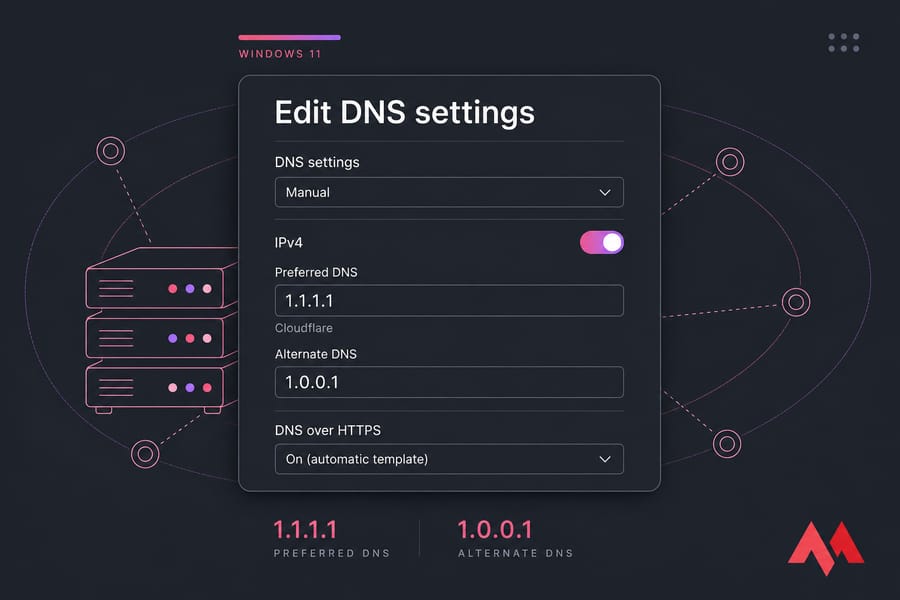
- Windows 10/11: Settings → Network & Internet → your adapter → Edit DNS server assignment → Manual → toggle IPv4 on → enter primary and secondary. Full walkthrough here: how to change DNS server on Windows.
- macOS: System Settings → Network → your connection → Details → DNS → click
+, add each IP, then Apply. - Android: Settings → Network & Internet → Private DNS → Private DNS provider hostname → enter
one.one.one.oneordns.quad9.net. That gives you DoT automatically. - iPhone/iPad: Settings → Wi-Fi → (i) next to the network → Configure DNS → Manual → Add Server.
- Router: log into the admin panel, find WAN or DHCP settings, set the DNS fields there. Every device on the LAN inherits it. MikroTik users can follow the MikroTik DNS setup guide.
Changes not taking effect? Flush the DNS cache and restart the browser. If lookups break entirely, the DNS server not responding fix cover almost every scenario I've run into.
📶 How to Test DNS Speed Yourself
Two minutes of testing beats any listicle, including this one.
- GRC DNS Benchmark (Windows) queries dozens of resolvers from your connection and ranks them.
- dnsperftest or similar shell scripts work on Linux and macOS.
- Command line:
nslookup example.com 1.1.1.1on Windows, ordig @9.9.9.9 example.com | grep "Query time"on Linux.
Test at different times of day. Cached results skew the first run, so query domains you haven't visited. And expect the winner to change if you switch ISPs or move cities — that's normal, not a broken test.
🚀 Can Changing DNS Actually Make Your Internet Faster?
Partly. It cuts the time between typing a domain and the first byte arriving — sometimes 100 ms or more per uncached lookup on a slow ISP resolver. It does not increase your bandwidth. Your 100 Mbps line stays 100 Mbps.
What you reliably gain: faster lookups, better uptime, DNSSEC validation, optional threat blocking, and freedom from ISP-level DNS hijacking. What you don't gain: higher throughput or lower game ping.
Running your own resolver on a VPS is a different story — full control, custom blocklists, no third-party logging at all. If you go that route, our guide on what a DNS checker does is a useful companion for verifying records after changes.
🎯 Conclusion
The details of the best DNS servers provide fantastic security and privacy without compromising stability. As we have mentioned earlier, the word DNS stands for Domain Name Server, so it works to handle web surfing by offering adequate security and privacy.
The list we have created is based on the advantages and disadvantages of customer reviews, published provider documentation, and third-party benchmark data, so this article has some of the most accurate information you will find on the internet. As you know from this article, using the best DNS server is very important, so also we have an option that you can buy a domain and use the best DNS server and get 24/7 support from the MonoVM team.
📚 People Are Also Reading

I'm fascinated by the IT world and how the 1's and 0's work. While I venture into the world of Technology, I try to share what I know in the simplest way with you. Not a fan of coffee, a travel addict, and a self-accredited 'master chef'.