
In a world of growing surveillance and network restrictions, secure communication is no longer optional it’s essential. V2Ray is one of the most powerful and flexible tools for building encrypted, resilient internet connections.
Whether you’re deploying a private proxy on a VPS, testing advanced routing as a developer, or strengthening your online privacy, proper setup matters. A well-configured V2Ray installation can deliver high performance, strong encryption, and reliable traffic control.
In this guide, you’ll learn how to install V2Ray on Linux, Windows, and macOS, understand its core architecture, and configure it for real-world use. We’ll also cover example configurations, troubleshooting tips, and key security best practices to prepare your deployment for production.
What Is V2Ray and Why Use It?
V2Ray is a powerful open-source network proxy platform built to route internet traffic securely, intelligently, and efficiently. It was designed with flexibility at its core, allowing organizations and individuals to manage how data moves across networks with precision and control.
The platform supports multiple communication protocols and advanced routing capabilities. This makes it highly adaptable for a range of use cases, including privacy protection, traffic obfuscation, performance optimization, and operating within restrictive or regulated network environments. In short, it provides both resilience and discretion in complex connectivity scenarios.
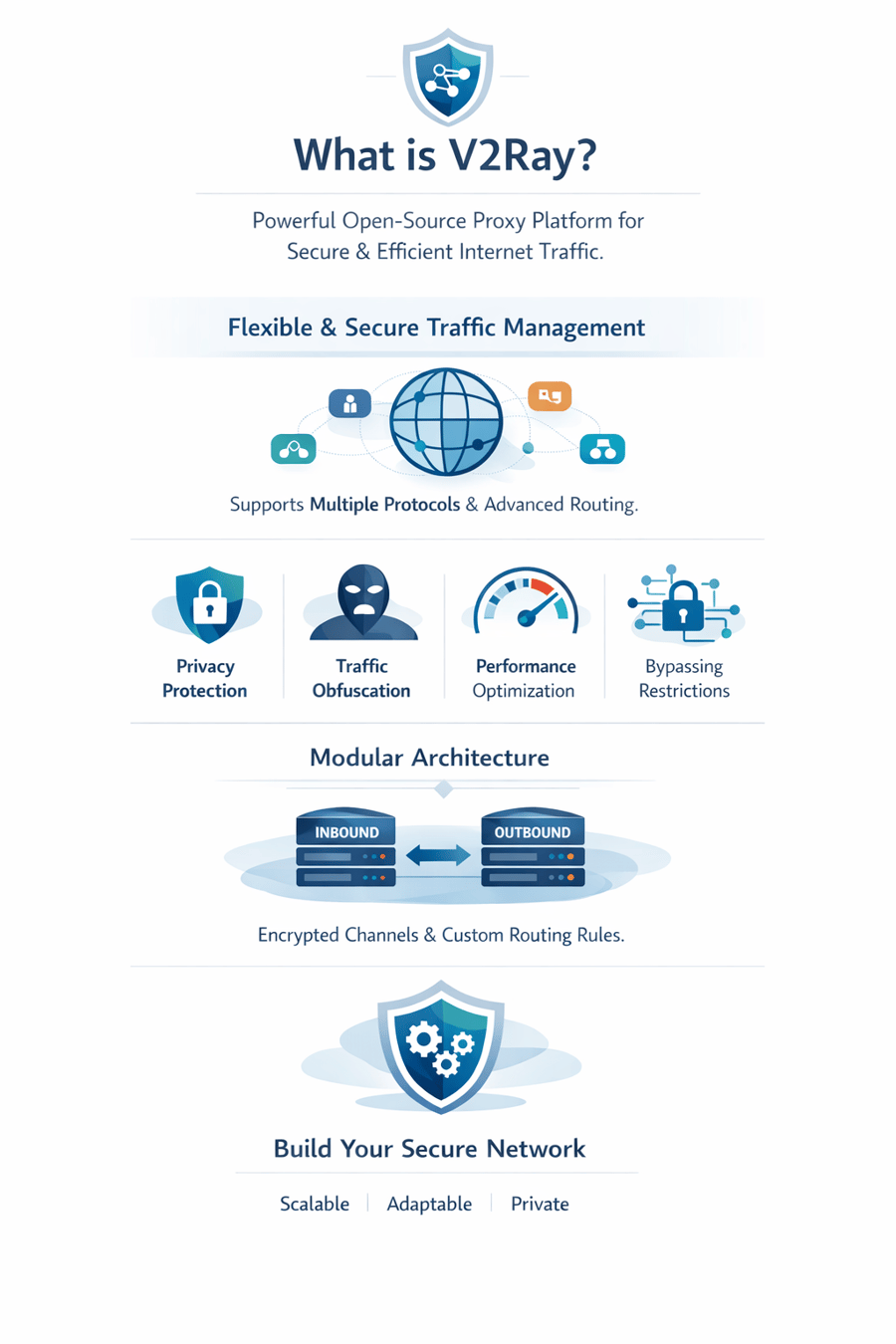
Unlike traditional proxy tools that offer limited configuration, V2Ray is modular by design. It separates inbound and outbound traffic management, enabling granular control over how requests are received, processed, and forwarded. This architecture allows for encrypted communication channels, intelligent traffic distribution, and the creation of sophisticated routing rules tailored to specific operational needs.
The result is not just a proxy tool, but a configurable network framework. It empowers technical teams to build secure, scalable, and adaptable traffic management systems aligned with modern privacy and infrastructure requirements.
V2Ray Architecture Overview
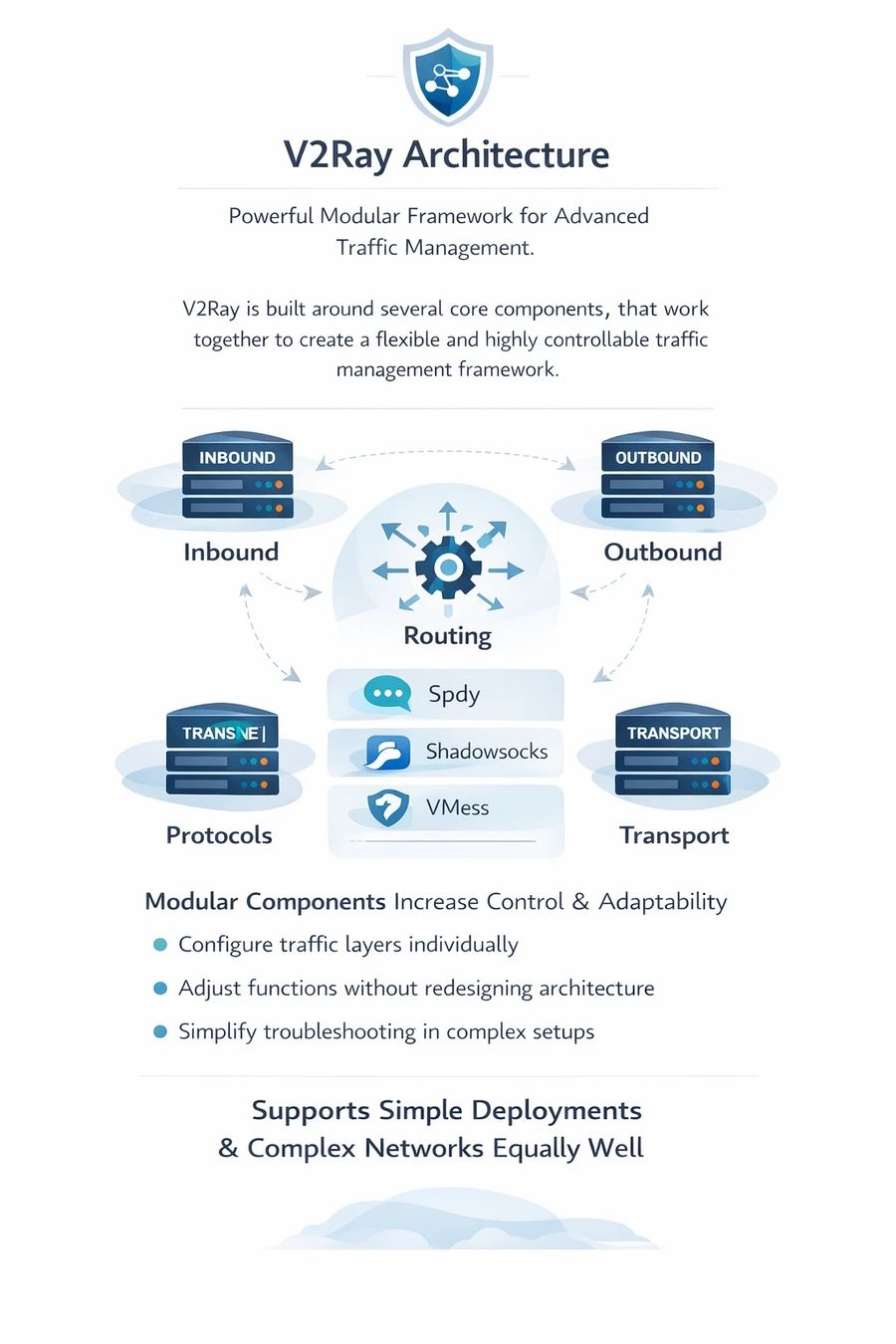
V2Ray is built around several core components that work together to create a flexible and highly controllable traffic management framework.
Each component has a clearly defined role. This modular structure allows teams to configure, scale, and adapt the system without redesigning the entire architecture. Instead of a monolithic proxy, V2Ray operates as a set of coordinated building blocks.
This design approach increases reliability, simplifies troubleshooting, and enables advanced customization. Organizations can adjust specific layers of traffic handling—such as inbound connections, outbound routing, or protocol management without impacting the broader system.
The result is a platform that supports both simple deployments and highly complex network environments with equal efficiency.
|
Component |
Purpose |
|
Inbound |
Accepts incoming connections (e.g., from your client app) |
|
Outbound |
Sends traffic to its final destination |
|
Routing |
Determines how traffic is handled |
|
Transport |
Defines how data is transmitted (TCP, WebSocket, etc.) |
|
Protocols |
VMess, Shadowsocks, VLESS, Trojan, and others |
Supported Protocols
V2Ray supports multiple communication protocols, allowing organizations to select the right balance between performance, security, and obfuscation based on their operational needs.
- VMess – A fully encrypted protocol developed specifically for V2Ray. It offers strong security, authentication mechanisms, and flexible configuration, making it suitable for structured and controlled deployments.
- VLESS – A streamlined evolution of VMess. It reduces overhead while maintaining flexibility, making it ideal for high-performance environments where efficiency is a priority.
- Shadowsocks – A widely adopted encrypted proxy protocol known for its simplicity and reliability. It is lightweight, stable, and effective for general secure traffic routing.
- Trojan – A TLS-based protocol designed to closely mimic standard HTTPS traffic. It blends seamlessly with normal web activity, making it particularly effective in restrictive or highly monitored networks.
Each protocol provides a different level of complexity, encryption strength, and traffic obfuscation. This flexibility allows decision-makers to align technical implementation with risk tolerance, compliance requirements, and infrastructure strategy.
Prerequisites Before Installation
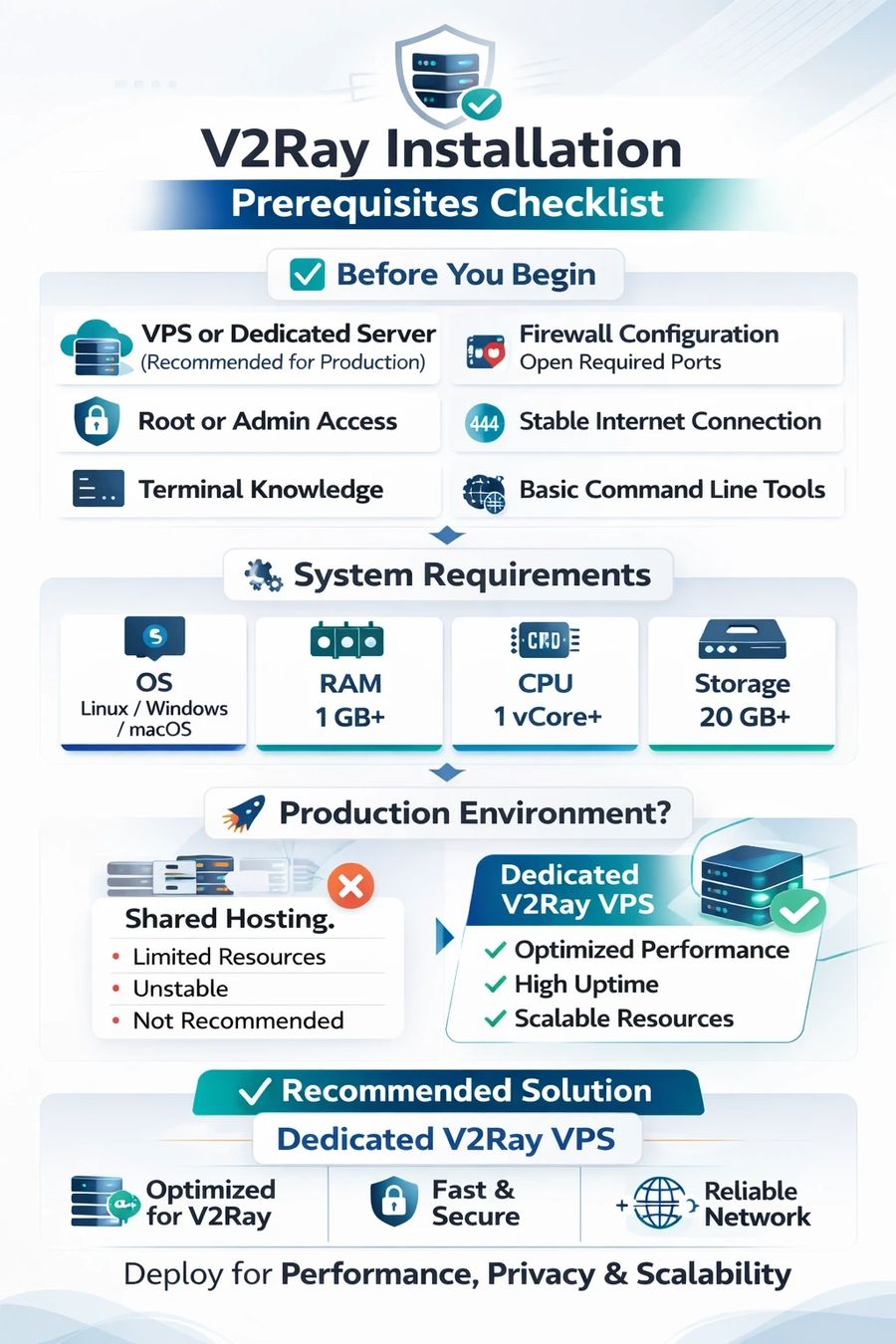
Before proceeding with the installation, ensure the following prerequisites are in place:
- A VPS or dedicated server (strongly recommended for production environments)
- Root or administrative access to the system
- Basic familiarity with terminal commands
- Required firewall ports open (commonly port 443 or a designated custom port)
These foundational requirements help ensure a smooth deployment process and reduce configuration issues during setup.
For organizations planning to use V2Ray in a live or high-traffic environment, infrastructure quality matters. Running V2Ray on a properly optimized server significantly improves stability, uptime, and network consistency.
If you do not yet have a server in place, deploying on a Dedicated V2Ray VPS is the recommended approach. A purpose-built VPS environment ensures predictable performance, stronger network reliability, and better long-term scalability.
To ensure maximum performance and reliability from day one, explore our Dedicated V2Ray VPS solutions and deploy your V2Ray infrastructure on a server optimized specifically for secure proxy operations.
Recommended System Requirements
To ensure stable and efficient operation, V2Ray should be deployed in a compatible and properly resourced environment.
For Linux deployments, a VPS with at least 1 vCPU and 1GB of RAM is considered the minimum baseline. While this configuration is sufficient for light usage and testing environments, production workloads may require higher specifications depending on traffic volume and concurrency levels.
On Windows systems, V2Ray is supported on Windows 10 or newer. Administrative privileges are recommended to properly configure network settings and firewall rules.
For macOS users, macOS 10.15 (Catalina) or later is required to ensure compatibility with the latest binaries and security frameworks.
From a networking standpoint, a public IP address is essential. This enables external clients to establish inbound connections reliably. Without a public-facing IP, remote access and proper routing functionality will be limited.
Ensuring the right environment from the start reduces operational friction and creates a solid foundation for secure, scalable deployment.
Preparing Your Server and Client Machines
Before moving into configuration and deployment, it is essential to properly prepare both the server and client environments. A structured setup process reduces errors, strengthens security, and ensures long-term operational stability.
On the server side, this means validating system requirements, updating the operating system, securing access credentials, and confirming that required network ports are open and properly routed. A clean, hardened server environment minimizes vulnerabilities and creates a reliable foundation for V2Ray installation.
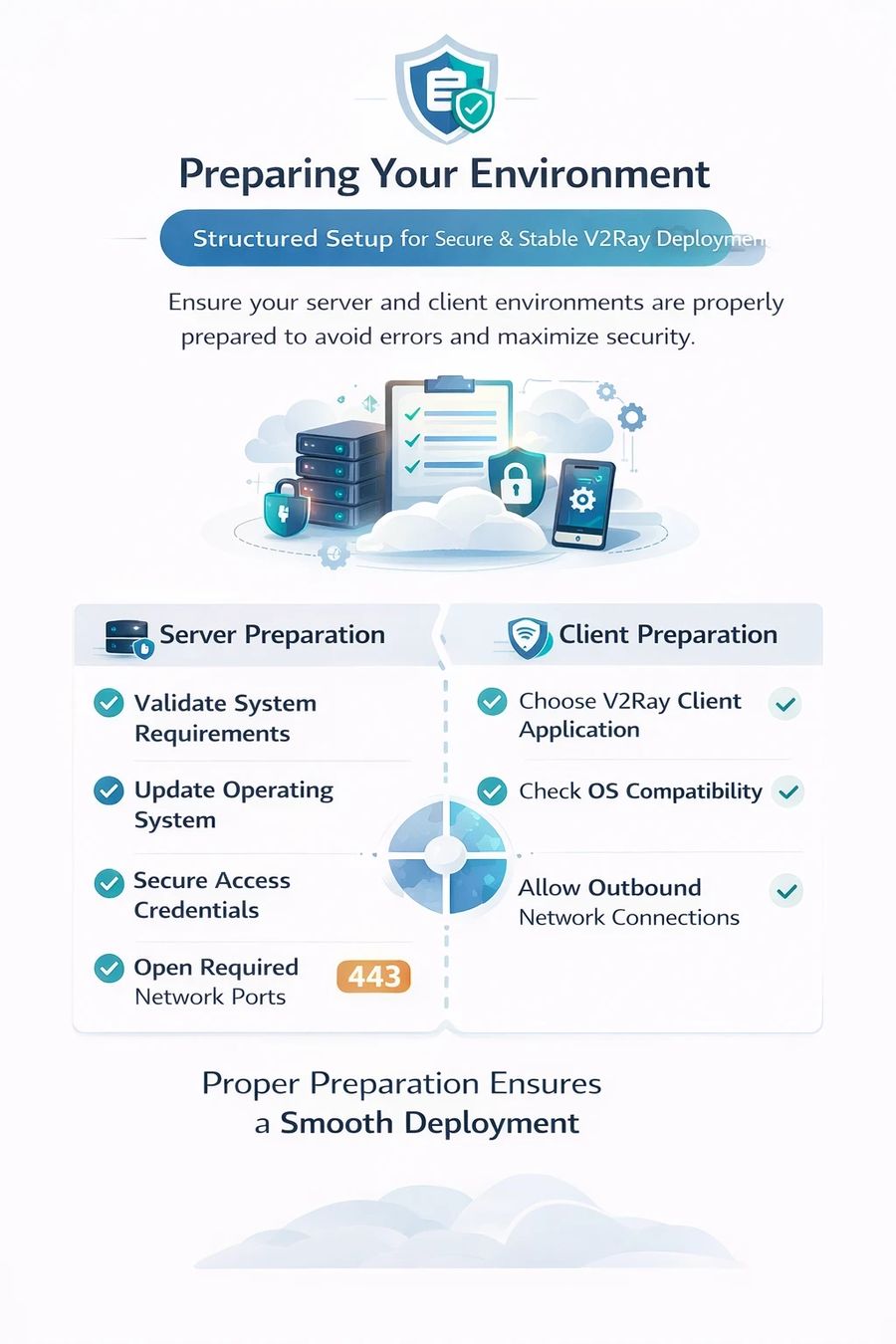
On the client side, preparation involves selecting the appropriate V2Ray-compatible application, verifying operating system compatibility, and ensuring network permissions allow outbound connections. Proper client configuration is just as critical as server setup to maintain secure and consistent connectivity.
With both environments prepared correctly, deployment becomes streamlined, predictable, and significantly more resilient.
How to Install V2Ray
Install V2Ray on Linux
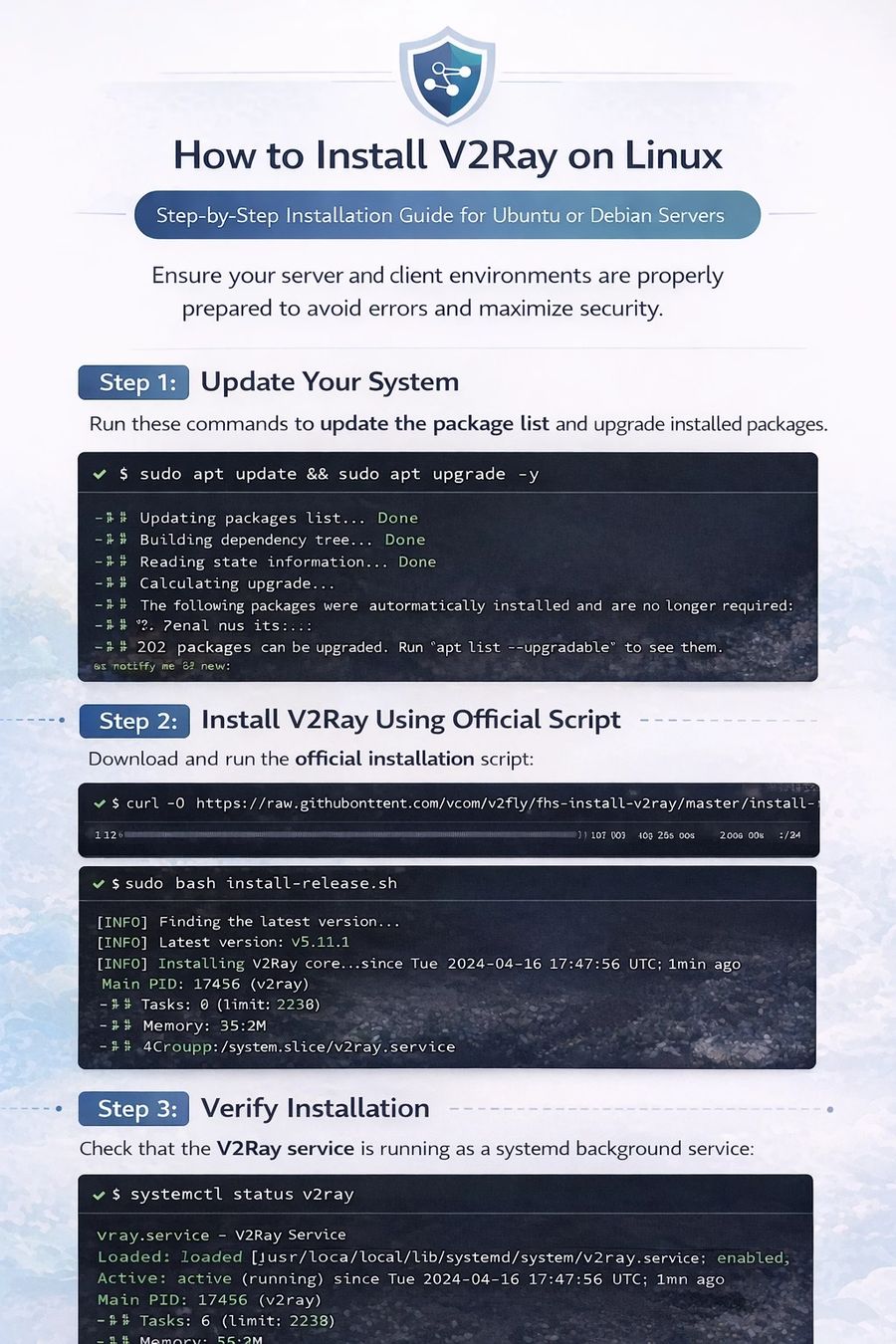
Most deployments use Linux servers such as Ubuntu or Debian.
Step 1: Update Your System
sudo apt update && sudo apt upgrade -y
Step 2: Install V2Ray Using Official Script
curl -O https://raw.githubusercontent.com/v2fly/fhs-install-v2ray/master/install-release.sh
sudo bash install-release.sh
This installation process deploys the V2Ray core on your Linux server, providing the engine that manages encrypted traffic routing.
It also creates a systemd service file, allowing V2Ray to run as a background service with automatic startup and simplified management through standard Linux commands.
In addition, a dedicated configuration directory is generated to store routing rules and protocol settings, ensuring an organized and production-ready setup.
Step 3: Verify Installation
systemctl status v2ray
If active and running, installation was successful.
Install V2Ray on Windows
- Download the latest release
Go to the official V2Ray release page and download the Windows ZIP package (choose the correct one for your system, typically 64-bit). - Extract the ZIP file
Unzip the file into a clean folder, such as C:\V2Ray\. Avoid placing it inside system-protected folders. - Find the configuration file
Open the extracted folder and locate config.json. This is the main file you will edit to add your server details and protocol settings. - Edit config.json carefully
Update the file with your correct inbound/outbound settings (server address, port, UUID/credentials, TLS settings if used). Save the file once finished. - Run V2Ray
Double-click v2ray.exe to start it. If Windows Firewall prompts you, allow access based on your network policy. - Confirm it’s running
If the console window shows no errors and stays open, V2Ray is running. If it closes immediately, re-check config.json for formatting or configuration issues.
If you want easier setup and management, many users install V2RayN. It provides a user-friendly interface for importing server profiles, switching nodes, and managing routing without editing JSON manually.
Install V2Ray on macOS
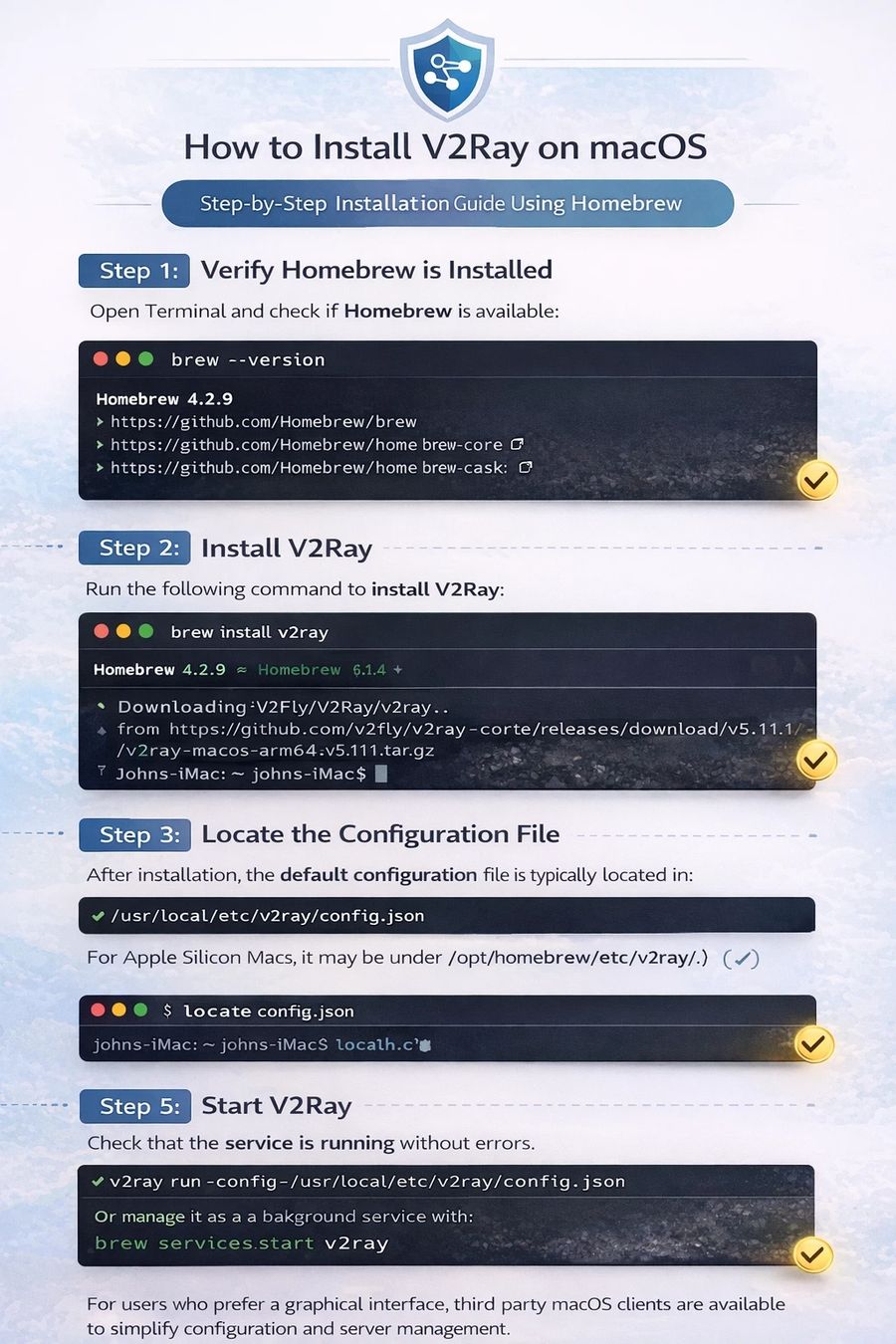
Installing V2Ray on macOS is straightforward when using Homebrew. Follow the steps below to ensure a clean and stable setup.
1) Verify Homebrew is installed
Open Terminal and check if Homebrew is available:
brew --version
If it is not installed, install Homebrew first from the official website before proceeding.
2) Install V2Ray
Run the following command to install V2Ray:
brew install v2ray
Homebrew will automatically download and configure the latest compatible version.
3) Locate the configuration file
After installation, the default configuration file is typically located in:
/usr/local/etc/v2ray/config.json
For Apple Silicon Macs, it may be under /opt/homebrew/etc/v2ray/.)
Edit this file to add your server credentials, routing rules, and protocol settings.
4) Start V2Ray
You can run V2Ray directly using:
v2ray run -config=/usr/local/etc/v2ray/config.json
Or manage it as a background service with:
brew services start v2ray
6) Verify operation
Check that the service is running without errors. If needed, review logs for troubleshooting.
For users who prefer a graphical interface, third-party macOS clients are available to simplify configuration and server management.
Configuring V2Ray
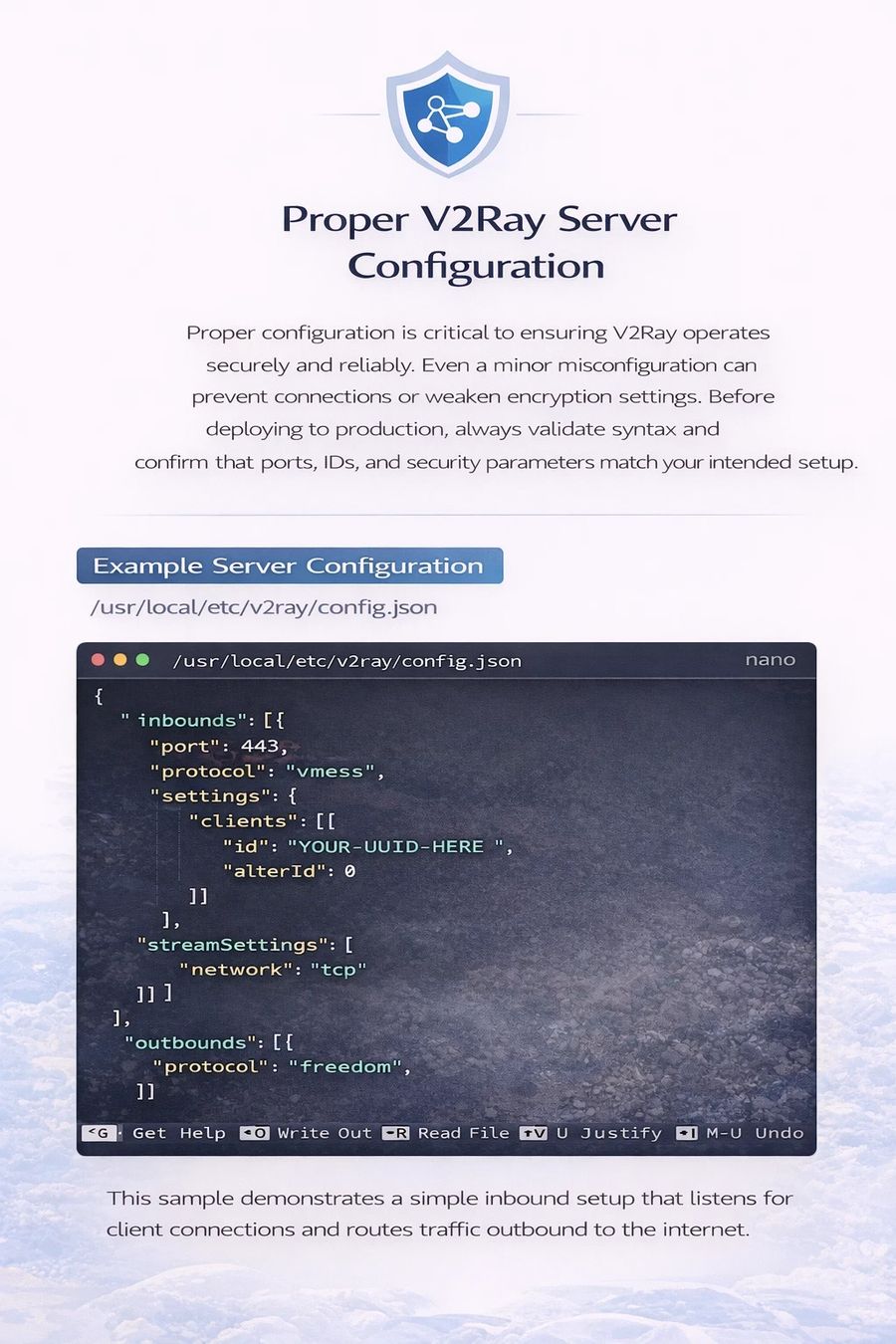
Proper configuration is critical to ensuring V2Ray operates securely and reliably. Even a minor misconfiguration can prevent connections or weaken encryption settings. Before deploying to production, always validate syntax and confirm that ports, IDs, and security parameters match your intended setup.
Below is a basic example of a server configuration using the VMess protocol. This sample demonstrates a simple inbound setup that listens for client connections and routes traffic outbound to the internet.
Example Server Configuration
/usr/local/etc/v2ray/config.json
{
  "inbounds": [{
    "port": 443,
    "protocol": "vmess",
    "settings": {
      "clients": [{
        "id": "YOUR-UUID-HERE",
        "alterId": 0
      }]
    },
    "streamSettings": {
      "network": "tcp"
    }
  }],
  "outbounds": [{
    "protocol": "freedom",
    "settings": {}
  }]
}
Important Fields Explained
|
Field |
Description |
|
port |
Listening port |
|
id |
Unique UUID for client authentication |
|
protocol |
Communication protocol |
|
network |
TCP, WebSocket, etc. |
|
freedom |
Allows direct outbound traffic |
Generate a UUID:
cat /proc/sys/kernel/random/uuid
Restart V2Ray after editing:
sudo systemctl restart v2ray
Basic Client Configuration Example
Client configuration mirrors the server:
{
  "outbounds": [{
    "protocol": "vmess",
    "settings": {
      "vnext": [{
        "address": "SERVER-IP",
        "port": 443,
        "users": [{
          "id": "YOUR-UUID-HERE"
        }]
      }]
    }
  }]
}
Ensure:
- IP address matches your server
- UUID matches server configuration
- Firewall allows selected port
Example Configuration Files and Explanation
Understanding the configuration structure is essential for deploying V2Ray correctly. The configuration file defines how traffic enters the server, how it is processed, and how it exits to its final destination.
Below, you will find example configuration files designed to illustrate a standard setup. These examples are intentionally simplified to highlight the core components without unnecessary complexity. In a production environment, additional security layers such as TLS, advanced routing rules, or traffic masking may be required.
Each section of the configuration plays a specific role from defining inbound connection parameters to setting outbound routing behavior and encryption methods. Following the examples, we will break down the key sections to clarify what each parameter controls and how it impacts performance and security.
Use these samples as a foundation, then tailor them according to your infrastructure requirements and security standards.
Testing and Verifying Your V2Ray Setup
Once installation and configuration are complete, verification is essential. This step confirms that the service is running correctly, ports are open, and the configuration is functioning as expected.
Follow the steps below to validate your setup:
1) Check the service status
On Linux systems using systemd, run:
systemctl status v2ray
2) Review logs
After confirming the service is running, the next step is to review the logs. Logs provide immediate visibility into configuration errors, failed connection attempts, port conflicts, or authentication issues.
On Linux systems using systemd, you can check recent logs with:
sudo journalctl -u v2ray -n 50 --no-pager
3) Test the connection from the client
Once the service is running and logs show no critical errors, the final step is to test connectivity from a client device.
Configure your client application (such as V2RayN, V2RayU, or another compatible client) using the exact server details defined in your config.json. This includes the server IP address, port, UUID, protocol type, and any TLS settings if enabled.
After saving the configuration, initiate the connection from the client.
4) Confirm IP change
After successfully connecting from the client, the final verification step is to confirm that your public IP address has changed.
Open a browser on the connected client device and visit an IP-check service such as:
https://whatismyipaddress.com
If V2Ray is functioning correctly, the displayed IP address should match your server’s public IP — not your local ISP address.
This confirmation ensures that traffic is properly routing through your V2Ray server and that the tunnel is active. If the IP does not change, revisit your client configuration, routing rules, or firewall settings.
Troubleshooting Common Issues
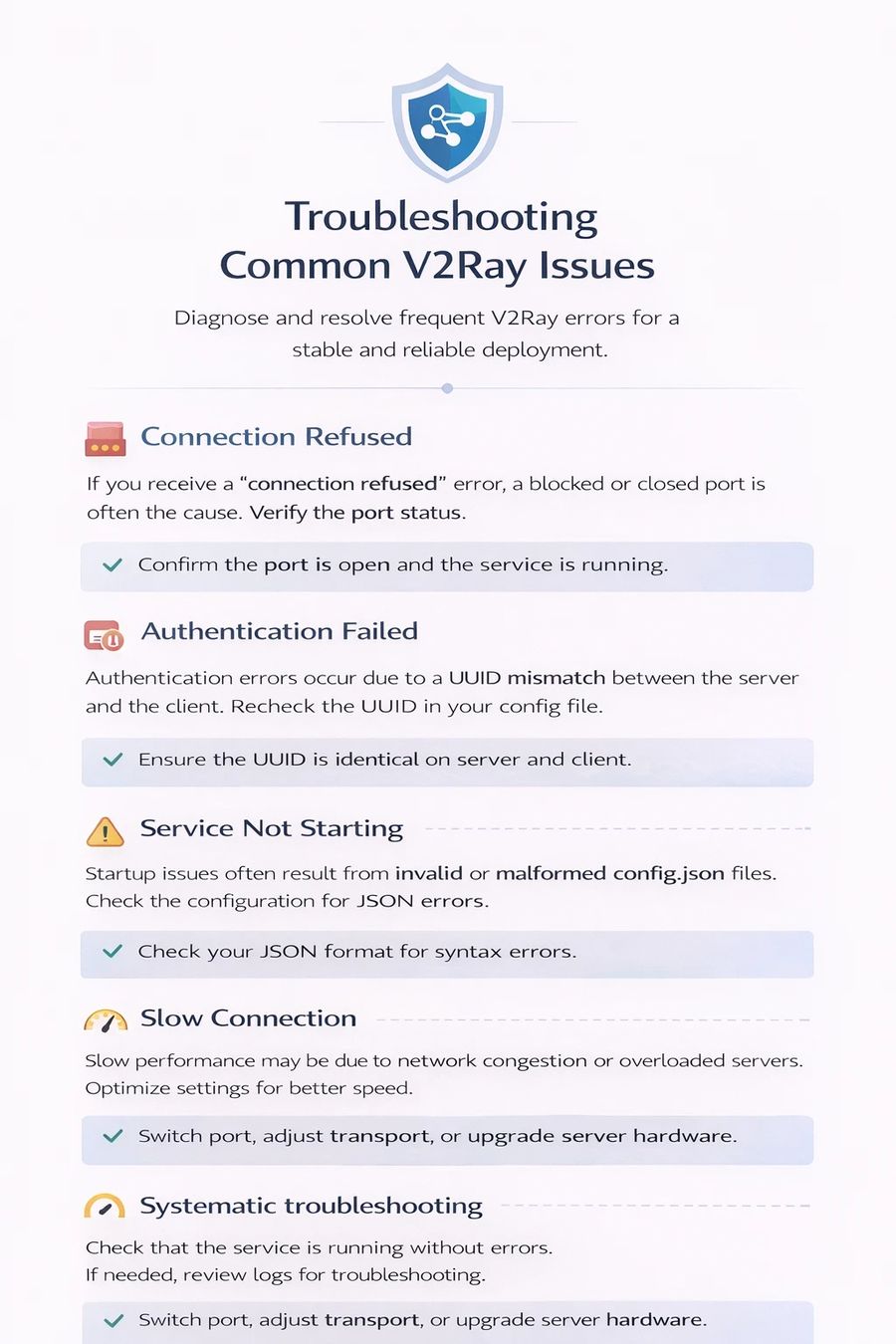
Connection refused
If you receive a “connection refused” error, the most common cause is a blocked or closed port on the server. Verify that the configured port is open in your firewall and correctly mapped. Also confirm that the service is actively running and listening on the expected port.
Authentication failed
Authentication errors typically occur due to a UUID mismatch between the server and the client. Carefully recheck the client ID in your config.json file and ensure the exact same UUID is configured on the client side. Even a small formatting difference will prevent successful authentication.
Service not starting
If the V2Ray service fails to start, the issue is often related to an invalid configuration file. Review the JSON syntax carefully for missing commas, brackets, or formatting errors. Running a JSON validator can quickly identify structural issues.
Slow connection
Performance issues are commonly linked to network congestion, suboptimal routing, or overloaded server resources. Consider switching ports, adjusting the transport protocol, or upgrading server specifications if the problem persists.
Systematic troubleshooting ensures stability and helps maintain a reliable production-ready deployment.
Security and Privacy Best Practices
To strengthen security and operational stability, follow these best practices:
- Enable TLS encryption – Essential for production environments to protect data in transit and prevent interception.
- Deploy behind NGINX with WebSocket + TLS – Helps traffic blend with normal HTTPS activity, improving stealth and reducing detection risks.
- Use strong, unique UUIDs – Prevents unauthorized access and strengthens authentication security.
- Change default ports – Reduces exposure to automated scans and common attack patterns.
- Keep the system updated – Regularly update both the operating system and V2Ray core to patch vulnerabilities and maintain performance.
- Use a dedicated VPS – For higher stability, better resource allocation, and improved stealth, avoid shared environments and deploy on dedicated infrastructure.
Real-World Use Cases for V2Ray
V2Ray is widely used for secure remote access to internal services, allowing teams to connect to private infrastructure safely from external networks. It is also commonly deployed to encrypt traffic on public Wi-Fi, protecting users from interception and unsecured network risks.
In restrictive environments, V2Ray enables controlled access to external resources by intelligently routing and masking traffic. It is equally effective in protecting sensitive browsing sessions, ensuring that transmitted data remains encrypted and private.
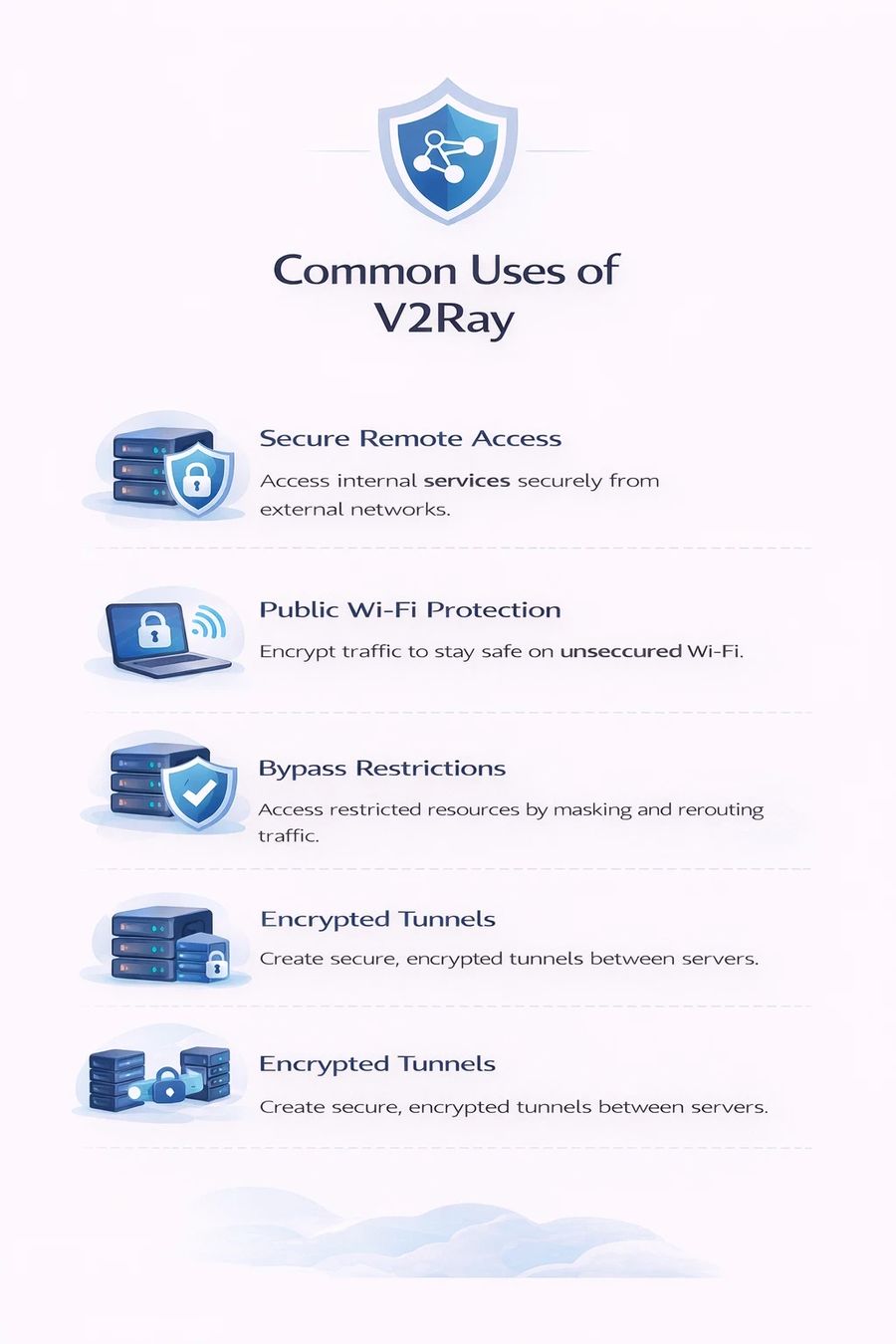
Beyond individual use cases, V2Ray can be configured to create private, encrypted tunnels between servers. This makes it a practical solution for secure inter-server communication and distributed infrastructure setups.
Its flexibility and modular architecture make V2Ray suitable for both personal privacy configurations and enterprise-grade routing environments that demand scalability, control, and security.
Final Thoughts
Installing and configuring V2Ray correctly requires more than a basic setup. Understanding its architecture and how it interacts with your environment is essential.
While installation is straightforward, long-term reliability depends on secure configuration, proper routing rules, and well-managed firewall settings. These elements determine stability and performance over time.
Infrastructure quality also matters. For users focused on privacy, uptime, and consistent performance, deploying on a reliable V2Ray VPS ensures stronger control and production-level stability.
With this guide, you now have the foundation to install V2Ray, configure server and client components, troubleshoot common issues, and apply security best practices with confidence.


I'm fascinated by the IT world and how the 1's and 0's work. While I venture into the world of Technology, I try to share what I know in the simplest way with you. Not a fan of coffee, a travel addict, and a self-accredited 'master chef'.