
If you're shopping for a Linux VPS right now, the hard part isn't finding providers. It's figuring out which one actually fits your workload, your budget, and how much server admin you're willing to do yourself. That's the gap this comparison tries to close. Below you'll find ten of the better-known Linux VPS hosting providers lined up by starting price, management level, root access, and data centre footprint — plus straight recommendations by use case.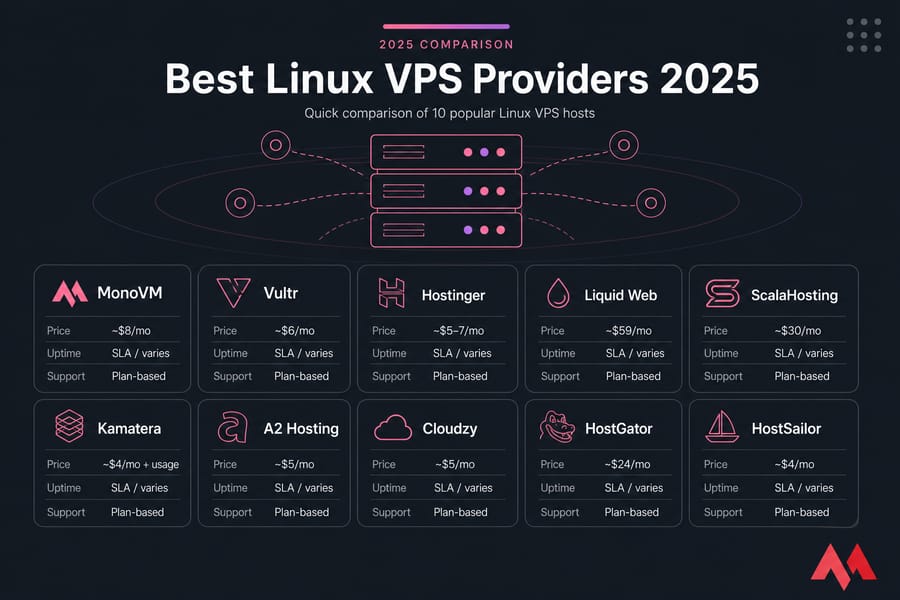
📌 What Is a Linux VPS Server?
A Linux virtual server is a type of VPS that uses the Linux operating system. Each Linux VPS acts as an independent computer and can have its own memory, disk space, network resources, and software applications. Linux is an open-source operating system kernel that powers everything from embedded devices to enterprise servers, making it the most widely deployed OS in hosting environments. Compared to shared hosting, Linux VPS has better security, is more affordable, highly flexible, and much easier to manage. These features allow websites and applications to use these servers for hosting without worrying about future resource expansion. You can select from a wide range of distributions of Linux, including Ubuntu, Debian, or Fedora, according to your particular needs. If you're looking for a broader Linux hosting solution that covers shared, VPS, and dedicated options, it's worth comparing the full spectrum before committing to one tier.
🌐 Want to enhance your VPS performance? Learn more about the Best Operating Systems for VPS Hosting and see how they can boost your server's efficiency!
✅ What Are the Benefits of Using a Linux VPS Server?
The main advantage of a Linux virtual server is that it provides a dedicated and secure environment for your needs. Linux is used for everything from web hosting and database management to AI workloads and container orchestration — its versatility is why it dominates the server market. Here are the key benefits of using a Linux VPS:
- Stability and continuous uptime
- Abundant security with regular patches and updates
- Cost-effective and customizable to user needs
- Excellent scalability and flexibility
- High-quality performance with dedicated processing power
- Privacy protection for sensitive workloads
- Dedicated resource allocation — no sharing with noisy neighbours
- Full root access for complete server control
- Dedicated support from most providers
- Ability to host multiple domains on a single server
- Regular backup and snapshot capabilities
In general, Linux virtual servers, as an open-source operating system, have more features than Windows virtual servers and their price is also more affordable. For this reason, they have become the go-to virtual servers for programmers and website developers.
📊 How We Ranked These Linux VPS Providers
Let's be honest about method, because plenty of roundups aren't. This is an editorial comparison, not a lab benchmark. Rankings come from published specs and pricing, documented feature sets (virtualization type, storage media, control panel options), support channels and hours, management tiers, data centre footprint, and refund or trial terms. Pricing was verified against public provider pages and reflects entry plans without promotional lock-ins where possible. Prices move constantly, so treat figures as a range, not a quote. Where a provider publishes an uptime SLA, we cite the SLA — we don't claim to have measured it ourselves. Editorial note: MonoVM is our own service and appears here for completeness. Judge it on the same criteria as everything else in the table.
⚡ Quick Comparison: Best Linux VPS Hosting Providers
| Provider | Best for | Starting price (approx.) | Management | Root access | Regions |
| MonoVM | Flexible distro choice + crypto payment | ~$6/mo | Unmanaged (managed add-ons) | Yes | 35+ worldwide |
| Vultr | Developers, hourly billing | ~$6/mo | Unmanaged | Yes | 30+ locations |
| Hostinger | Cheap KVM VPS | ~$5–7/mo | Semi-managed | Yes | 8 locations |
| Liquid Web | Business-critical managed VPS | ~$59/mo | Fully managed | Yes | US, EU |
| ScalaHosting | Managed VPS with built-in security | ~$30/mo | Fully managed (SPanel) | Yes | US, EU |
| Kamatera | Custom vCPU/RAM sizing | ~$4/mo + usage | Both | Yes | 13+ zones |
| A2 Hosting | Speed-focused NVMe stacks | ~$5/mo | Both | Yes (higher tiers) | 4 regions |
| Cloudzy | Wide distro + location choice | ~$5/mo | Unmanaged | Yes | 15+ locations |
| HostGator | Familiar cPanel ecosystem | ~$24/mo | Semi-managed | Yes | US |
| HostSailor | Bare-bones budget VPS | ~$4/mo | Unmanaged | Yes | NL, RO, US |
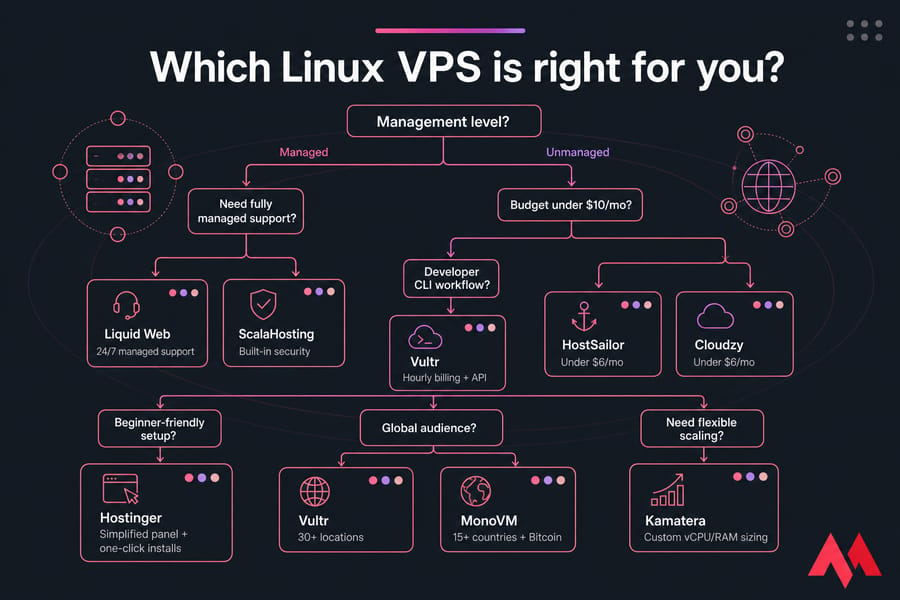
🎯 Best Linux VPS Providers by Use Case
Best for Beginners
Hostinger. KVM plans, a simplified panel, and one-click app installs mean you can get a working stack up without touching a firewall rule on day one. Still gives you root when you want it.
Best for Developers
Vultr. Hourly billing, a clean API, snapshots, and enough locations to test latency properly. Perfect for spinning up a Docker host, tearing it down, and paying pennies.
Best Managed Linux VPS
Liquid Web for business workloads with real SLAs and 24/7 sysadmin help; ScalaHosting if you want managed hosting plus bundled security and its own control panel instead of a cPanel licence bill.
Best Budget Linux VPS
HostSailor or Cloudzy. Both land under $6/mo for a usable slice. You're doing your own patching and hardening at that price — that's the trade.
Best for Global Audiences
Vultr and MonoVM. Latency is the cheapest performance win available. Put the server near your users. If you need to pay privately, MonoVM's Linux VPS hosting plans also accept Bitcoin.
Best for Scaling Projects
Kamatera. Dial vCPU, RAM, and disk independently instead of jumping up a fixed tier you don't need. When your project outgrows VPS entirely, consider a Linux dedicated server for bare-metal performance.
🧾 10 Best Linux VPS Hosting Providers in Detail
1. MonoVM
MonoVM stands out as a leading provider of Linux VPS hosting due to its remarkable features and efficiency. Users can expect 99.9% uptime for their applications and services. Linux VPS services provide rapid performance and scalability, providing peak performance regardless of website size or traffic level. Furthermore, with over 35 locations worldwide, users can select the server location nearest to their intended audience, improving speed and accessibility. Also, MonoVM's cloud VPS approach is cost-effective, charging only for the resources used, making it an appealing alternative for enterprises of all kinds. Combined with 24/7 customer assistance supplied by a team of skilled professionals, MonoVM delivers a comprehensive and trustworthy solution for Linux virtual servers.
What we like:
- Full SSH/Administrator Access
- Dedicated Resources
- 99.9% Uptime
- 24/7 Support
- Unlimited (Europe) SSD caching
- 35 Locations Worldwide
- Cost-effective
- Secure private network
- Accepts Bitcoin and cryptocurrency payments
What we don't like:
- You can mention any cons in comments and we'll try to fix it.
Price range:
- $5.99 for 512 MB
- $9.08 for 1024 MB
- $13.99 for 2048 MB
- $20.99 for 4096 MB
- $34.99 for 6144 MB
- $45.49 for 8192 MB
2. Vultr
Vultr is a prominent brand in the Linux VPS hosting market, offering a variety of plans and services. Their pricing can be steep for some consumers, with plans ranging up to enterprise-level depending on your needs. Likewise, Vultr has a strict no-refund policy, which may not be appropriate for all consumers who require flexibility. Despite these shortcomings, Vultr offers a secure private network, 24-hour technical assistance, hourly billing, a clean API, and snapshots that make it a developer favourite.
What we like:
- Variety of plans and services
- Secure private network
- 24/7 technical support
- Hourly billing with clean API
- 30+ locations worldwide
What we don't like:
- Confusing website
- Expensive prices at higher tiers
- No refund policy
Price range:
- 1 GB RAM – $5/month
- 2 GB RAM – $10/month
- 8 GB RAM – $40/month
- 16 GB RAM – $80/month
| Provider | MonoVM | Vultr |
| Available Locations | 35 locations worldwide | 30+ Locations |
| 24/7 Support | Yes | Yes |
| Root access | Yes | Yes |
| Service Offer | 7 days money-back guarantee | No |
| Payment Methods | Credit Card, PayPal, Bitcoin, WebMoney, Perfect Money, Skrill, Payeer, Western Union, Bank Transfer | Mastercard, Visa, American Express, PayPal, Discover, JCB, BitPay, Alipay, UnionPay |
3. HostGator
HostGator is a simple-to-use brand in the Linux VPS hosting industry, catering to both novices and specialists. You should know that it comes with a higher price tag. Also, HostGator lacks a full refund guarantee, which could discourage some customers. Likewise, setting up SSH and remote access can be difficult for inexperienced VPS users.
What we like:
- Full root access
- User-friendly interface
- Familiar cPanel ecosystem
What we don't like:
- Expensive prices
- No money-back guarantee
- Limited server locations (US-focused)
Price range:
- 4 GB RAM – $19.95/month
- 8 GB RAM – from $39.95/month
- 16 GB RAM – from $79.95/month
| Provider | MonoVM | HostGator |
| Available Locations | 35 locations worldwide | 4 Locations |
| 24/7 Support | Yes | Yes |
| Root access | Yes | Yes |
| Service Offer | 7 days money-back guarantee | No information |
| Payment Methods | Credit Card, PayPal, Bitcoin, WebMoney, Perfect Money, Skrill, Western Union, Bank Transfer | PayPal, Credit Cards |
4. HostSailor
HostSailor is aimed exclusively at Linux VPS enthusiasts. They offer lightning-fast servers and prioritize Linux support. Their data centers (Romania, Netherlands, and US) provide distinct functionality, and you can upgrade without losing data. Not to mention that their pricing is on the budget end, but their server locations are limited and they only accept Bitcoin, limiting payment alternatives.
🔒 Explore the benefits of privacy and flexibility in web hosting. Buy VPS with Bitcoin now for enhanced security and performance!
What we like:
- 24/7 tech support
- Scalable VPS
- Very affordable entry pricing
What we don't like:
- Limited locations
- Limited payment methods
Price range:
- 256 MB RAM – $1.99/month
- 512 MB RAM – $2.99/month
- 1 GB RAM – $4.99/month
| Provider | MonoVM | HostSailor |
| Available Locations | 35 locations worldwide | 3 locations |
| 24/7 Support | Yes | Yes |
| Root access | Yes | Yes |
| Service Offer | 7 days money-back guarantee | 100% money-back guarantee |
| Payment Methods | Credit Card, PayPal, Bitcoin, WebMoney, Perfect Money, Skrill, Western Union, Bank Transfer | Bitcoin |
5. Liquid Web
Liquid Web provides powerful Linux VPS hosting with reliable 24/7 support for business-critical workloads. Their servers are lightning fast, but the monthly cost ranges from $59 to enterprise levels, making it a premium option. There are servers in Lansing, Phoenix, and Amsterdam, so the location variety is restricted. Finally, payment methods may be limited, so verify your alternatives before signing up.
What we like:
- 24/7 support system with real SLAs
- High-performance servers
- Fully managed with sysadmin help
What we don't like:
- Expensive prices
- Limited locations
Price range:
- Starts at ~$59/month for managed plans
| Provider | MonoVM | Liquid Web |
| Available Locations | 35 locations worldwide | 3 locations |
| 24/7 Support | Yes | Yes |
| Root access | Yes | Yes |
| Service Offer | 7 days money-back guarantee | No information |
| Payment Methods | Credit Card, PayPal, Bitcoin, WebMoney, Perfect Money, Skrill, Western Union, Bank Transfer | Mastercard, Visa, Discover, American Express |
6. Hostinger
Hostinger provides Linux VPS hosting with various features designed for better control and performance. Users benefit from full root access, dedicated IP addresses, and useful tools like an AI assistant, a browser terminal, and a malware scanner. Additionally, Hostinger offers 24/7 support to assist users. One drawback is the limited availability of server locations.
What we like:
- Full root access
- Dedicated IP address
- AI assistant
- 24/7 support
- Browser terminal
- KVM virtualization
What we don't like:
- Limited locations
Price range:
- $4.99 for 4 GB RAM
- $5.99 for 8 GB RAM
- $10.49 for 16 GB RAM
| Provider | MonoVM | Hostinger |
| Available Locations | 35 locations worldwide | 5 locations |
| 24/7 Support | Yes | Yes |
| Root access | Yes | Yes |
| Service Offer | 7 days money-back guarantee | 30-day money-back guarantee |
| Payment Methods | Credit Card, PayPal, Bitcoin, WebMoney, Perfect Money, Skrill, Western Union, Bank Transfer | Credit Cards, Mastercard, Visa, PayPal, American Express, Discover, Alipay |
7. Cloudzy
With the newest hardware innovations, such as NVMe SSD storage and DDR4 RAM, Cloudzy's Linux VPS hosting options guarantee dependable performance and quick data transfer. Users may anticipate low latency and reliable service availability thanks to a 99.95% uptime guarantee and 10 Gbps network connections. With servers spread across more than 15 countries and support for 11 Linux distributions, Cloudzy lets customers choose the environment that works best for them.
What we like:
- High-end hardware (NVMe SSD storage, DDR4 RAM)
- Support for 11 Linux distributions
- DDoS protection included
- Root access provided
- 15+ global locations
What we don't like:
- No fully managed server hosting plans
Price Range:
- Starter Plan: 1 GB DDR4 Memory, $4.95/month
- Basic Plan: 2 GB DDR4 Memory, $9.95/month
- Advanced Plan: 4 GB DDR4 Memory, $19.95/month
- Professional Plan: 8 GB DDR4 Memory, $36.95/month
| Provider | MonoVM | Cloudzy |
| Available Locations | 35 locations worldwide | 15+ global locations |
| 24/7 Support | Yes | Yes |
| Root access | Yes | Yes |
| Service Offer | 7 days money-back guarantee | 7 days money-back guarantee |
| Payment Methods | Credit Card, PayPal, Bitcoin, WebMoney, Perfect Money, Payza, Skrill, Neteller, Payeer, Western Union, Bank Transfer | Credit cards, PayPal, and cryptocurrencies |
8. ScalaHosting
Reputable managed Linux VPS hosting company ScalaHosting tries to provide outstanding customer service and a strong infrastructure to deliver high availability and superior performance. One of their key features is their proprietary SPanel control panel. As a result, you'll experience an easy-to-use interface and you can easily manage your VPS. Their managed VPS plans include advanced security features like SShield, which offers real-time protection against various threats, server monitoring, and automatic backups.
What we like:
- Managed VPS hosting with exceptional customer support
- User-friendly SPanel control panel for easy management
- Strong emphasis on security with real-time protection
- Choice of Linux distributions and full root access
What we don't like:
- Pricing may be higher compared to some other providers
- Limited data center locations compared to larger hosting companies
Price Range:
- 4 GB RAM – $29.95/month
- 8 GB RAM – $44.95/month
- 16 GB RAM – $69.95/month
- 24 GB RAM – $94.95/month
| Provider | MonoVM | ScalaHosting |
| Available Locations | 35 locations worldwide | Limited |
| 24/7 Support | Yes | Yes |
| Root access | Yes | Yes |
| Service Offer | 7 days money-back guarantee | Money-back guarantee for new clients only |
| Payment Methods | Credit Card, PayPal, Bitcoin, WebMoney, Perfect Money, Payza, Skrill, Neteller, Payeer, Western Union, Bank Transfer | Credit cards, PayPal |
9. Kamatera
With unmatched scalability and top-tier performance across data centers in America, Europe, Asia, and the Middle East, Kamatera stands out as a premium Linux VPS hosting service. Their Linux VPS hosting is compatible with Linux distributions like CentOS, AlmaLinux, and RockyLinux. This provider guarantees smooth hosting that can be customized to meet the demands of a wide range of users. It is a great option for Linux VPS hosting because of its advanced infrastructure, which includes SSD drives, Xeon Platinum CPUs, and a 99.95% uptime guarantee.
What we like:
- Compatibility with multiple Linux distributions (e.g., AlmaLinux, RockyLinux)
- Flexible plans allowing custom resource configurations
- High performance with SSD storage and a 99.95% uptime guarantee
- Pay-as-you-go billing
What we don't like:
- Better suited for advanced users (managed services available at an additional cost)
Price Range for Linux VPS:
- Starting at $4/month with pay-as-you-go options
| Provider | MonoVM | Kamatera |
| Available Locations | 35 locations worldwide | America, Europe, Asia, Middle East |
| 24/7 Support | Yes | Yes |
| Root access | Yes | Yes |
| Service Offer | 7 days money-back guarantee | 30-day free trial |
| Payment Methods | Credit Card, PayPal, Bitcoin, WebMoney, Perfect Money, Payza, Skrill, Neteller, Payeer, Western Union, Bank Transfer | Pay-as-you-go options, monthly/hourly billing, major credit cards, and PayPal |
10. A2 Hosting
If features like speed and customization options are important to you, A2 Hosting is a great option. It offers well-known developer-friendly and speed-focused Linux VPS hosting packages. Turbo servers, SSD storage, and optimized software stacks are features of their VPS services that guarantee quick website loads. In addition to offering root access and developer tools like SSH access, Git integration, and support for many programming languages, A2 Hosting also supports a number of Linux distributions, including Ubuntu and CentOS.
What we like:
- Ultra-fast speeds with turbo servers and SSD storage
- Developer-friendly tools, including root access and Git integration
- Supports multiple Linux distributions (e.g., Ubuntu, CentOS)
- Excellent customer support
What we don't like:
- Higher pricing compared to some competitors
- Limited server locations in certain regions
Price Range:
- Unmanaged VPS: Starts at $6.99/month
- Managed VPS: Starts at $49.99/month
- Core VPS (managed with root access): Starts at $49.99/month
| Provider | MonoVM | A2 Hosting |
| Available Locations | 35 locations worldwide | Multiple locations, primarily US, Europe, and Asia |
| 24/7 Support | Yes | Yes |
| Root access | Yes | Yes |
| Service Offer | 7 days money-back guarantee | 30 Day Satisfaction Guarantee |
| Payment Methods | Credit Card, PayPal, Bitcoin, WebMoney, Perfect Money, Payza, Skrill, Neteller, Payeer, Western Union, Bank Transfer | Credit cards, PayPal, and other standard payment options |
⚙️ Managed vs Unmanaged Linux VPS
With an unmanaged VPS you get root, an IP, and a fresh OS. Everything after that is yours: kernel updates, firewall rules, web server config, backups, monitoring, the 2am reboot when something wedges. Great if you're comfortable in a terminal. Miserable if you're not.
Managed VPS shifts patching, monitoring, and troubleshooting to the provider. Expect to pay roughly two to four times the unmanaged price for equivalent hardware — a $10 unmanaged box is often $35–60 managed. In my experience, if nobody on your team can confidently harden SSH and read an nginx error log, managed hosting is cheaper than the downtime it prevents. Middle ground exists too: semi-managed plans handle OS updates and core services but leave your application alone.
💰 Linux VPS Pricing in 2026
- Entry-level ($4–10/mo): 1–2 vCPU, 1–4 GB RAM, 20–80 GB NVMe. Fine for a blog, staging box, VPN, or small API.
- Mid-range ($15–40/mo): 4 vCPU, 8–16 GB RAM. WooCommerce, several client sites, a SaaS MVP.
- Managed ($30–120/mo): same hardware, plus humans on call.
Watch the extras. Offsite backups, cPanel or Plesk licences (often $15–45/mo now), extra bandwidth, DDoS scrubbing add-ons, and multi-year renewal jumps all inflate that headline $4.99.
🔍 What to Look for in the Best Linux VPS Hosting
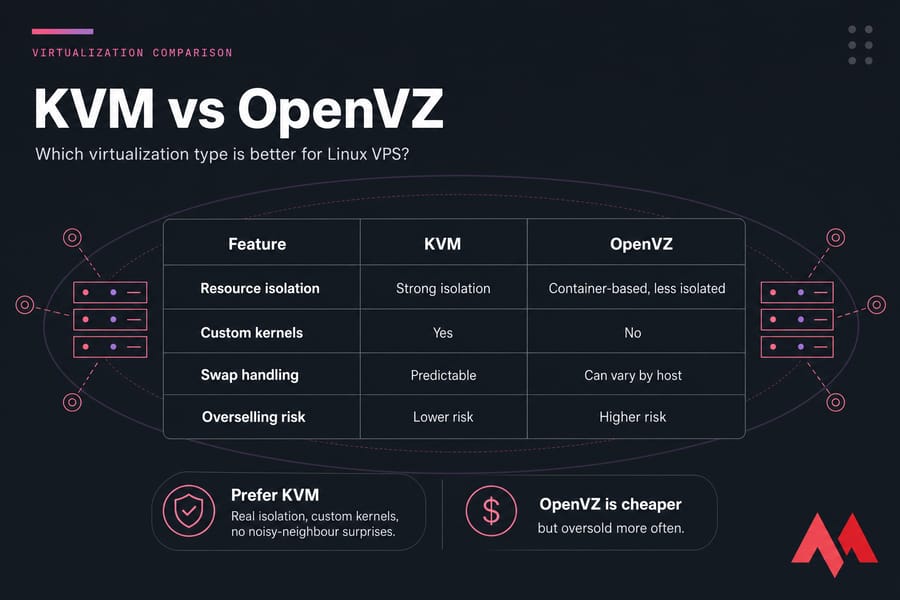
- Virtualization: prefer KVM. Real isolation, custom kernels, no noisy-neighbour surprises. OpenVZ containers are cheaper but oversold far more often.
- Storage: NVMe over SATA SSD. On database-heavy sites the difference is obvious.
- Uptime: read the SLA, not the marketing number. 99.9% still allows ~43 minutes down per month.
- Security: DDoS mitigation, snapshots, private networking, firewall controls, SSH key authentication, and 2FA on the control panel. Skip any provider without snapshot backups.
- Root access: confirm it's included on the tier you're buying, not just the top plan.
- Location and latency: a server two continents away costs you 150ms on every request.
- Support and migration: free migration assistance saves a weekend. Ask before you buy.
🐧 Best Linux Distros for VPS Hosting
Now we'll look at some of the most popular alternatives, emphasizing their benefits and optimal use scenarios:
- Ubuntu LTS: The default for a reason — biggest tutorial pool, five years of updates, everything's packaged. User-friendly interface and comprehensive documentation make setting up your server a breeze. Explore our comprehensive comparison in What is Ubuntu!
- Debian: Well-known for its persistent commitment to free software and solid security, and prioritizes server stability. Trades newness for rock-solid reliability — run it on boxes you'd rather not think about.
- AlmaLinux: A community-driven CentOS alternative created to address the vacuum left by the shift from CentOS to CentOS Stream. Learn more in What is AlmaLinux.
- Rocky Linux: Another CentOS replacement designed to replace CentOS after it shifted focus to CentOS Stream. If you prefer a ready-to-deploy image, Rocky Linux VPS hosting gets you started immediately. Read What is Rocky Linux for a detailed overview.
- OpenSUSE: A versatile and adaptable Linux distribution appropriate for a variety of applications, including server installations.
- Fedora Server: Backed by Red Hat, focuses on innovation and cutting-edge technologies. Suits developers chasing newer toolchains, but its short lifecycle makes it a poor production host. Learn more in What is Fedora Linux.
CentOS note: CentOS 7 hit end of life in mid-2024, and CentOS Stream is now an upstream preview of RHEL rather than a stable downstream clone. If you're still on old CentOS, migrate to AlmaLinux or Rocky Linux. Both offer in-place conversion scripts. Read our detailed guide: What is CentOS.
✅ What to Consider When Choosing the Best Linux VPS Hosting
There are several crucial aspects to examine so that you can make an informed selection and select the finest Linux VPS service for your needs and expectations:
- RAM Capacity: Check the amount of RAM provided by the VPS provider to make sure it fulfills the needs of your apps and workload.
- Server Uptime Reassurance: Look for suppliers who give high uptime guarantees to reduce potential downtime and keep your server available to users.
- Money-Back Guarantee: Look for suppliers who offer a money-back guarantee, which allows you to try their services risk-free.
- Reliability and Security: To secure your data and server from threats, choose providers with a reputation for dependability and strong security measures like firewalls, DDoS mitigation, and frequent security updates.
- Root Access: Make sure the VPS provider provides full root access, which allows you to customize and manage your server to your exact needs.
- 24/7 Customer Support: Choose a supplier that offers responsive and skilled customer service 24 hours a day, seven days a week.
- Scalability: Consider the provider's scalability options, including the ability to easily upgrade resources such as CPU, RAM, and storage as your needs grow over time.
- VPS Location: Evaluate the geographic location of the VPS servers offered by the provider to minimize latency and ensure optimal performance for your target audience.
🎯 Final Verdict
When picking the finest Linux VPS service, it is critical to examine RAM capacity, server uptime guarantee, dependability, security, root access, customer support, scalability, and VPS location. Here's how the providers stack up:
- Best overall: Vultr — best balance of price, locations, tooling, and predictability.
- Best managed: Liquid Web, with ScalaHosting close behind on value.
- Best budget: Hostinger for beginners, HostSailor if you truly just need cheap root.
- Best for developers: Vultr for API-driven workflows; Kamatera if you need odd resource ratios.
- Best for distro and payment flexibility: MonoVM — with 35 locations worldwide, full root access, and acceptance of Bitcoin and cryptocurrency payments alongside traditional methods.
Pick based on management level first, then location, then price. Get those three right and the rest is configuration. After thoughtful consideration, MonoVM provides a complete set of capabilities, including full SSH/Administrator access, dedicated resources, an amazing 99.9% uptime guarantee, and 24/7 customer support, making it a strong choice among Linux VPS hosting providers.


Hello, everyone, my name is Lisa. I'm a passionate electrical engineering student with a keen interest in technology. I'm fascinated by the intersection of engineering principles and technological advancements, and I'm eager to contribute to the field by applying my knowledge and skills to solve real-world problems.