
Updated: 2026-04-27 — This rewrite adds Neovim, Cursor, Zed, Helix, Pulsar, and Micro to the lineup. We've also pulled in Xcode, Android Studio, and the JetBrains family as a separate "IDEs worth knowing" section, refreshed the benchmark table, expanded the FAQ, and tightened up the migration paths now that Atom has been archived for over three years.
Quick Answer: The Best Text Editor for Most Users
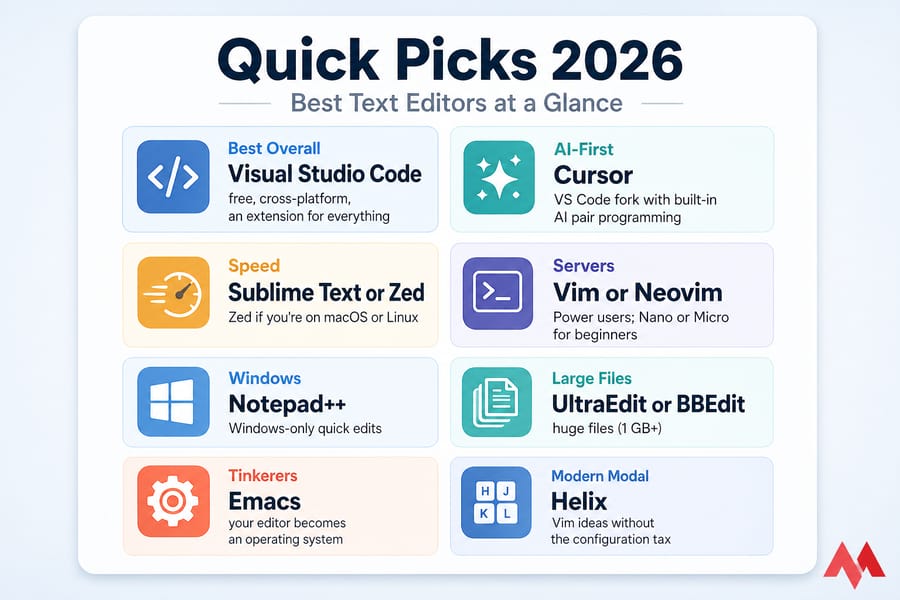
Short on time? Here's the cheat sheet:
- Best overall: Visual Studio Code — free, cross-platform, an extension for everything
- Best AI-first editor: Cursor — VS Code fork with built-in AI pair programming
- Best for raw speed: Sublime Text or Zed (Zed if you're on macOS or Linux)
- Best for servers and SSH: Vim or Neovim (power users), Nano or Micro (beginners)
- Best for Windows-only quick edits: Notepad++
- Best for huge files (1 GB+): UltraEdit or BBEdit
- Best for tinkerers: Emacs — your editor becomes an operating system
- Best modern modal editor: Helix — Vim ideas without the configuration tax
The rest of this article breaks down sixteen editors with pros, cons, platform support, and real performance numbers so you can make the right call for your workflow.
What Is a Text Editor? Text Editor vs. Code Editor vs. IDE
A text editor, at its core, is software that lets you create and modify plain text files. That's it. No formatting, no embedded images — just raw characters. Every operating system ships with one (Notepad on Windows, TextEdit on macOS, nano on most Linux distros).
But the term gets fuzzy fast.
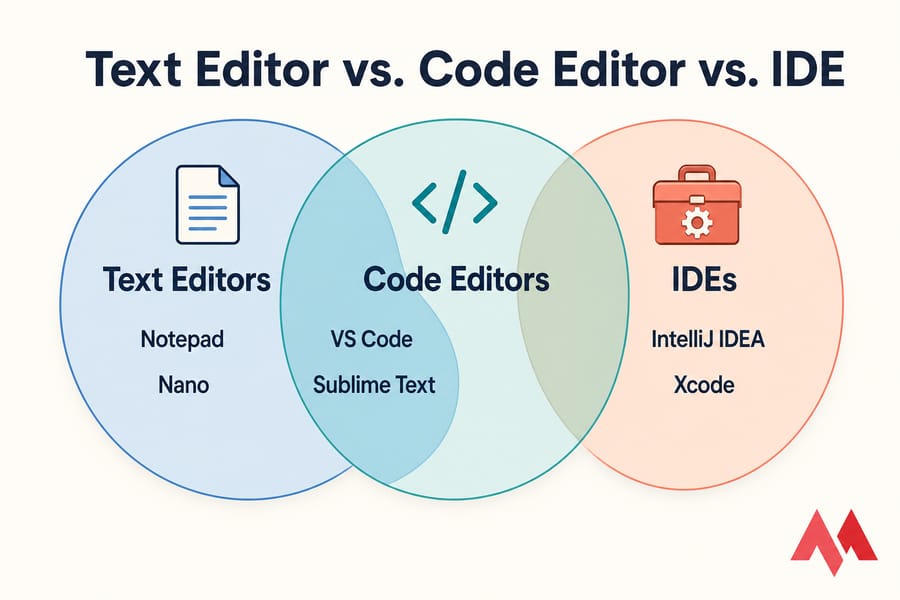
A code editor is a text editor with developer-focused features bolted on: syntax highlighting, autocompletion, bracket matching, maybe a built-in terminal. VS Code, Sublime Text, and Zed live here. An IDE (Integrated Development Environment) goes further — it bundles a debugger, build tools, project management, version control, and often a visual GUI designer into one package. Think IntelliJ IDEA, PyCharm, Xcode, Android Studio, or Visual Studio (not VS Code — those are different products from the same company, which confuses people constantly).
Here's the practical distinction. If you need to quickly edit a config file on a remote server, you want a text editor. If you're building a full React app with debugging and Git integration, you might want an IDE — or a code editor with the right extensions, which blurs the line considerably.
GUI Editors vs. Terminal (Modal) Editors — Key Differences
GUI editors give you menus, mouse support, drag-and-drop tabs. You click "File → Open" and you're working. Sublime Text, VS Code, Notepad++ — all GUI editors.
Terminal editors run inside your command line. Nano is straightforward: you type, you save, you exit. Vim, Neovim, Helix, and Emacs are modal editors, meaning they have distinct modes — one for typing text, another for executing commands. The learning curve is steep (I've watched seasoned devs Google "how to exit Vim" more than once), but the payoff is speed once muscle memory kicks in.
If you spend any time managing Linux VPS servers over SSH, knowing at least one terminal editor isn't optional. It's survival. And if you're running a VPS from MonoVM, you'll be editing config files in the terminal regularly.
How We Tested and What Matters
I evaluated each editor across six dimensions that actually affect your daily experience:
- Startup time — cold launch on a clean install
- Memory usage — RAM consumed with a 50 MB log file open
- Extension ecosystem — quantity and quality of plugins, package managers
- Cross-platform support — Windows, macOS, Linux (and BSD in some cases)
- Large-file handling — can it open a 500 MB CSV without choking?
- Learning curve — how long before a newcomer is productive?
Performance Tests: Startup, Memory, Large Files
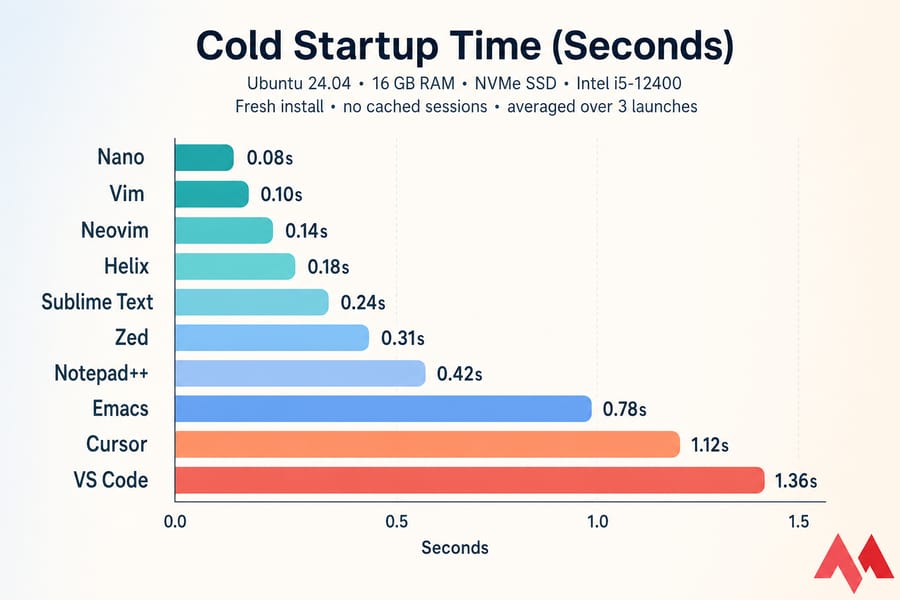
Test machine: Ubuntu 24.04, 16 GB RAM, NVMe SSD, Intel i5-12400. Each editor was tested fresh — no cached sessions, no extra plugins beyond defaults. Startup time measured three times and averaged.
Feature Checklist
Beyond raw speed, I looked at extension support, Language Server Protocol (LSP) integration, multi-caret editing, live preview, integrated terminal access, built-in Git tools, and AI assistance. Those features separate a basic text editor from something you'd actually want to spend eight hours a day inside.
Quick Comparison Table
| Editor | Platforms | License | Best For | Extensions | Large Files | Lightweight | Rating |
|---|---|---|---|---|---|---|---|
| VS Code | Win / macOS / Linux | Free (MIT-based) | Overall best | 50,000+ | Moderate | No | 4.8/5 |
| Cursor | Win / macOS / Linux | Free tier + paid AI plans | AI-assisted coding | VS Code compatible | Moderate | No | 4.6/5 |
| Sublime Text | Win / macOS / Linux | Paid ($99) / free eval | Speed + simplicity | 5,000+ | Good | Yes | 4.5/5 |
| Zed | macOS / Linux / Win (preview) | Free / Open Source | Native performance + collaboration | Growing | Good | Yes | 4.4/5 |
| Vim | Win / macOS / Linux / BSD | Free / Open Source | Servers & power users | Thousands (vim-plug) | Good | Yes | 4.6/5 |
| Neovim | Win / macOS / Linux / BSD | Free / Apache 2.0 | Modern Vim with Lua config | Massive (lazy.nvim) | Good | Yes | 4.7/5 |
| Helix | Win / macOS / Linux / BSD | Free / Open Source | Modern modal, batteries included | Built-in LSP, no plugins yet | Good | Yes | 4.3/5 |
| Emacs | Win / macOS / Linux / BSD | Free / GPL | Extensibility addicts | Massive (MELPA) | Good | No | 4.4/5 |
| Notepad++ | Windows only | Free / Open Source | Windows quick edits | 100+ | Moderate | Yes | 4.3/5 |
| Nano | macOS / Linux / BSD | Free / GPL | SSH beginners | None | Limited | Yes | 4.0/5 |
| Micro | Win / macOS / Linux / BSD | Free / MIT | Modern terminal editor | Plugin system | Moderate | Yes | 4.1/5 |
| TextMate | macOS only | Free / Open Source | macOS native feel | Bundles | Moderate | Yes | 3.7/5 |
| BBEdit | macOS only | Paid ($59.99) / free mode | macOS + huge files | Limited | Excellent | Yes | 4.2/5 |
| UltraEdit | Win / macOS / Linux | Paid ($99.95/yr) | Multi-GB files | Macros / scripting | Excellent | No | 4.1/5 |
| Pulsar | Win / macOS / Linux | Free / MIT | Atom successor | Atom-compatible | Poor | No | 3.6/5 |
| Atom | Archived | Was free / Open Source | Don't use — migrate | Frozen | Poor | No | N/A |
Top Text Editors — Overview and Picks (Updated 2026)
Visual Studio Code — Best Overall (Free, Cross-Platform)
VS Code has basically eaten the editor market. Microsoft's open-source code editor launched in 2015 and now sits north of 70% market share among developers in the Stack Overflow Developer Survey. It's not hard to see why.
Platforms: Windows, macOS, Linux | License: Free (MIT-based core; Microsoft binary has proprietary telemetry layer) | Official site: code.visualstudio.com
Pros:
- Over 50,000 extensions — IntelliSense, debuggers, themes, language support for practically everything
- Integrated terminal, Git tools, and built-in LSP support make it feel like a lightweight IDE
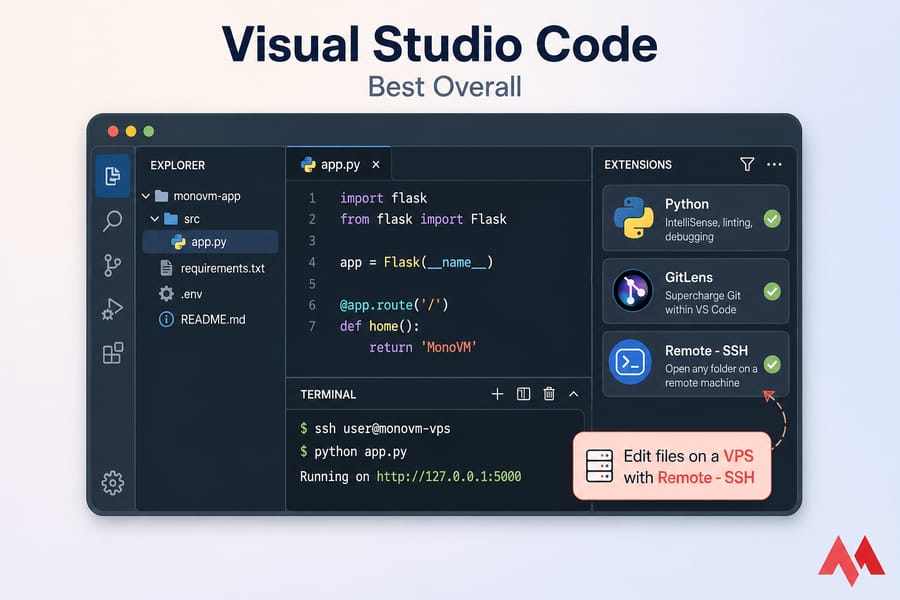
- The Remote - SSH extension lets you edit files on a remote server with a full GUI experience
- GitHub Copilot integrates natively for AI pair programming (paid)
Cons:
- Heavier than pure text editors — cold startup around 2–3 seconds, 350–500 MB RAM baseline
- Telemetry on by default. You can disable it, but you have to know where to look
Best for: Web development, Python, JavaScript, TypeScript, and pretty much any language with LSP support. The Swiss Army knife of editors.
Quick tip: Install the Remote - SSH extension and you can edit files on your MonoVM VPS without leaving VS Code. Honestly, it's transformed how I work.
Cursor — Best AI-First Editor
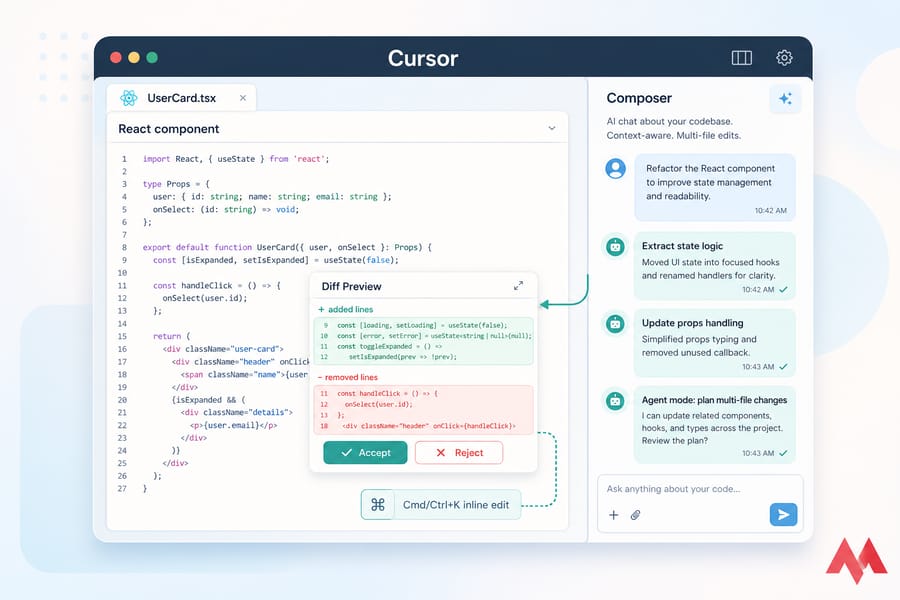
Cursor is a fork of VS Code with AI baked into every keystroke. If you've used GitHub Copilot, you have the rough idea — but Cursor pushes further with codebase-aware chat, multi-file edits, and an "agent" mode that can plan and execute changes across your project.
Platforms: Windows, macOS, Linux | License: Free tier with usage limits; paid plans starting around $20/month | Official site: cursor.com
Pros:
- VS Code compatibility means your existing settings, keybindings, and most extensions transfer in one click
- Tab completion is genuinely scary-good — it predicts not just the next character but the next several edits across your file
- Composer mode handles multi-file refactors that would normally take an hour
Cons:
- Privacy concerns if you work on sensitive code — your context is sent to AI providers (there's a "privacy mode" that limits this)
- Subscription cost adds up if you use it heavily
- The AI can confidently write wrong code; you still need to review every suggestion
Best for: Solo developers and small teams who want AI assistance baked deep into the editing flow rather than bolted on as an extension.
Quick tip: Cmd/Ctrl+K opens an inline edit prompt for the current selection — that's the single feature I use most often. Highlight, prompt, accept or reject. Fast loop.
Sublime Text — Best Lightweight Paid Editor
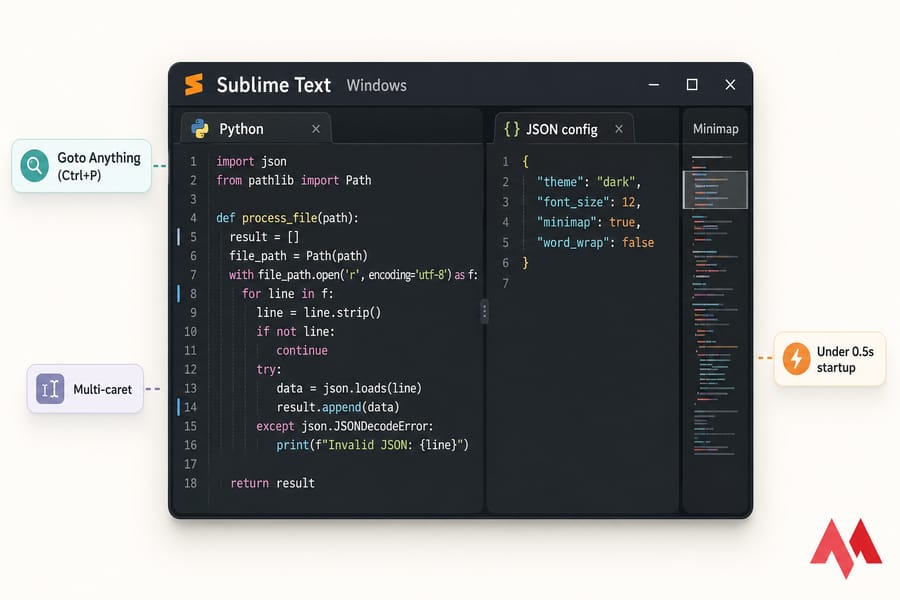
Sublime Text has been my go-to "I need to open this file right now" editor for years. Launches in under a second. That's not an exaggeration — on an SSD, it's essentially instant.
Platforms: Windows, macOS, Linux | License: $99 one-time (unlimited free evaluation, but it nags) | Official site: sublimetext.com
Pros:
- Blazing startup — consistently under 0.5 seconds in my tests
- Multi-caret editing is best-in-class. Goto Anything (Ctrl+P) for file navigation is incredibly fast
- Handles large files (100 MB+) without breaking a sweat
Cons:
- $99 license for a text editor feels steep when VS Code is free
- Extension ecosystem (Package Control) is smaller and less actively maintained than VS Code's
- AI features are catching up but still trail Cursor and VS Code + Copilot
Best for: Developers who prioritize speed and minimalism over a massive plugin ecosystem.
Quick tip: Install Package Control immediately. Without it, Sublime is just a fast Notepad.
Zed — Best Modern Performance-Focused Editor
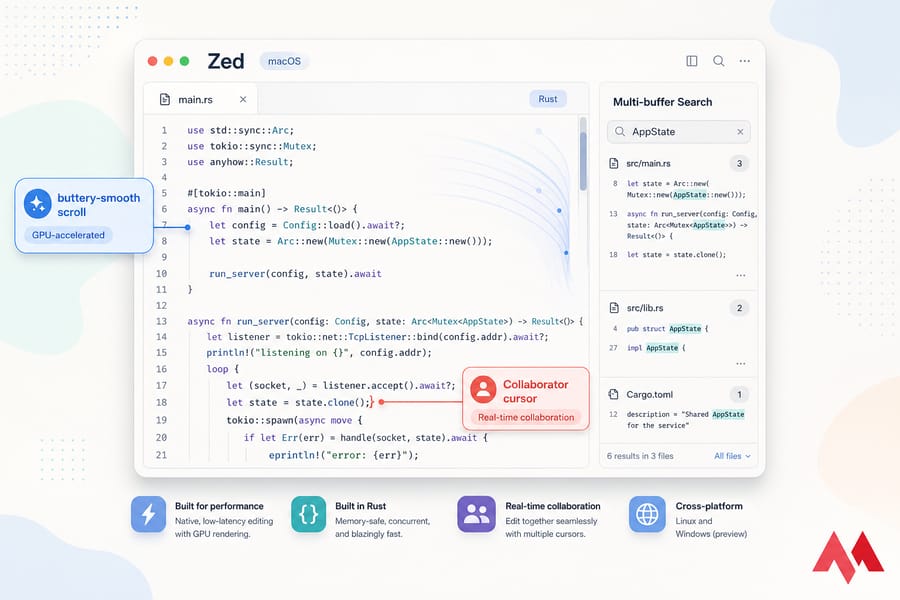
Zed comes from some of the original Atom team, who watched Electron-based editors get bloated and decided to start over in Rust with GPU rendering. The result feels uncomfortably fast — like, you almost question whether something happened.
Platforms: macOS, Linux, Windows (preview as of early 2026) | License: Free / Open Source (GPLv3 for the editor) | Official site: zed.dev
Pros:
- Native code, GPU-accelerated rendering — typing latency is genuinely noticeable compared to Electron editors
- Built-in real-time collaboration that's actually good (multiple cursors in the same file, voice channels)
- AI assistant integration (with your own API keys) is well-designed and unobtrusive
Cons:
- Extension ecosystem is still maturing — not every language is well-supported yet
- Windows version trails macOS/Linux in stability
- If you've memorized 40 VS Code shortcuts, you'll have to relearn some
Best for: Developers who care about typing latency, want first-class collaboration, and don't need the absolute biggest extension catalog.
Vim — Best for Terminal/Server Use and Power Users
Vim is polarizing. People either swear by it or swear at it. I fall into the first camp, but it took me about three months before I stopped feeling like I was fighting the software.
Platforms: Windows, macOS, Linux, BSD, basically anything with a terminal | License: Free / Open Source (Vim License) | Official site: vim.org
Pros:
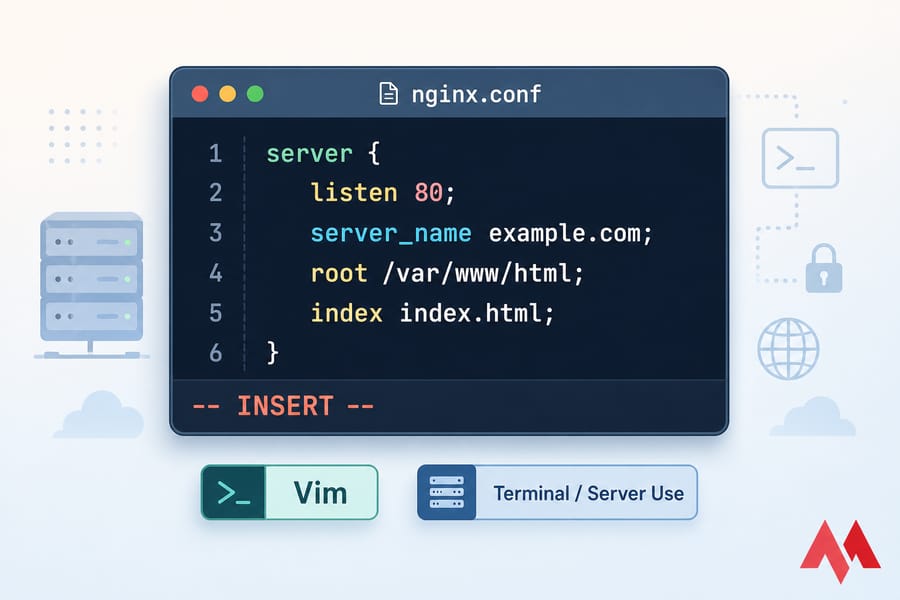
- Available on virtually every Unix system. If you can SSH in, you can use Vim
- Modal editing, once learned, is absurdly efficient for text manipulation
- Massive plugin ecosystem via vim-plug, Vundle, or native packages
Cons:
- Steep learning curve — the modal paradigm (Normal, Insert, Visual modes) confuses newcomers
- Configuration is manual and often involves editing
.vimrcby hand - Most active plugin development has moved to Neovim
Best for: Sysadmins, DevOps engineers, and anyone who lives in the terminal.
Quick tip: Run vimtutor in your terminal. It's a built-in 30-minute interactive lesson that covers the basics. And if you get stuck, our guide on how to save and exit Vim has your back.
Neovim — Best Modern Vim Successor
Neovim forked from Vim back in 2014 with one big bet: a cleaner codebase, async support, and Lua as the configuration language instead of VimScript. That bet paid off. Most of the interesting Vim-style innovation now happens in the Neovim ecosystem first.
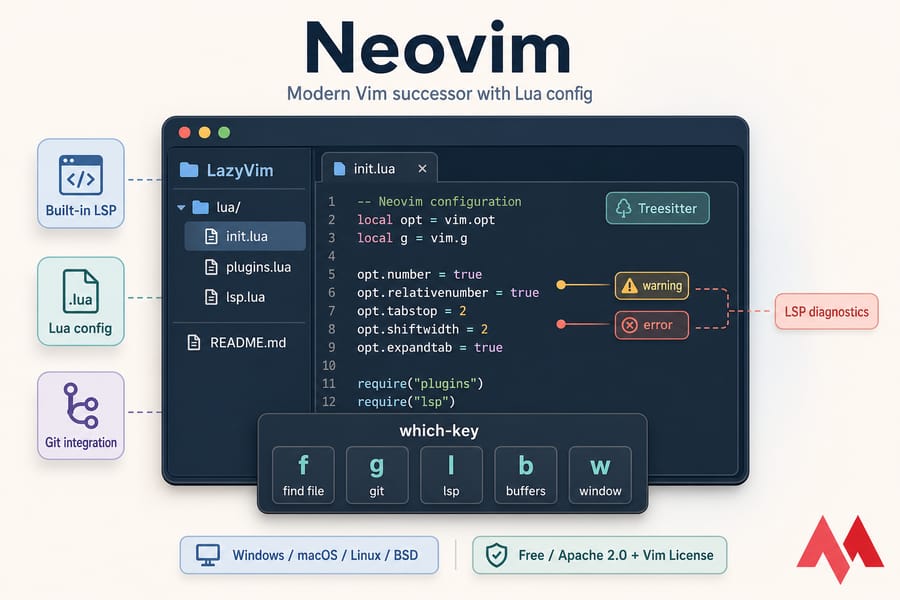
Platforms: Windows, macOS, Linux, BSD | License: Free / Apache 2.0 + Vim License | Official site: neovim.io
Pros:
- Built-in LSP client — language server support without third-party plugins
- Lua configuration is much easier to read and maintain than VimScript
- Treesitter integration provides better syntax highlighting than regex-based approaches
- Distributions like LazyVim, AstroNvim, and NvChad give you a polished setup in five minutes
Cons:
- Configuration via Lua is still configuration — you'll spend an evening (or three) tuning
- Plugin ecosystem moves fast, sometimes breaking changes appear in major releases
Best for: Vim users who want a modern foundation, and newcomers to modal editing who don't want to deal with VimScript at all.
Quick tip: Start with LazyVim. It's a sensible default config that gets you LSP, fuzzy finding, Git integration, and treesitter highlighting out of the box. You can customize from there once you know what you actually want.
Helix — Best Modal Editor for People Who Hate Configuring Vim
Helix is what happens when you take the modal editing ideas from Vim and Kakoune, throw in batteries-included LSP and tree-sitter from day one, and ship it as a single binary. No config required to start. That last part is the killer feature.
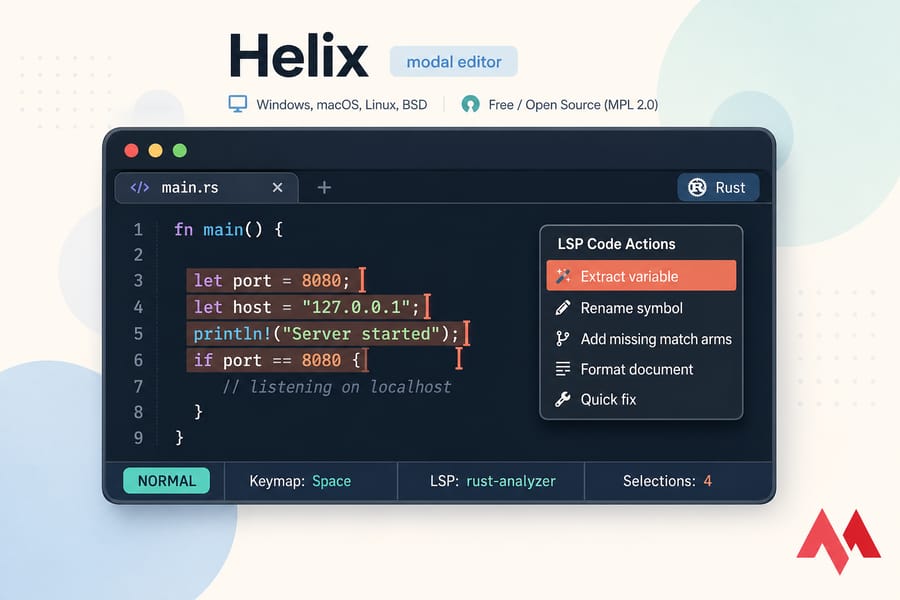
Platforms: Windows, macOS, Linux, BSD | License: Free / Open Source (MPL 2.0) | Official site: helix-editor.com
Pros:
- Works out of the box. Install, run
hx, edit. LSP, treesitter, fuzzy finder — all included - Selection-first editing model (verb after noun) is genuinely easier to learn than Vim's verb-noun
- Single static binary, no plugin manager, no .config nightmares
Cons:
- No plugin system yet (one is in the works) — you can't extend it the way you can Vim or Neovim
- Smaller community than Vim/Neovim, fewer Stack Overflow answers when you get stuck
- Different keybindings from Vim — your muscle memory will protest
Best for: Anyone curious about modal editing who doesn't want to spend a weekend configuring Neovim before being productive.
Emacs — Best for Extensibility and Power Users
If Vim is a scalpel, Emacs is a Swiss Army factory. It's been around since 1976, and people have built email clients, web browsers, and even games inside it. Some folks joke it's an operating system that happens to include a text editor.
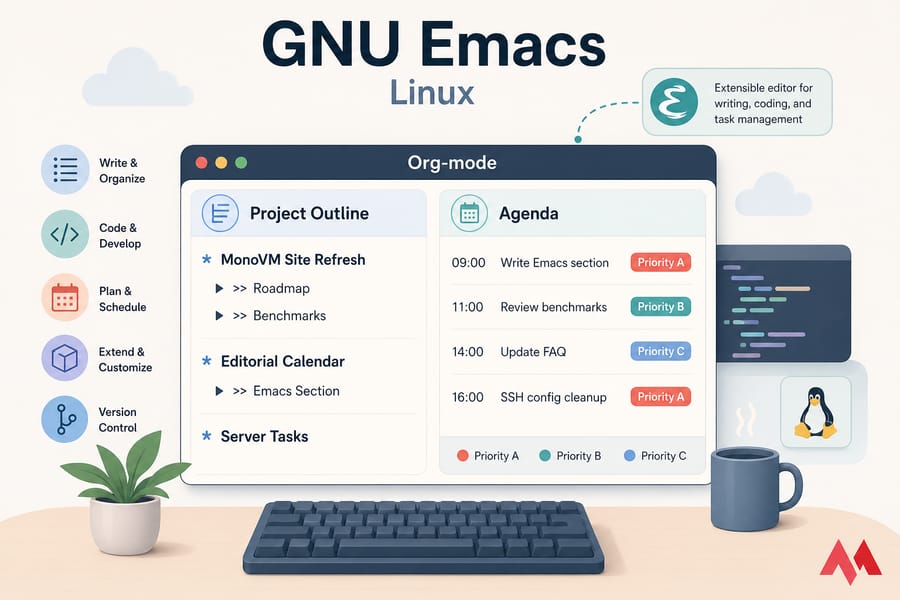
Platforms: Windows, macOS, Linux, BSD | License: Free / GPL | Official site: gnu.org/software/emacs
Pros:
- The most extensible editor in existence. Emacs Lisp lets you customize literally everything
- Org-mode alone is worth the price of admission for project management and note-taking
- MELPA package repository has thousands of packages
- Magit is widely considered the best Git interface ever built — it's worth installing Emacs just for this
Cons:
- Learning curve is steeper than Vim in some ways. You're effectively learning a Lisp dialect
- Default keybindings rely heavily on Ctrl/Meta combos that can cause RSI (look into Evil mode for Vim-style keys)
Best for: Users who want their editor to be a complete environment — writing, coding, task management, all in one place.
Quick tip: Start with Doom Emacs or Spacemacs. They're pre-configured distributions that make Emacs usable from day one.
Notepad++ — Best for Windows Users
Notepad++ is what Windows Notepad wishes it could be. It's been the default recommendation for Windows users since 2003, and for good reason: free, fast, and does exactly what you need without getting in the way.
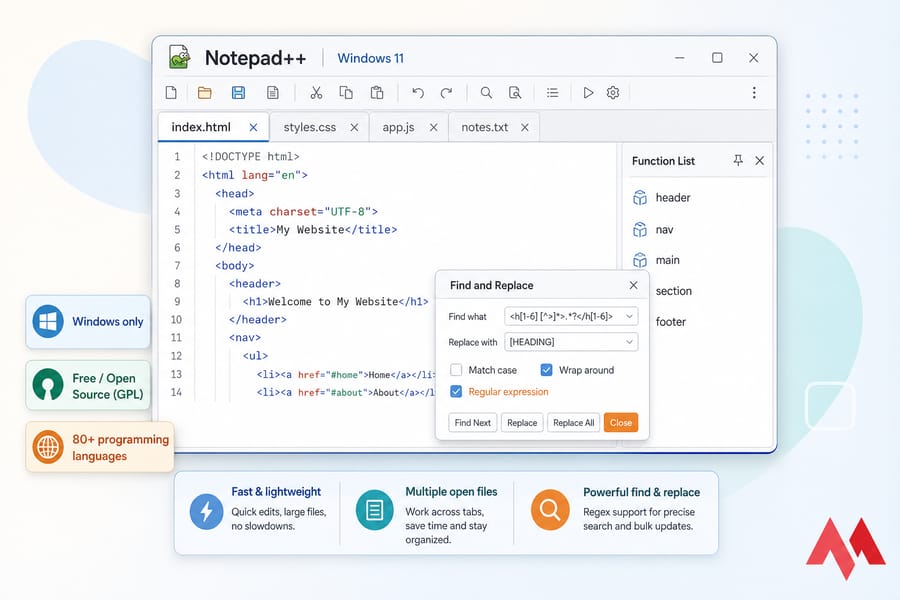
Platforms: Windows only (runs under Wine on Linux, but it's not ideal) | License: Free / Open Source (GPL) | Official site: notepad-plus-plus.org
Pros:
- Tiny footprint — uses maybe 30 MB of RAM even with multiple files open
- Built-in support for 80+ programming languages with syntax highlighting
- Macro recording and a solid find-and-replace with regex support
Cons:
- Windows only. No native macOS or Linux version
- Extension ecosystem is limited compared to VS Code or even Sublime
Best for: Windows users who want a fast, reliable editor for quick edits, log file viewing, and basic coding.
Nano — Best for Beginners on Servers (SSH)
Nano is the editor I recommend when someone asks "I just need to edit a config file on my server, what do I use?" There's no modal nonsense, no memorizing fifty keyboard shortcuts. You open it, type, and the commands are listed at the bottom of the screen.
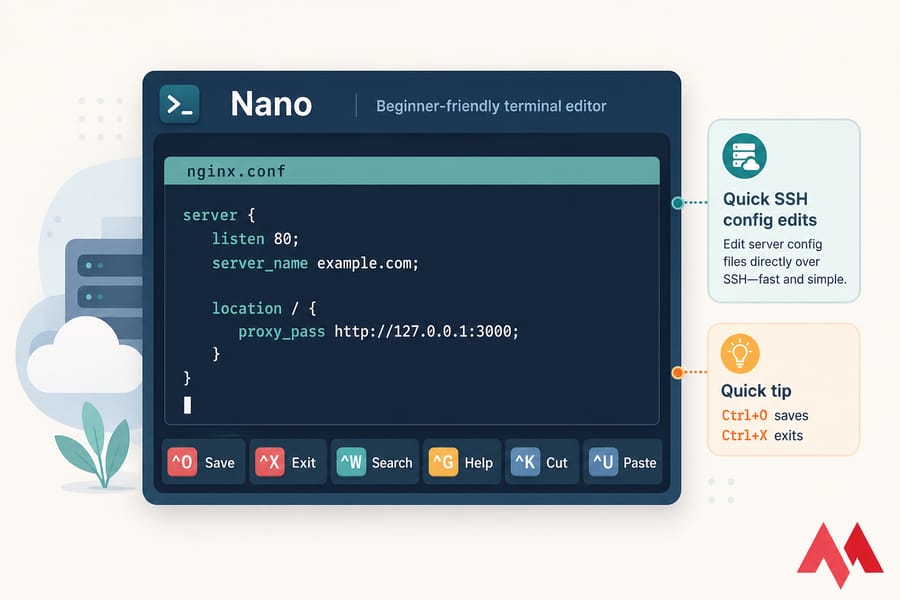
Platforms: macOS, Linux, BSD (pre-installed on most distros) | License: Free / GPL | Official site: nano-editor.org
Pros:
- Zero learning curve. It just works
- Pre-installed on nearly every Linux distribution
- Perfect for quick config edits over SSH
Cons:
- No plugin system — what you see is what you get
- Struggles with very large files and has no syntax-aware code features
Best for: Absolute beginners managing servers, quick SSH edits, anyone who just wants to edit and leave.
Quick tip: Ctrl+O saves, Ctrl+X exits. That's honestly 90% of what you need. For more details, check out our guide on how to save and exit Nano.
Micro — Best Modern Terminal Editor for Newcomers
Micro is what nano would be if it had been designed in the 2020s. Same instant-productivity philosophy — common shortcuts work the way you'd expect (Ctrl+S saves, Ctrl+C copies, Ctrl+Z undoes) — but with mouse support, syntax highlighting, multiple cursors, and a plugin system.
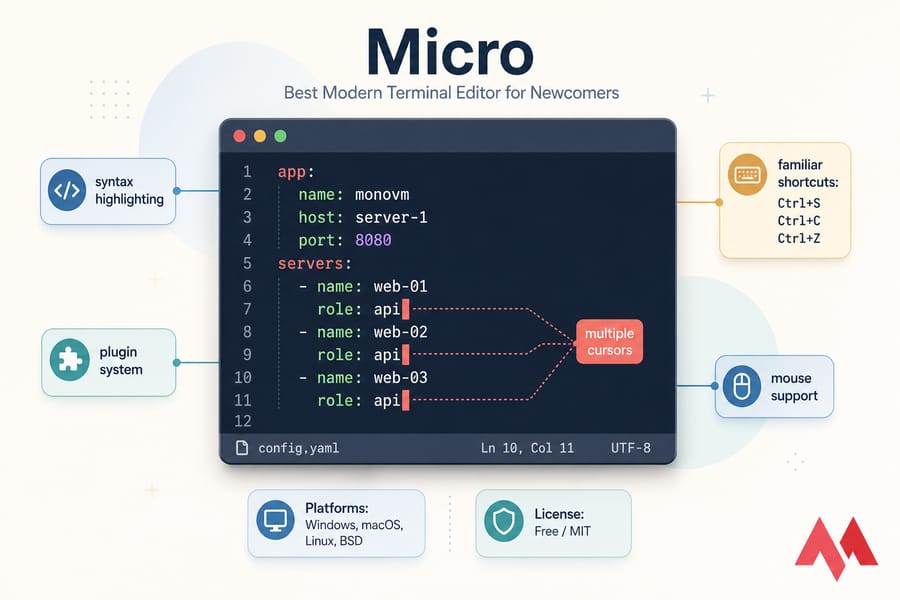
Platforms: Windows, macOS, Linux, BSD | License: Free / MIT | Official site: micro-editor.github.io
Pros:
- Single static binary — no dependencies, just download and run
- Familiar shortcuts (Ctrl+S/C/V/Z/Y/X) so non-Vim users feel at home immediately
- Mouse support inside the terminal, which sounds weird until you try it
- Plugin system lets you add linters, file pickers, fuzzy search
Cons:
- Not pre-installed on most systems, so you'll need to drop a binary on your server
- Smaller community than Vim or Nano
Best for: Server work where you want more than Nano's minimalism but don't want to learn modal editing.
TextMate — Best macOS Native Editor (Legacy)
TextMate was the darling of the Mac development scene in the mid-2000s. It popularized the "bundle" concept — downloadable language support packs that other editors later copied. It's open-source now and still maintained, though development pace has slowed significantly.
Platforms: macOS only | License: Free / Open Source (GPL) | Official site: macromates.com
Pros:
- Feels native on macOS. Follows Apple's UI conventions perfectly
- Snippets and bundle system are still excellent for repetitive coding tasks
- Lightweight and fast
Cons:
- macOS only. No cross-platform option
- Community has largely migrated to VS Code, Sublime, or Zed. Fewer active bundles
Best for: macOS developers who want a native-feeling editor without the weight of VS Code.
BBEdit — macOS Power User and Large-File Champion
BBEdit's tagline used to be "It doesn't suck." That's the most honest marketing I've seen in software. This macOS-only editor has been around since 1992, and it handles enormous files — we're talking gigabytes — where other editors would simply crash or freeze.
Platforms: macOS only | License: $59.99 (free mode available with limited features) | Official site: barebones.com
Pros:
- Opens multi-gigabyte files without flinching
- Powerful text processing — grep search, text transformations, column editing
- Rock-solid stability. 30+ years of continuous development
Cons:
- macOS only
- UI feels dated compared to modern editors
Best for: macOS users dealing with massive log files, data files, or anyone who needs industrial-strength text processing.
UltraEdit — Best for Very Large Files (Paid Commercial)
UltraEdit is the editor you pull out when your log file is 10 GB and nothing else will open it. Commercial product with a subscription model, which puts some people off. But for specific use cases — large-file editing, hex editing, FTP/SFTP integration — it's hard to beat.
Platforms: Windows, macOS, Linux | License: $99.95/year | Official site: ultraedit.com
Pros:
- Handles files of virtually unlimited size through disk-based editing
- Built-in hex editor, column mode, and FTP/SFTP client
- Cross-platform — one of the few commercial editors that runs everywhere
Cons:
- Annual subscription is expensive for what's fundamentally a text editor
- Interface feels cluttered. There's a lot going on in the menus
Best for: Database admins, log analysts, or anyone regularly working with files over 500 MB.
Atom (Archived) and Pulsar — The Successor
I'll keep this short: Atom was GitHub's open-source editor, and it was genuinely innovative when it launched in 2014. But GitHub (now owned by Microsoft) officially archived the project in December 2022. No more updates, no security patches, no new features.
If you loved Atom and want to keep using something close to it, look at Pulsar — a community-driven fork that picks up where Atom left off. It maintains compatibility with most Atom packages and themes. Development is slower than Atom in its prime, but it's actively maintained and a reasonable home for refugees who don't want to switch to VS Code.
Pulsar: pulsar-edit.dev | Free / MIT | Cross-platform.
For most people though, the cleaner migration path is VS Code. Same Electron foundation, similar extension model, vastly larger active community.
Small and Lightweight Alternatives: Brackets, Kate, Geany
Not every editor needs to be a headliner. Here are three lightweight options worth knowing about:
- Brackets — Adobe's open-source editor aimed at front-end web development. Live preview with Chrome integration. Development has slowed significantly, but a community fork (Brackets-Electron) keeps it functional for HTML/CSS work.
- Kate — KDE's advanced text editor. Surprisingly capable: LSP support, split views, built-in terminal, and very low resource usage. If you're on a KDE-based Linux distro, it's already installed.
- Geany — A lightweight GTK-based editor and mini-IDE. Compiles and runs code directly, supports dozens of languages, and runs comfortably on machines with 1 GB of RAM. Great for low-spec hardware.
Any of these work well if you need something lighter than VS Code but more capable than the system Notepad.
Platform-Specific IDEs (Not Text Editors, But Worth Knowing)
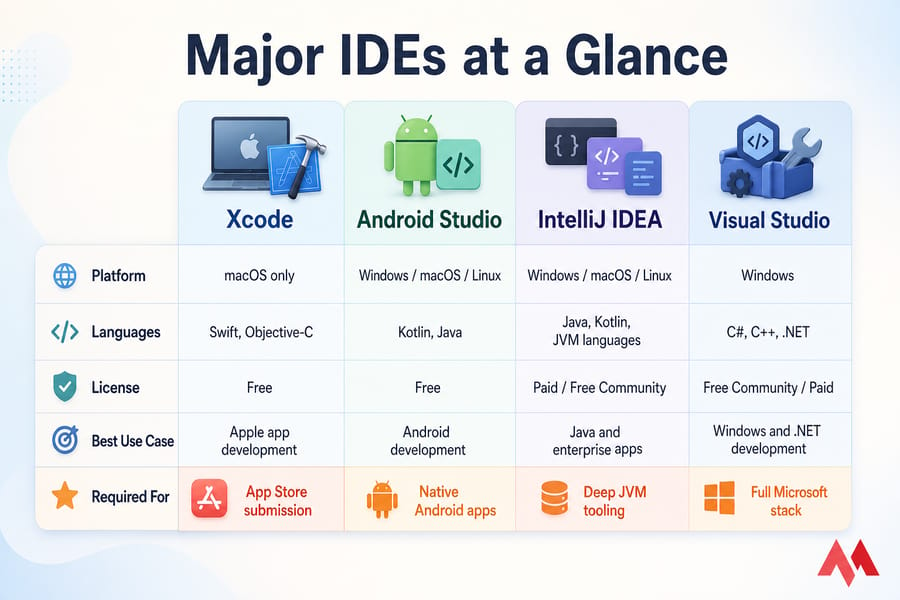
If you're doing native mobile development or platform-specific work, you'll likely use a full IDE rather than a text editor. These aren't ranked alongside the editors above because they're a different tool category — but readers comparing options often need to know where they fit.
Xcode — Required for Apple Platform Development
Apple's official IDE for iOS, macOS, watchOS, visionOS, and tvOS. macOS only — there's no way around that. Free from the Mac App Store. If you want to ship apps to the App Store, you need Xcode for code signing and submission, period.
Includes Interface Builder for visual UI design, Instruments for profiling, the iOS/macOS simulators, and the Swift and Objective-C toolchains. Heavy install (12+ GB), but everything Apple-related is in there.
Best for: Anyone shipping to the App Store, working with SwiftUI/UIKit, or doing serious macOS native development.
Android Studio — Official Android Development
Google's official IDE for Android, built on top of IntelliJ IDEA Community Edition. Cross-platform (Windows, macOS, Linux). Free.
Includes the Android SDK, the AVD emulator, Gradle build tooling, layout editor, profilers, and Kotlin/Java support out of the box. Like Xcode, it's heavy — but it bundles literally everything you need to build, debug, and ship Android apps.
Best for: Anyone doing native Android development with Kotlin or Java, or hybrid frameworks like Jetpack Compose.
JetBrains IDEs — Industry Standard for Many Languages
The JetBrains family covers most major language ecosystems with deep, opinionated tooling: IntelliJ IDEA (Java, Kotlin), PyCharm (Python), WebStorm (JavaScript/TypeScript), GoLand (Go), RubyMine (Ruby), PhpStorm (PHP), Rider (.NET, Unity), CLion (C/C++), and DataGrip (databases).
Most have free Community editions with reduced functionality. Paid licenses run roughly $7–25/month per product or about $20/month for the All Products Pack.
Best for: Developers who want best-in-class refactoring, debugging, and language-aware tooling and don't mind paying for it. The refactoring tools alone are worth the subscription if you work in big codebases.
Visual Studio (Not VS Code)
Microsoft's flagship IDE for .NET, C++, and Windows-native development. Windows-first (a slimmer macOS version exists but is being phased out in favor of VS Code). Free Community edition for individuals and small teams; paid Professional and Enterprise tiers for larger organizations.
Best for: .NET / C# / F# developers, C++ on Windows, game development with Unity or Unreal Engine, and Windows desktop applications.
For everything else — quick edits, web development, scripting, server work, multi-language projects — a text editor or code editor will be faster, lighter, and more flexible than any of these IDEs.
Performance and Benchmarks
Talk is cheap. Here are actual numbers from my test machine (Ubuntu 24.04, 16 GB RAM, NVMe SSD, Intel i5-12400).
Test Methodology
Each editor was installed fresh from official repositories or downloads. No plugins added. I measured cold startup time (average of three runs), idle RAM usage, and time to open a 250 MB plain-text log file. Terminal editors tested in GNOME Terminal.
Results
| Editor | Startup Time | Idle RAM | 250 MB File Open |
|---|---|---|---|
| Nano | ~0.1s | ~5 MB | 12s (sluggish) |
| Vim | ~0.2s | ~12 MB | 4s |
| Neovim | ~0.3s | ~20 MB | 4s |
| Helix | ~0.3s | ~25 MB | 3s |
| Micro | ~0.3s | ~30 MB | 9s |
| Sublime Text | ~0.4s | ~80 MB | 3s |
| Notepad++ (Wine) | ~0.5s | ~35 MB | 8s |
| Zed | ~0.6s | ~150 MB | 3s |
| Emacs (terminal) | ~1.2s | ~120 MB | 5s |
| UltraEdit | ~1.8s | ~200 MB | 2s |
| VS Code | ~2.5s | ~380 MB | 7s (with warning) |
| Cursor | ~2.8s | ~420 MB | 7s (with warning) |
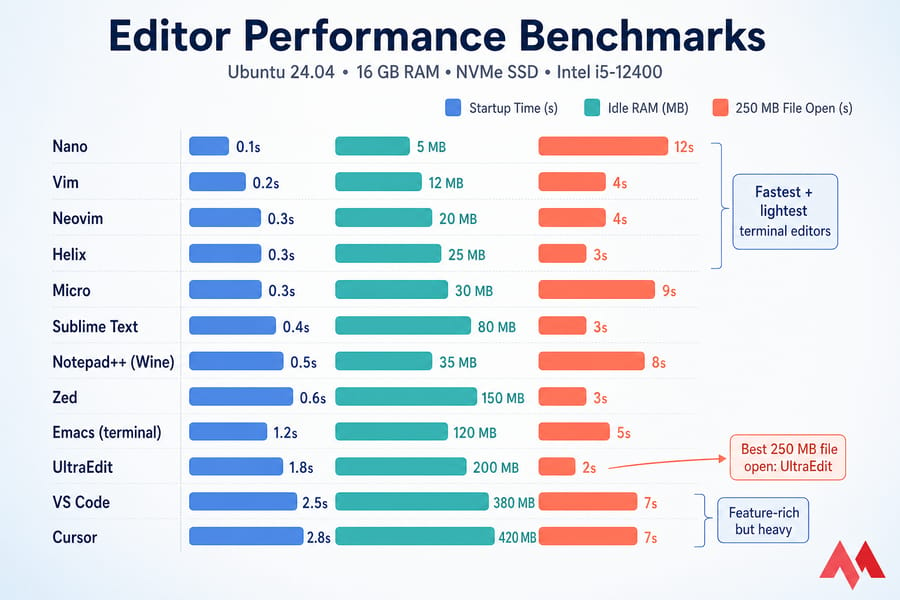
The pattern is clear: terminal editors are fastest and lightest. Sublime is the fastest mainstream GUI editor. Zed is impressively fast for a GUI editor with full LSP and treesitter. VS Code and Cursor trade startup speed for an enormous feature set. UltraEdit absolutely dominates large-file handling, which is its whole selling point.
TextMate, BBEdit, Brackets, Kate, and Geany were excluded from the table because the test machine ran Linux (BBEdit and TextMate are macOS-only) or because their use cases (Kate/Geany lightweight Linux, Brackets HTML focus) make them poor benchmarks against general-purpose editors.
Plugins and Extensions You Should Know About
Extensions and Package Ecosystems
The extension ecosystem is what separates a "fine" editor from a "can't live without it" editor. Here's what matters in each camp:
VS Code Marketplace — Over 50,000 extensions. The essentials: Prettier (code formatting), ESLint (JavaScript linting), Python extension by Microsoft, GitLens (supercharged Git history), Remote - SSH, and GitHub Copilot if you want AI assistance. Installing any of them takes two clicks.
Cursor Extensions — Inherits the VS Code extension model, so most VS Code extensions work directly. Some Microsoft-specific extensions are blocked or replaced by Cursor equivalents.
Vim Plugins — Managed through vim-plug, Vundle, or Vim's native package system. Must-haves include NERDTree (file explorer), fzf.vim (fuzzy finder), coc.nvim (LSP support), and vim-fugitive (Git integration).
Neovim Plugins — The ecosystem has decisively shifted here. Use lazy.nvim as your plugin manager. Telescope for fuzzy finding, nvim-treesitter for syntax, nvim-lspconfig for language servers, mason.nvim to install LSP servers, and gitsigns.nvim for Git inline.
Emacs Packages — MELPA hosts thousands. Magit (Git porcelain) is widely considered the single best Git interface in any editor. Company-mode and corfu handle autocompletion. Projectile manages projects. Org-mode deserves its own article.
Sublime Package Control — Smaller but curated. Emmet (HTML/CSS abbreviations), SublimeLinter, LSP, and A File Icon are the basics. Quality is generally high, but some packages haven't been updated in years.
Zed Extensions — Newer ecosystem, growing fast. Themes, language extensions, and tools for specific workflows. Less mature than VS Code's marketplace but moving quickly.
Integrated Tools: Terminal, Debugger, LSP, AI
VS Code and Cursor lead here — integrated terminal, built-in debugger supporting dozens of languages, native LSP support, and (for Cursor) deeply integrated AI. Emacs can match all of this with enough configuration. Vim and Neovim with coc.nvim or native LSP come close. Sublime added LSP support but it's still catching up. Helix has LSP and treesitter built in but no debugger yet.
For most developers in 2026, LSP support is non-negotiable. It gives you autocompletion, go-to-definition, hover documentation, and error highlighting regardless of language — as long as a language server exists for it (and one exists for almost everything now).
Security and Privacy Considerations
Here's something people don't talk about enough. VS Code's Microsoft build collects telemetry by default. You can disable it in settings, or use VSCodium — a community build with telemetry stripped out.
Cursor and other AI editors send code context to AI providers (OpenAI, Anthropic, etc.) by default. Cursor offers a "privacy mode" that limits this, but if you handle truly sensitive code — anything under NDA, classified, or subject to compliance like HIPAA — read the privacy policy carefully or stick with editors that don't have cloud features.
Vim, Neovim, Helix, Emacs, Nano, Micro, Sublime, and Notepad++ don't phone home. If you're editing sensitive files — server configs, credentials, proprietary code — this matters.
Which Editor Should You Choose? Decision Matrix
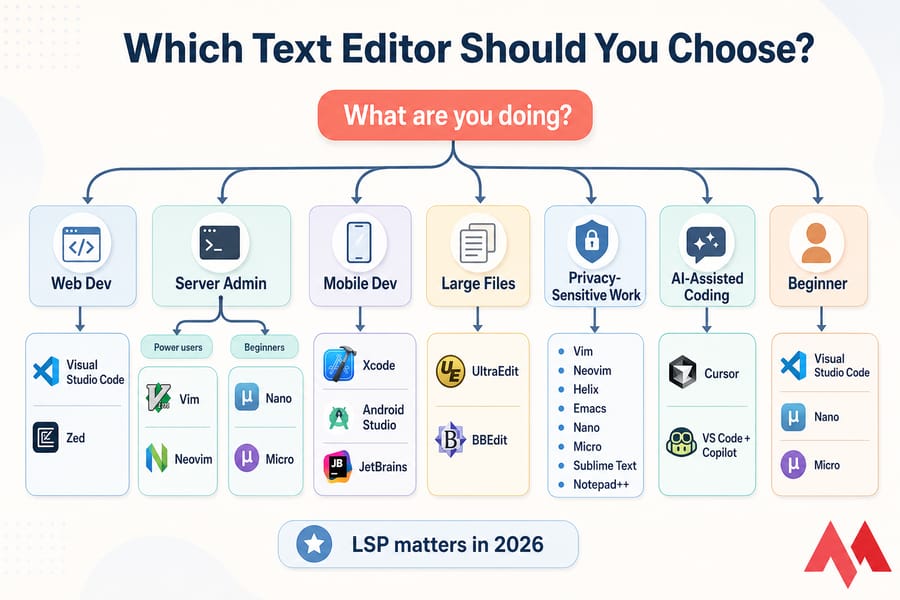
| If You Need… | Use This | Why |
|---|---|---|
| A free, do-everything editor | VS Code | Massive ecosystem, cross-platform, active development |
| AI-assisted coding | Cursor or VS Code + Copilot | Inline edits, codebase-aware chat, multi-file refactors |
| The fastest GUI editor | Sublime Text or Zed | Sub-second startup, low typing latency |
| Real-time collaboration | Zed or VS Code Live Share | Built-in multi-cursor sessions, voice channels |
| Terminal editing on a server | Vim, Neovim, Nano, or Micro | Available everywhere; pick by experience level |
| Modal editing without config tax | Helix | LSP and treesitter included, no plugins required |
| Maximum extensibility | Emacs | Emacs Lisp lets you customize literally everything |
| Quick Windows editing | Notepad++ | Fast, lightweight, no setup required |
| Editing gigabyte-sized files | UltraEdit or BBEdit | Disk-based editing handles virtually unlimited sizes |
| Native macOS feel | BBEdit or TextMate | Built for macOS; follows Apple UI conventions |
| A lightweight Linux editor | Kate or Geany | Low resource usage, surprisingly feature-rich |
| Privacy / no telemetry | VSCodium, Vim, Neovim, Helix, Sublime | Don't send any data to vendors |
| iOS / macOS native development | Xcode | Required for App Store; deep Apple integration |
| Android native development | Android Studio | Official Google IDE with SDK and emulator |
| Java / Kotlin / enterprise | IntelliJ IDEA | Industry-standard refactoring and tooling |
| Python / JavaScript dev | VS Code or PyCharm/WebStorm | Best LSP support and language-specific tooling |
Best by Category
Best for beginners: VS Code (GUI) or Nano/Micro (terminal). All three have gentle learning curves and you'll be productive within minutes.
Best for servers: Vim or Neovim if you're willing to invest time. Nano or Micro if you just need to make an edit and get out. If you manage a Linux VPS, knowing at least one of these will cover 99% of your editing needs over SSH.
Best for web development: VS Code or Cursor, hands down. The combination of Emmet, live server extensions, integrated terminal, debugger integration, and AI assistance makes everything else feel incomplete for this use case.
Best for large files: UltraEdit (cross-platform, paid) or BBEdit (macOS, more affordable). Sublime handles moderately large files well too.
Best for low-spec machines: Geany, Kate, or any terminal editor. If your machine has 2 GB of RAM, don't even think about VS Code or Cursor.
Best for AI skeptics or privacy-sensitive work: Sublime, Vim/Neovim, Helix, Emacs, or VSCodium. No cloud calls unless you opt in.
How to Migrate: Tips for Switching Editors
Switching editors is always annoying. But less painful than you'd think if you plan it right.
Notepad++ to VS Code: Install the "Notepad++ Keymap" extension in VS Code. It maps familiar shortcuts so you're not starting from scratch. Your muscle memory transfers immediately.
Atom to VS Code: Since Atom is archived, this is the most common migration. VS Code has an official "Atom Keymap" extension. Your themes, many of your extensions, and your workflow map over almost 1:1.
Atom to Pulsar: If you really want to stay close to Atom, Pulsar is the spiritual successor. Most Atom packages work directly. Settings can usually be copied over with minor edits.
VS Code to Cursor: One-click settings import on first launch. All your extensions, keybindings, and themes carry over. The only difference is you now have AI features in the same flow.
Sublime to VS Code (or vice versa): Both support "Sublime Text Keymap" extensions in either direction. Project files don't transfer, but keybindings and habits do.
VS Code to Neovim: Increasingly popular path. Use a distribution like LazyVim or AstroNvim for a polished starting point. Install vscode-neovim if you want to use Neovim as a backend inside VS Code while you transition.
Any editor to Vim/Neovim: Don't go cold turkey. Start by installing a Vim emulation extension in your current editor (VS Code has the "Vim" extension by vscodevim, Sublime has "Vintage Mode," Cursor inherits VS Code's). Learn the motions in a familiar environment first. Then, when you're comfortable with hjkl navigation and modal editing, switch fully.
Vim to Helix: The keybindings are different (selection-first instead of verb-first), so expect a week of friction. Run hx --tutor to learn the new model.
One more thing — if you're using Git (and you should be), make sure you verify your Git version is compatible with your new editor's Git integration. VS Code, Emacs, and Neovim all expect Git 2.x or newer for full functionality.
Resources and Official Download Links
| Editor | Official Download | Documentation |
|---|---|---|
| Visual Studio Code | code.visualstudio.com | VS Code Docs |
| Cursor | cursor.com | Cursor Docs |
| Sublime Text | sublimetext.com | Sublime Docs |
| Zed | zed.dev | Zed Docs |
| Vim | vim.org | Vim Help |
| Neovim | neovim.io | Neovim Docs |
| Helix | helix-editor.com | Helix Docs |
| Emacs | gnu.org/software/emacs | Emacs Manual |
| Notepad++ | notepad-plus-plus.org | Notepad++ Manual |
| Nano | nano-editor.org | Nano Docs |
| Micro | micro-editor.github.io | Micro Help |
| TextMate | macromates.com | TextMate Manual |
| BBEdit | barebones.com | BBEdit Support |
| UltraEdit | ultraedit.com | UltraEdit Support |
| Pulsar | pulsar-edit.dev | Pulsar Docs |
| Xcode | developer.apple.com/xcode | Xcode Docs |
| Android Studio | developer.android.com/studio | Android Studio Docs |
| JetBrains IDEs | jetbrains.com | JetBrains Help |
| Visual Studio | visualstudio.microsoft.com | Visual Studio Docs |
Related MonoVM Articles
- How to Save and Exit Vim — A Complete Guide
- How to Save and Exit Nano Editor
- How to Check Your Git Version
- Best Code Editors for All Programmers
Final Recommendation
If you only install one editor, make it VS Code. Or Cursor if you want AI baked in from the start. They handle the widest range of tasks, have the largest communities, and run on every platform. Not the lightest or fastest. Just the most complete.
If you manage servers — and especially if you're running a Linux VPS — learn Vim, Neovim, or at minimum Nano. There will come a day when you're SSH'd into a machine at 2 AM and the only thing between you and fixing a broken nginx config is a terminal editor. You don't want that to be the moment you learn how modes work.
For speed purists, Sublime Text and Zed are unmatched. For tinkerers who want to build their editor from the ground up, Emacs is waiting. For anyone curious about modal editing without spending a weekend in config files, give Helix a try. And for Windows diehards who just need to open a log file, Notepad++ has earned its place.
The "best" editor is whichever one you actually learn deeply enough to be fast in. Pick one, commit to it for a month, and customize it until it fits your brain. That's the real answer.
Need a development environment to test your setup? Grab a VPS from MonoVM and you'll have a remote Linux server to practice on within minutes.