Virtualization remains a foundational technology for modern cloud infrastructure, VPS hosting, and enterprise IT environments. Even in Xen vs KVM 2025, these two hypervisors continue to dominate discussions among system administrators, DevOps teams, and cloud providers. While containers and Kubernetes have reshaped application deployment, hypervisors still sit at the core of infrastructure performance, security, and scalability.
In this guide, we break down KVM vs Xen from a real world hosting and cloud provider perspective. We analyze architecture, benchmarks, Xen vs KVM performance, security trade offs, and current usage trends. Most importantly, we help you decide which hypervisor fits your specific use case today.
Quick Comparison of KVM vs Xen
Below is a quick high level comparison before diving deeper into each technology.
|
Feature |
KVM |
Xen |
|
Hypervisor type |
Kernel integrated |
Bare metal type 1 |
|
Performance overhead |
Low |
Medium due to Dom0 |
|
Guest OS compatibility |
Unmodified OS |
Paravirtualized or HVM |
|
Security model |
Linux kernel based |
Strong isolation via domains |
|
Cloud adoption |
Very high |
Declining but still used |
|
Best for |
VPS hosting, cloud workloads |
Legacy enterprise, isolation focused use cases |
|
Cost efficiency |
High |
Moderate |
|
Ease of management |
Easier with Linux tooling |
More complex |
This table reflects why KVM is better than Xen for many modern hosting environments, especially cloud and VPS platforms.
What Is KVM?
Kernel based Virtual Machine, commonly referred to as KVM, is a Linux virtualization technology that transforms the Linux kernel into a full featured hypervisor. Unlike traditional standalone hypervisors, KVM is built directly into the Linux kernel, making it deeply integrated with the operating system.

KVM allows a single physical server to run multiple isolated virtual machines, each with its own operating system, CPU, memory, storage, and network interfaces.
KVM relies on hardware assisted virtualization technologies such as Intel VT x and AMD V. These extensions allow near native performance for virtual machines, which plays a major role in Xen vs KVM performance comparisons.
How KVM Works with QEMU
KVM does not work alone. It is commonly paired with QEMU, which handles hardware emulation. This relationship is often misunderstood, leading to confusion around KVM vs QEMU.
KVM provides CPU virtualization and memory isolation, while QEMU emulates devices like disks, network cards, and BIOS. Together, they form a complete virtualization stack. Without KVM, QEMU runs purely in software and is much slower.
This tight integration explains why KVM vs QEMU is not a fair comparison. QEMU is not a standalone hypervisor in modern cloud setups.
Common KVM Use Cases
KVM is widely adopted across modern infrastructure, including:
- VPS hosting platforms
- Public and private cloud environments
- Proxmox clusters
- Kubernetes worker nodes
- High performance application hosting
MonoVM relies heavily on KVM due to its performance, scalability, and cost efficiency. If you want a deeper technical explanation, refer to MonoVM’s guide on What is KVM Virtualization, which explains how KVM powers modern virtual machine hosting.
What Is Xen?
Xen is an open source, type 1 hypervisor that runs directly on bare metal hardware. Unlike KVM, Xen does not rely on a host operating system. Instead, it sits between the hardware and guest operating systems, managing CPU, memory, and device access directly.

Xen introduced the concept of domains. The first domain created at boot time is Domain 0, also called Dom0. Dom0 has special privileges and is responsible for managing hardware drivers, creating guest virtual machines, and handling I O operations.
Guest virtual machines run in unprivileged domains known as DomU.
Xen Virtualization Modes
Xen supports two main virtualization approaches:
Paravirtualization requires modifying the guest operating system so it can interact directly with the hypervisor. This reduces overhead and improves performance but limits compatibility.
While Xen was once known for superior performance, modern hardware and kernel improvements have shifted Xen vs KVM performance results in favor of KVM for most workloads.
Where Xen Is Still Used
Xen remains present in certain environments:
- Legacy enterprise infrastructure
- High isolation workloads
- Older cloud platforms
- Specialized security focused deployments
However, adoption has declined in favor of KVM, especially among cloud and VPS providers.
Xen vs KVM Architecture Explained
Understanding architecture is critical when comparing difference between Xen and KVM. Their design philosophies are fundamentally different.
Xen Architecture Explained
Xen uses a microkernel style architecture. The hypervisor itself is small and focused on CPU scheduling and memory management. Device drivers and management tools live in Dom0.
This separation provides strong isolation between guest virtual machines. If one guest crashes, it does not directly affect others. This architecture historically fueled the belief that Xen is more secure.
However, Dom0 introduces complexity and overhead. Since Dom0 handles most I O operations, it becomes a performance bottleneck under heavy workloads.
KVM Architecture Explained
KVM integrates virtualization directly into the Linux kernel. There is no separate management domain like Dom0. Device drivers, scheduling, and memory management are handled by the kernel itself.
This architecture reduces overhead and simplifies management. It also allows KVM to benefit from continuous Linux kernel improvements, which is a major reason Xen vs KVM 2025 comparisons favor KVM.
KVM vs Xen Performance Benchmarks and Reality
Performance is one of the most searched aspects of Xen vs KVM. While benchmarks vary, real world usage tells a clear story.
CPU Performance
KVM generally delivers better CPU performance due to direct kernel scheduling and CPU pinning capabilities. Xen does not support CPU pinning as flexibly, which impacts high CPU workloads.
In most Xen vs KVM performance tests, KVM shows lower latency and better throughput under load.
Disk I O Performance
Disk performance is similar when both use modern storage backends. However, KVM benefits from direct access to Linux block devices and storage optimizations.
Xen relies on Dom0 for disk operations, adding an extra layer that can reduce performance under heavy I O.
Network Throughput
KVM assigns virtual network interfaces directly through Linux networking stacks. Xen uses virtual bridges managed by Dom0.
In high traffic environments, KVM typically delivers higher throughput and lower latency. This is a key reason cloud providers favor KVM for VPS hosting.
Latency Sensitive Workloads
Applications like databases, gaming servers, and real time analytics benefit from KVM’s lower overhead. This is one of the strongest arguments in why KVM is better than Xen discussions.
KVM vs Xen Security Comparison
Security is often misunderstood in the Kvm vs xen security debate. Xen has long been considered more secure due to its isolation model, but reality is more nuanced.
Isolation Models
Xen isolates guest virtual machines through its domain architecture. KVM isolates VMs as Linux processes using cgroups, namespaces, and SELinux.
Both models are secure when properly configured.
Attack Surface
Xen’s Dom0 increases the attack surface. If Dom0 is compromised, all guest VMs are at risk.
KVM benefits from the Linux security ecosystem, including rapid patching and hardened kernel configurations.
CVE Handling and Patching
KVM vulnerabilities are often patched quickly as part of Linux kernel updates. Xen patches may take longer to deploy due to architectural complexity.
In modern hosting environments, Kvm vs xen security favors KVM when combined with up to date kernels and proper hardening.
To learn more, you can read our guide on KVM vs VMware.
KVM vs Xen Cost Considerations
Kvm vs xen cost is another critical factor. Both hypervisors are open source, but operational costs differ.
KVM reduces costs by:
- Simplifying management
- Reducing overhead
- Integrating with existing Linux tooling
- Supporting automation at scale
Xen often requires specialized expertise and more complex setups, increasing operational expenses.
This cost advantage plays a major role in KVM’s dominance among VPS and cloud providers.
KVM vs Xen in 2025: Current Usage Trends
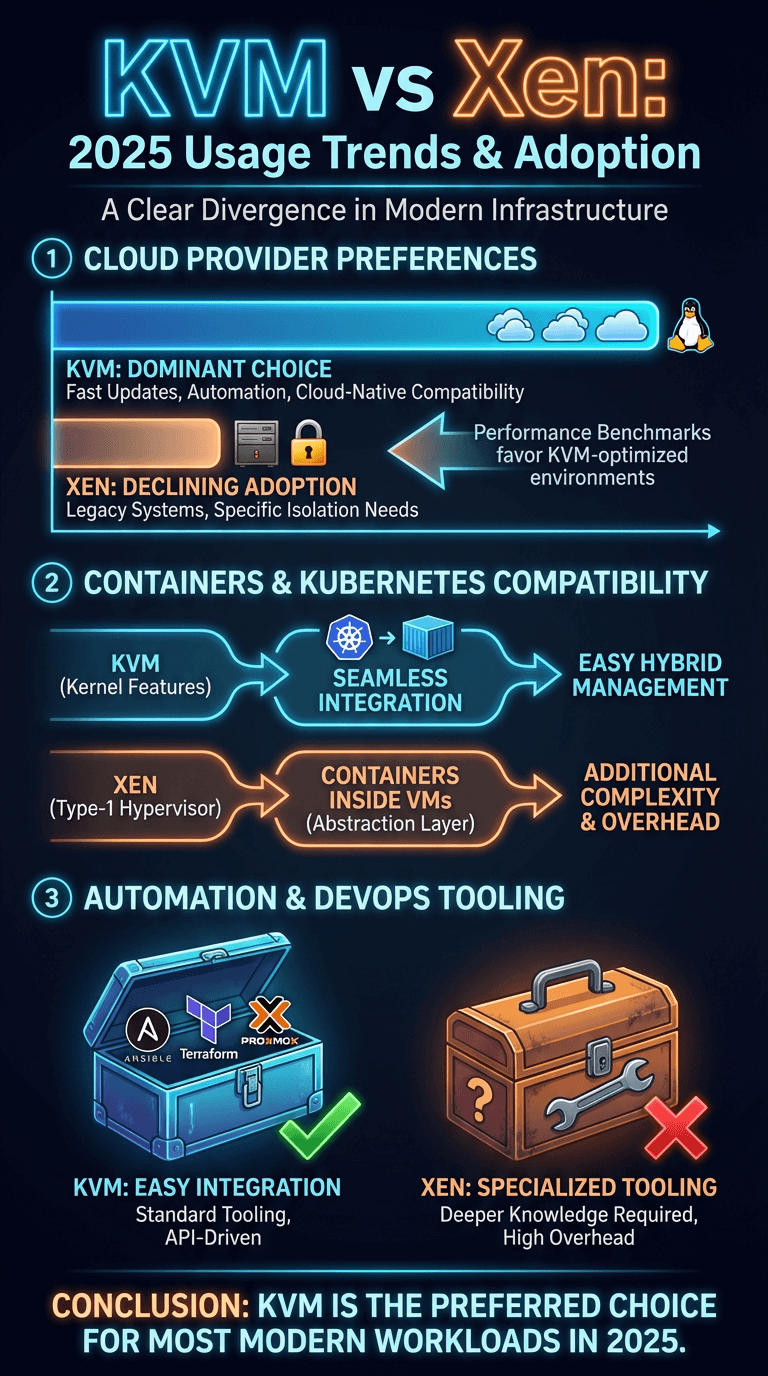
When evaluating Xen vs KVM 2025, one of the most telling indicators is real world adoption. While both hypervisors are mature and stable, their trajectories have diverged significantly over the past few years.
Cloud Provider Preferences
KVM integrates directly with Linux, which dominates cloud infrastructure. This tight integration enables faster updates, easier automation, and better compatibility with cloud native tooling.
Xen, while still present in some legacy cloud environments, has seen declining adoption. Some providers continue using Xen due to historical reasons or specific isolation requirements, but new deployments overwhelmingly favor KVM.
This shift strongly influences Xen vs KVM performance discussions, since benchmarks increasingly reflect KVM optimized environments.
Containers and Kubernetes Compatibility
Another major factor in Xen vs KVM comparisons is containerization. Kubernetes and container based workloads are now standard in modern infrastructure.
KVM works seamlessly alongside containers because both rely on Linux kernel features such as cgroups and namespaces. This makes hybrid environments easier to manage, where virtual machines and containers coexist on the same host.
Xen can run containers inside virtual machines, but it does not integrate as naturally with container orchestration platforms. This creates additional layers of abstraction and operational complexity.
Automation and DevOps Tooling
Automation is essential in 2025. Infrastructure as Code, CI CD pipelines, and API driven provisioning are no longer optional.
KVM integrates easily with tools like Ansible, Terraform, and cloud management platforms. Proxmox further simplifies this by offering a management layer built on KVM.
Xen environments often require specialized tooling and deeper hypervisor knowledge, which increases operational overhead.
These trends further explain why KVM is better than Xen for most modern workloads.
KVM vs Xen vs Proxmox vs QEMU Explained
One of the most searched topics today is Kvm vs xen vs proxmox, often mixed with confusion around KVM vs QEMU. Understanding how these technologies relate is essential.
Proxmox vs KVM
Proxmox is not a hypervisor by itself. It is a virtualization management platform that uses KVM as its primary hypervisor and LXC for containers.
When users compare Proxmox vs KVM, they are often comparing a management layer to the underlying hypervisor. Proxmox simplifies KVM usage by providing a web interface, clustering, backups, and high availability features.
This means Proxmox is not an alternative to KVM. It is built on top of KVM.
Kvm vs xen vs proxmox
In a direct Kvm vs xen vs proxmox comparison:
- KVM is the hypervisor
- Xen is an alternative hypervisor
- Proxmox is a platform that uses KVM
KVM vs QEMU
Another common misconception is KVM vs QEMU. QEMU is an emulator and hardware abstraction layer. KVM provides hardware acceleration.
Without KVM, QEMU runs entirely in software and performs poorly. With KVM enabled, QEMU leverages CPU virtualization extensions for near native performance.
In modern environments, KVM and QEMU work together, not against each other. This is why KVM vs QEMU is not a true comparison.
Which One Should You Choose? Decision Matrix
Choosing between Xen and KVM should be based on practical needs rather than outdated assumptions.
Choose KVM If
KVM is the better choice if you need:
- VPS hosting or cloud workloads
- High performance applications
- Easy automation and orchestration
- Cost efficient scaling
- Compatibility with Proxmox and Kubernetes
This is why most VPS providers and cloud platforms rely on KVM today. It consistently wins in Xen vs KVM performance, Kvm vs xen cost, and ecosystem support.
Choose Xen If
Xen may still be suitable if you require:
- Extremely strong isolation
- Legacy enterprise environments
- Specific compliance requirements
- Existing Xen based infrastructure
However, for new deployments, Xen is rarely the first choice.
|
Use Case |
Best Choice |
|
VPS hosting |
KVM |
|
Cloud infrastructure |
KVM |
|
Performance critical apps |
KVM |
|
Legacy enterprise systems |
Xen |
|
Container heavy workloads |
KVM |
|
Cost sensitive projects |
KVM |
This table reflects real world usage trends in Xen vs KVM 2025.
Common Mistakes When Choosing Between KVM and Xen
Many infrastructure decisions fail due to outdated assumptions. Here are the most common mistakes.
Relying on Old Benchmarks
Older benchmarks often show Xen outperforming KVM. Modern hardware and kernel improvements have reversed many of those results. Always evaluate Xen vs KVM performance using recent data.
Overestimating Security Differences
While Kvm vs xen security is an important topic, both hypervisors are secure when properly configured. Xen is not automatically safer than KVM.
Ignoring Ecosystem and Tooling
A hypervisor does not exist in isolation. Automation, monitoring, backups, and support matter just as much as raw performance.
Ignoring ecosystem compatibility often leads to higher long term costs.
Conclusion
The difference between xen and kvm is no longer just architectural. It is about ecosystem maturity, performance efficiency, automation readiness, and cost effectiveness.
In Xen vs KVM 2025, KVM clearly leads in cloud adoption, VPS hosting, and performance sensitive workloads. Xen still has niche use cases, but for most users, KVM delivers better results with less complexity.
At MonoVM, we specialize in high performance KVM based solutions designed for reliability and growth. If you are ready to deploy fast and reliable infrastructure, check out our KVM VPS solutions or visit MonoVM for professional virtual machine hosting.

An experienced tech and developer blog writer, specializing in VPS hosting and server technologies. Fueled by a passion for innovation, I break down complex technical concepts into digestible content, simplifying tech for everyone.