If you felt like you lost your reliable foundation after CentOS took an unexpected turn, you know exactly why we’re here today. In 2025, the market for RHEL-based distributions is hotter than ever, with two major names, AlmaLinux and Rocky Linux, competing for the top spot. The key question is: which one is better suited for your project? In this post from MonoVm, we’ll provide a complete AlmaLinux vs Rocky Linux comparison, covering everything from compatibility and performance to migration tools and support, so you can make the best choice for your server and environment.
What Is AlmaLinux?
When CloudLinux noticed the gap left after CentOS was discontinued, it was the first to act, introducing AlmaLinux with the slogan "Linux for the community, by the community." A key point about AlmaLinux is its strong focus on stability and compatibility. In 2023, when Red Hat restricted direct access to RHEL source code, the Alma team decided to move away from "bug-for-bug" copying and instead focus on maintaining ABI compatibility.
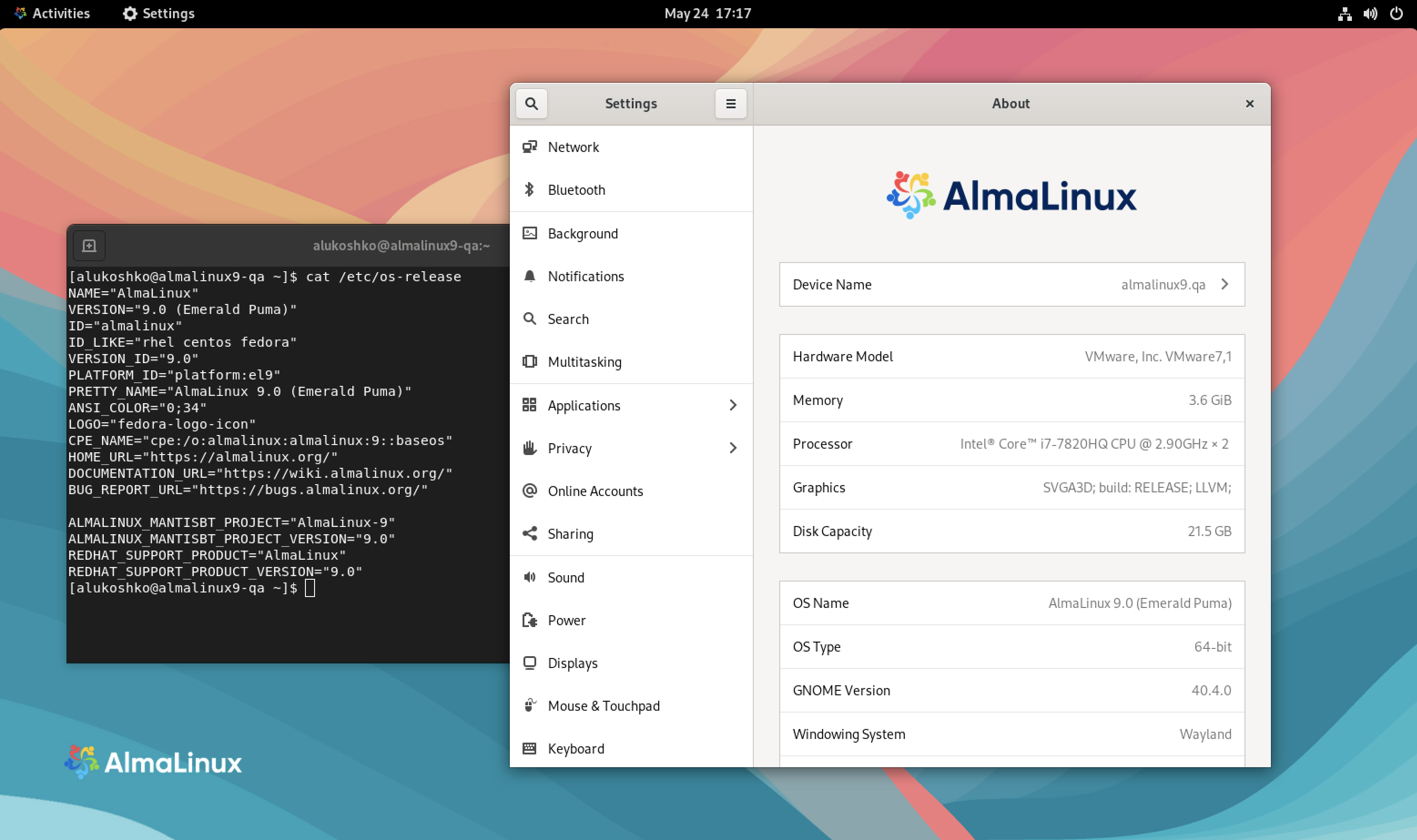
This means that software written for RHEL can run on AlmaLinux, while Alma can release security patches faster or fix bugs that Red Hat has not yet addressed.
AlmaLinux’s technical structure is now highly advanced, using its AlmaLinux Build System (ALBS), which is fully transparent and auditable. This distribution is optimized not only for standard servers but also for supercomputers, workstations, and even Raspberry Pi devices.
Pros and Cons of AlmaLinux
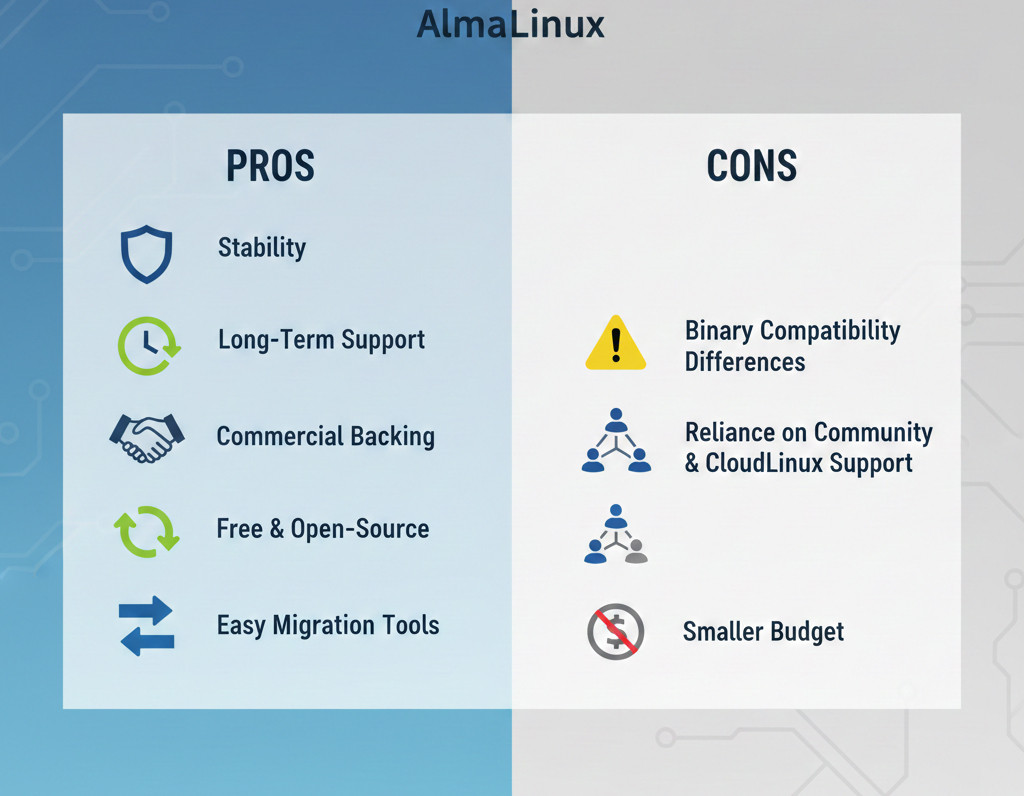
Let's list the most important advantages and disadvantages of AlmaLinux.
Pros of AlmaLinux
AlmaLinux offers several advantages that make it a compelling choice for organizations seeking stability and continuity. Key benefits include:
- High Stability and Reliability: Built on the proven foundations of RHEL, AlmaLinux offers strong stability and dependable performance in enterprise environments.
- Long-Term Support: Provides around a 10-year lifecycle with regular updates, usually released within a day of RHEL updates.
- Commercial Backing: Supported by CloudLinux and the non-profit AlmaLinux Foundation, ensuring professional support and sustainable resources.
- Free and Open-Source: Completely free, with a steadily growing community of developers and users contributing to its ecosystem.
- Easy Migration Tools: Tools like ELevate simplify upgrading from CentOS and similar distributions, making transitions straightforward.
These strengths make AlmaLinux not only a reliable enterprise platform but also a flexible and community-driven solution for long-term use.
Cons of AlmaLinux
While AlmaLinux offers many advantages, it also has some distinctions and considerations worth noting:
- Binary Compatibility: AlmaLinux focuses on binary compatibility rather than being a strict 1:1 clone of RHEL, so minor differences may exist but rarely affect usage.
- Community and CloudLinux Support: It relies on community contributions and the CloudLinux team to obtain RHEL source code, ensuring stability and consistency.
- Financial Investment: Although supported by CloudLinux, AlmaLinux’s budget is smaller than some competitors, around $1 million per year.
For more details about AlmaLinux and its features, you can read our what is AlmaLinux article.
What Is Rocky Linux?
On the other side, Rocky Linux stands as a distribution that considers itself the "true successor to CentOS." Gregory Kurtzer, the original founder of CentOS, when he saw his project take a different path, introduced Rocky Linux in memory of his late co-founder, Rocky McGough. The distribution was launched with the slogan "a community-owned operating system" and quickly gained popularity among those dissatisfied with Red Hat’s decisions. Its main goal is to provide a 100% compatible, drop-in replacement for RHEL.
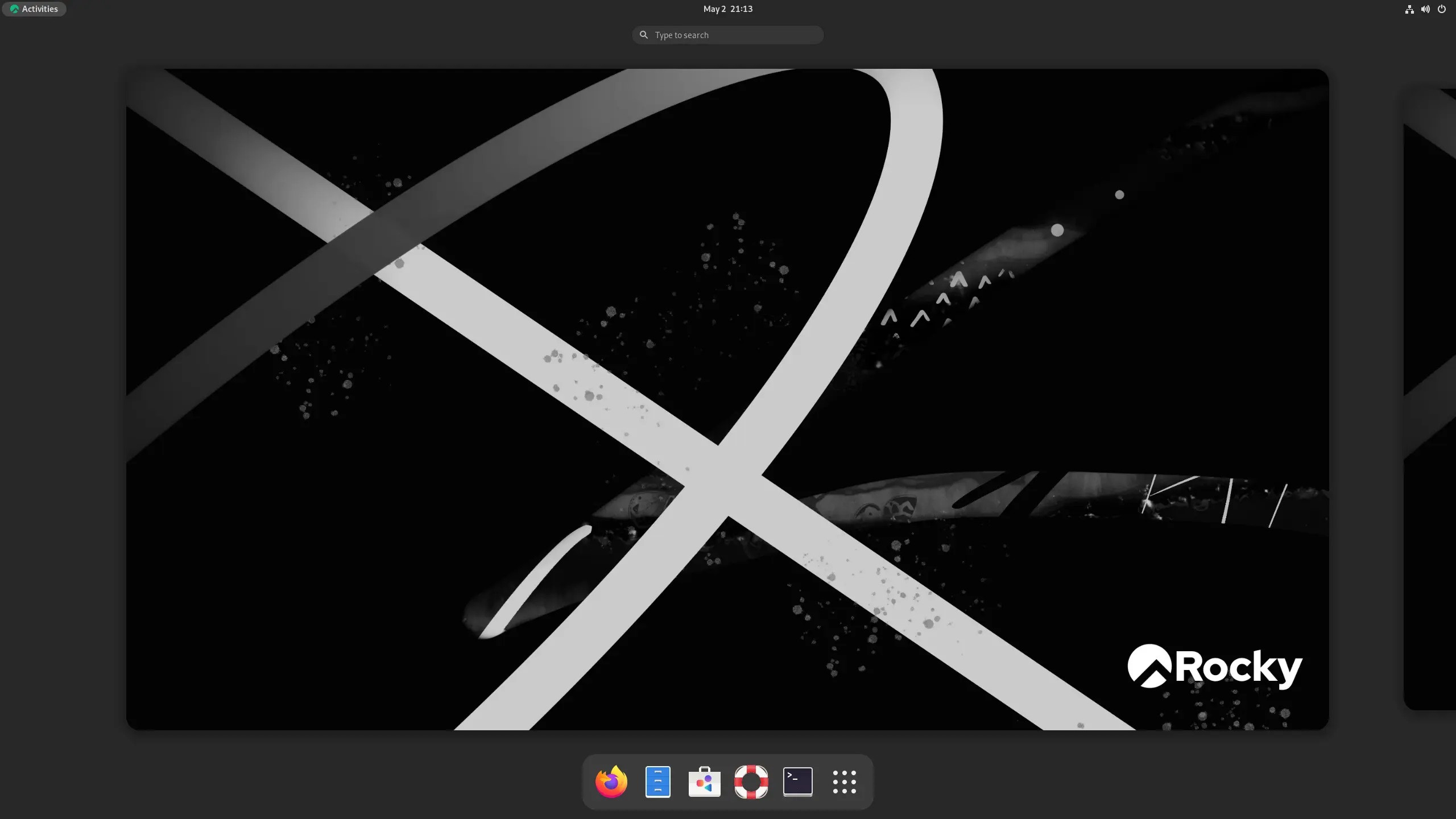
One of Rocky Linux’s greatest strengths in 2025 is its modern build system called Peridot, which allows it to convert source code into installable packages with high speed and precision. Rocky Linux is now recognized as a leading platform for high-performance computing (HPC) and artificial intelligence in many data centers worldwide.
Pros and Cons of Rocky Linux
Rocky Linux also has its own advantages and disadvantages that we need to consider.
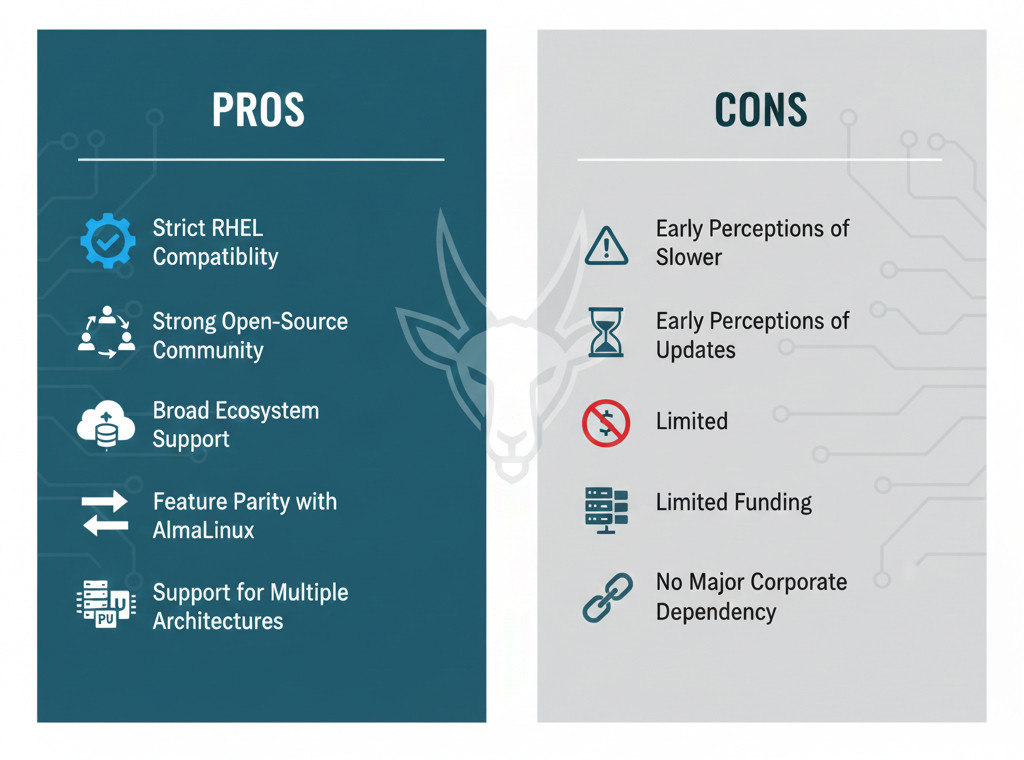
Pros of Rocky Linux
Rocky Linux offers several advantages that make it a strong choice for enterprises and organizations seeking a reliable RHEL-compatible platform. Key benefits include:
- Strict compatibility with RHEL: Rocky Linux has consistently aimed to be a bug-for-bug clone, meaning each RHEL update is rebuilt as accurately as possible to minimize any differences from the original system.
- Strong presence in the open-source community: With the founder of CentOS behind the project, Rocky Linux quickly gained attention and trust from long-time CentOS users.
- Broad ecosystem support: Despite not being backed by a single large corporation, several major organizations and technology partners (such as NVIDIA and Google Cloud) have officially certified their applications for Rocky Linux.
- Feature parity with AlmaLinux: Rocky Linux offers the same core capabilities, including a 10-year release lifecycle and updates with minimal delay.
- Wide range of supported architectures and platforms: Like AlmaLinux, Rocky Linux provides builds for x86_64, aarch64, ppc64le, and s390x architectures.
Together, these strengths demonstrate why Rocky Linux is a trusted and versatile option for a wide range of enterprise and cloud environments.
Cons of Rocky Linux
While Rocky Linux has many strengths, there are a few considerations and limitations to be aware of:
- Early Perceptions of Slower Updates: Initially, some users felt Rocky Linux updates were slower than AlmaLinux due to thorough testing, but recent releases (from version 9.0 onward) have minimized delays.
- Limited Funding: Rocky Linux has received about $26 million from CIQ and sponsors, which is modest compared to some competitors, though its active community helps compensate.
- No Major Corporate Dependency: While lacking formal corporate backing, the growing list of partners shows increasing enterprise support and adoption.
For more in-depth information about Rocky Linux and its technical details, you can read our what is Rocky Linux article.
AlmaLinux vs Rocky Linux: Key Differences
You might think that since both distributions are based on RHEL, they are practically the same. But no! Let me break down these differences into a few key layers for you.
|
Feature |
AlmaLinux |
Rocky Linux |
|
Initial Release |
March 2021 |
June 2021 |
|
Founder / Origin |
CloudLinux → AlmaLinux Foundation |
Greg Kurtzer (CentOS founder) |
|
Governance Model |
Non-profit 501(c)(6) foundation with strong community-driven governance and no direct corporate ownership |
RESF foundation with centralized control around the founder and commercial backing from CIQ |
|
Project Goal |
Provide a stable, enterprise-grade, open-source RHEL-compatible distribution |
Act as a direct CentOS replacement with maximum fidelity to RHEL |
|
RHEL Compatibility Approach |
ABI-compatible – focuses on ensuring RHEL applications run seamlessly |
Bug-for-bug compatible (1:1 clone of RHEL) |
|
Post–Red Hat Policy Strategy |
Builds from multiple trusted sources (RHEL + CentOS Stream) to ensure continuity and stability |
Rebuilds RHEL precisely using UBI containers and legally accessible cloud sources |
|
Release Lifecycle |
10 years (aligned with RHEL) |
10 years (aligned with RHEL) |
|
Release & Update Speed |
Very fast – typically ~1 day behind RHEL |
Very fast – often same day or less than 1-day delay |
|
Performance |
Nearly identical to RHEL; no noticeable differences in enterprise workloads |
Nearly identical to RHEL; well-suited for heavy workloads |
|
Stability Focus |
Strong emphasis on long-term stability, similar to classic CentOS |
Strong emphasis on long-term stability, similar to classic CentOS |
|
Supported Architectures |
x86_64, aarch64, ppc64le, s390x |
x86_64, aarch64, ppc64le, s390x |
|
Hosting Ecosystem Adoption |
Strong presence in hosting environments due to CloudLinux roots |
Strong adoption in cloud and HPC environments |
|
Control Panel Support |
Fully supported by cPanel, DirectAdmin, Plesk |
Fully supported by cPanel, DirectAdmin, Plesk |
|
Cloud Popularity |
Widely used in VPS and shared hosting |
Very strong presence in AWS, Google Cloud, and Azure |
|
Key Security Features |
CIS Benchmark profiles, security hardening focus |
Secure Boot, NTP, strict RHEL-aligned security |
|
Migration Tools |
Official ELevate tool (CentOS 7 → AlmaLinux 8/9) |
Official scripts and documentation for CentOS migration |
|
Ease of CentOS Migration |
Very high (often no reinstall required) |
High (may require extra care in some scenarios) |
|
Enterprise Support |
CloudLinux + commercial partners |
CIQ + enterprise partners (NVIDIA, Google Cloud, etc.) |
|
Project Funding |
~$1 million annually (CloudLinux) |
~$26 million (CIQ + foundation sponsors) |
|
Best-Fit Use Cases |
Hosting, VPS, commercial servers, long-term production workloads |
Data centers, cloud platforms, HPC, strict RHEL parity needs |
|
Core Philosophy |
“Practical stability over absolute sameness” |
“Maximum possible fidelity to RHEL” |
Now let's take a closer look at the key differences between Almalinux vs Rocky Linux.
1. Compatibility Approach (ABI vs. Bug-for-Bug)
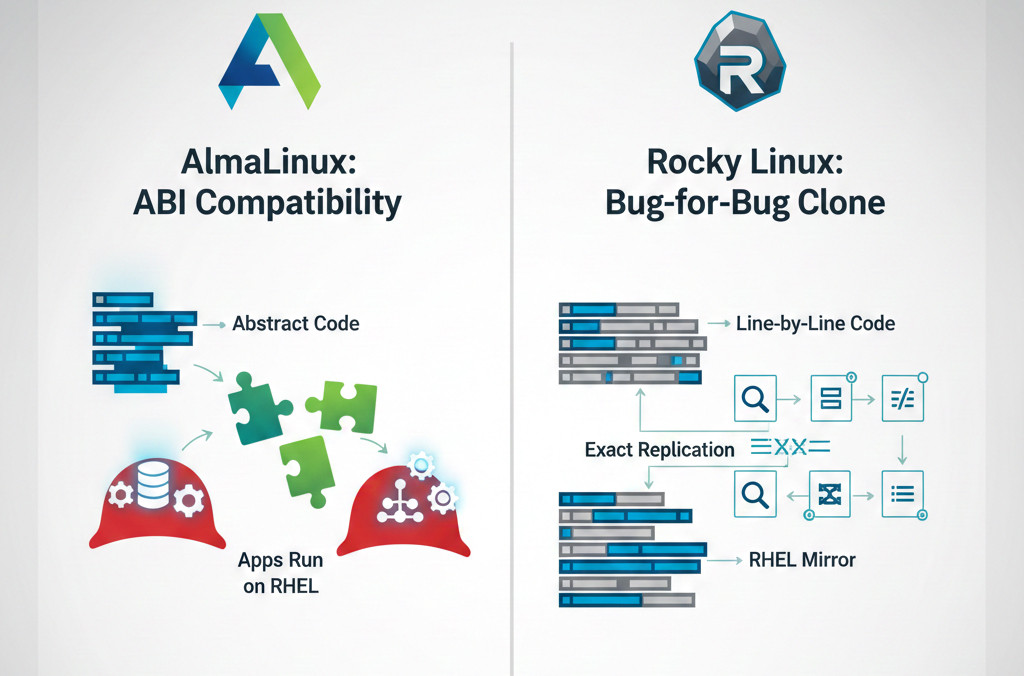
This is the most significant technical difference in 2025. After Red Hat restricted access to its source code, AlmaLinux moved toward ABI compatibility, ensuring that applications running on RHEL also work on Alma, even if the underlying code is not identical. In contrast, Rocky Linux still aims to remain a precise, line-for-line clone, adhering to "1:1 compatibility." They use methods like UBI container images and official Red Hat cloud instances to obtain and rebuild the exact original source code, ensuring no differences with RHEL.
2. Governance and Support
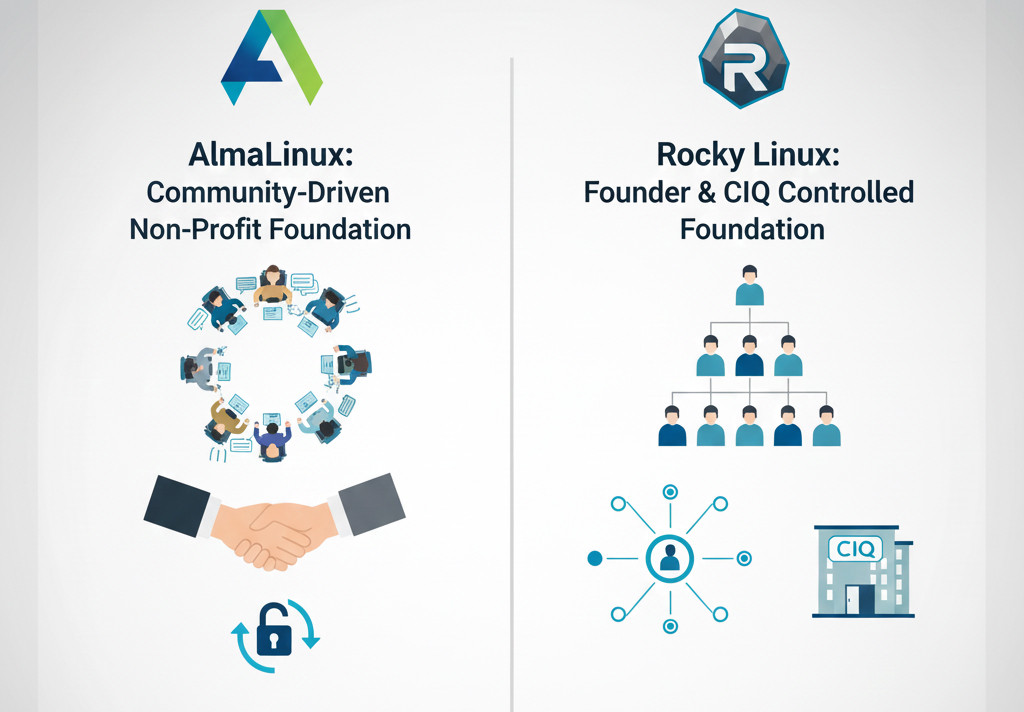
AlmaLinux is managed by a 501(c)(6) non-profit foundation. No company owns it, and community members, including you, can participate in decision-making. Rocky Linux, on the other hand, is overseen by the RESF foundation. While community-focused, its structure gives significant control and intellectual property ownership to the founder and CIQ, the main commercial supporter. Some experts consider Alma’s model safer for long-term, public projects, while Rocky’s model is preferred for faster enterprise-level coordination.
3. Release Cycle and Update Timing
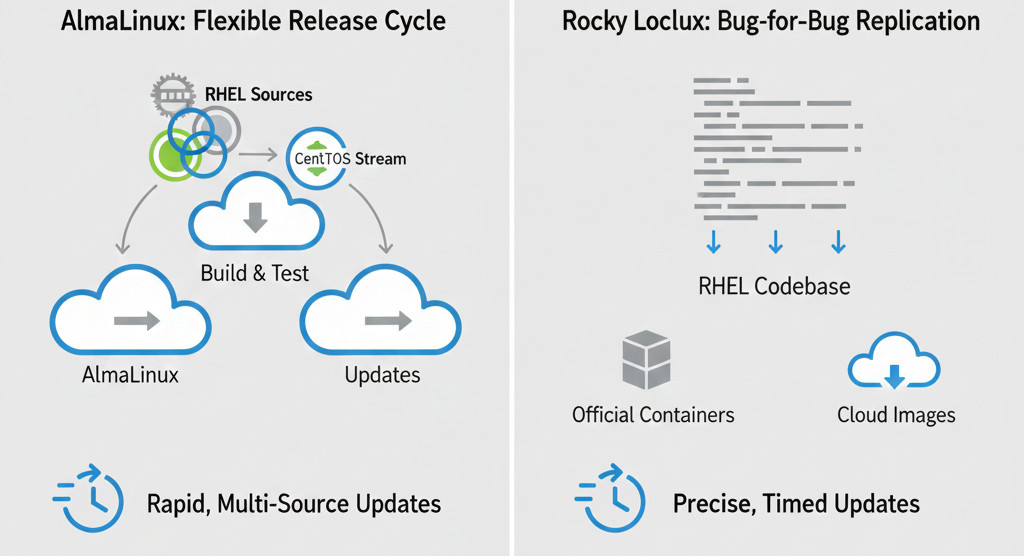
Until 2023, both distributions released updates almost simultaneously with RHEL. After Red Hat announced that full RHEL sources would no longer be published and only CentOS Stream would be available (June 2023), their approaches diverged. AlmaLinux now uses multiple sources, including RHEL and CentOS Stream, for builds. Rocky Linux continues to emphasize “bug-for-bug” cloning, obtaining RHEL sources via official containers and legally accessible cloud services. Nonetheless, both distributions maintain very fast updates, usually within a day or less of each other.
4. Performance and Stability
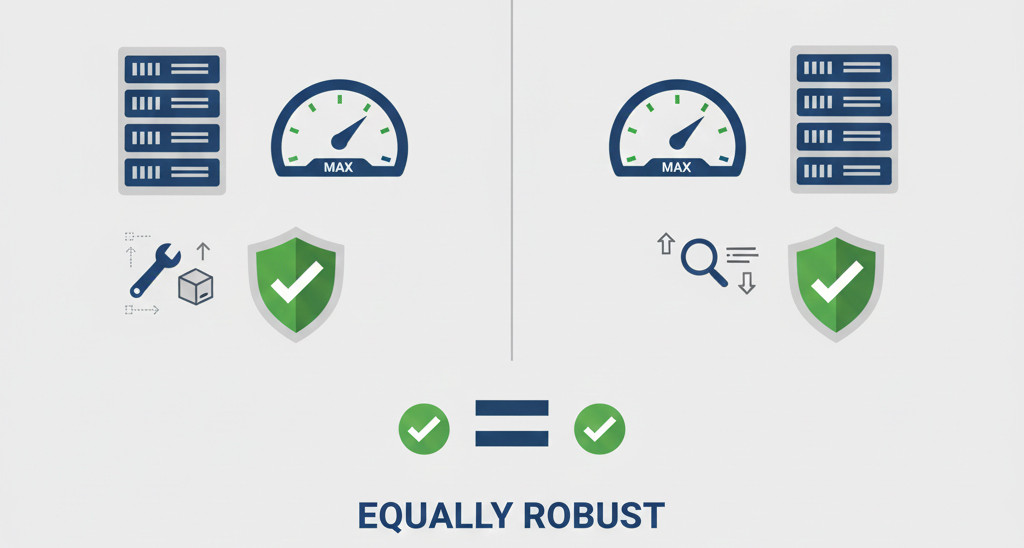
Since both distributions are built on the same RHEL codebase, their performance is nearly identical. Both are designed for enterprise workloads, with minor differences in efficiency due to specific package changes or small optimizations. Their primary focus is stability, meaning new features are only introduced once fully tested and stable. In other words, they are very similar to the old CentOS model, keeping systems stable and reliable.
5. Ecosystem and Support
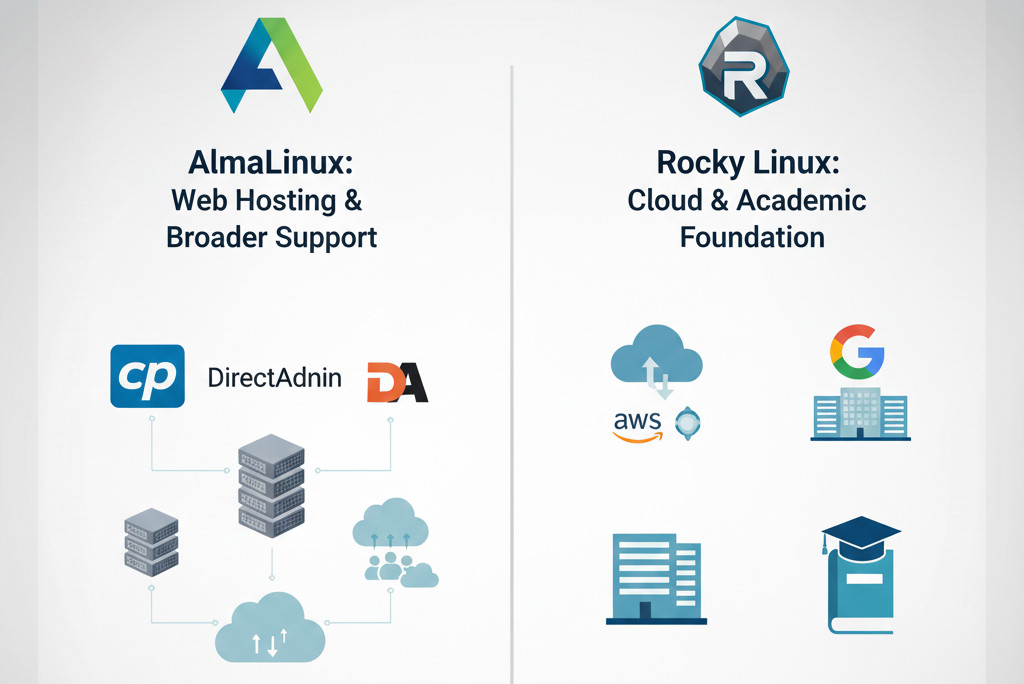
Both distributions are fully supported by popular hosting control panels like cPanel and DirectAdmin. AlmaLinux, due to its CloudLinux roots, has slightly more penetration in the hosting world, while Rocky Linux excels in academic environments and heavy cloud computing platforms like AWS and Google Cloud.
6. Migration Tools
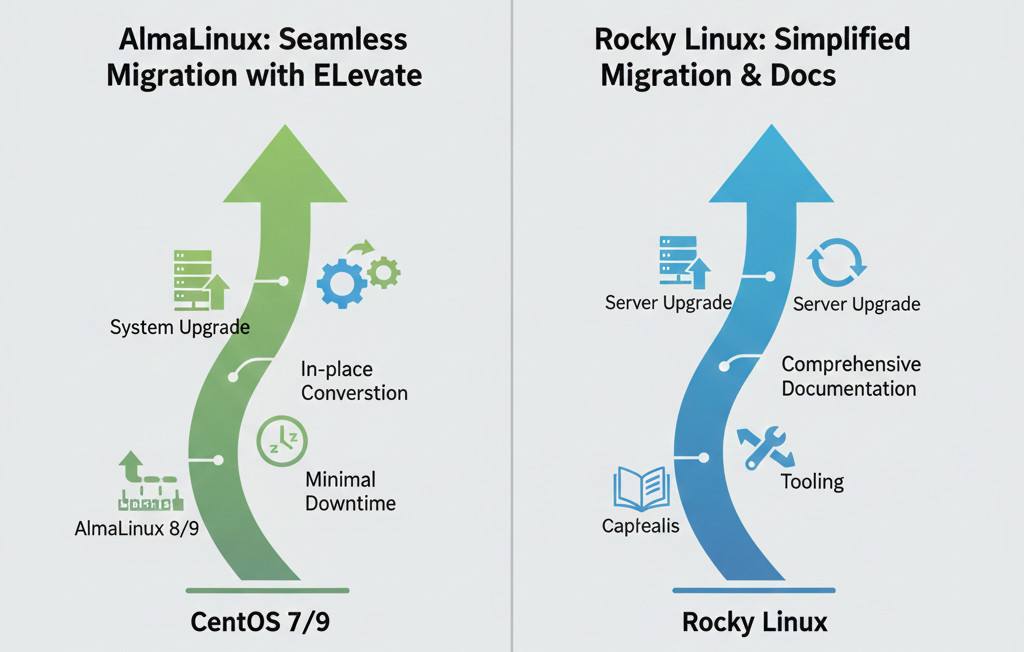
Both projects provide tools for easier migration from CentOS and other RHEL-based distributions. AlmaLinux offers ELevate, which allows upgrading from CentOS 7 to AlmaLinux 8/9 without reinstalling the system. Rocky Linux provides similar documentation and tools to facilitate migration from CentOS. These tools enable organizations to migrate their existing CentOS systems to either distribution without building a new system from scratch.
Best Use Cases (Who Should Choose What?)
.jpg?1766903230771)
As a professional, you know that there is no such thing as the “best” operating system—only the one that is most suitable for a specific scenario. Based on 2025 data, I recommend following this guide:
Who should choose AlmaLinux?
Depending on your specific needs and environment, AlmaLinux may be the ideal choice for certain users. Here’s a closer look at who benefits most from using AlmaLinux:
- Web hosting providers and cPanel/Plesk users: Thanks to its roots in CloudLinux, AlmaLinux offers the best compatibility with hosting control panels and is a leading choice in the hosting industry.
- Research and academic institutions: If you are looking for a model similar to CERN, AlmaLinux is their first choice. These institutions prefer AlmaLinux due to its better handling of security metadata (Errata) and the transparency of its foundation.
- Organizations with older hardware: If you have servers that are not supported by RHEL 10, the AlmaLinux x86-64-v2 build can be a lifesaver.
- Users interested in newer features: If you need the Btrfs filesystem or more advanced container management beyond Red Hat’s strict limitations, AlmaLinux gives you greater flexibility.
These examples highlight the versatility and strengths of AlmaLinux, making it a reliable and flexible option for a wide range of scenarios.
Who should choose Rocky Linux?
Depending on your organizational needs and technical requirements, Rocky Linux may be the preferred choice. Here are the types of users who benefit most from Rocky Linux:
- Large enterprise data centers: If your organization needs a replacement that behaves exactly like RHEL, with no noticeable differences in package behavior, Rocky Linux is the safer choice.
- High-performance computing (HPC) and artificial intelligence: Rocky Linux stands out in this area thanks to technical support from CIQ and the availability of NVIDIA GPU–optimized images (RLC-AI).
- Traditional system administrators: If you loved the classic CentOS experience and want to relive the same atmosphere in 2025, Rocky Linux, with its philosophy of “faithfulness to tradition,” will meet your expectations.
- RISC-V–based projects: For developers working on new processor architectures, Rocky Linux 10 is one of the few enterprise distributions that provides this level of support.
These examples demonstrate how Rocky Linux caters to enterprise, HPC, and specialized development environments, making it a robust and reliable RHEL-compatible option.
AlmaLinux vs Rocky Linux vs Other Distros
To get the full picture, we shouldn't just compare the two. In 2025, there are other options on the table that you should be aware of. So, let's take a quick look at them.
|
Distribution |
Base / Upstream |
Core Philosophy & Purpose |
Release Cycle & Stability |
Best Suited For |
Limitations |
|
AlmaLinux |
RHEL |
Stable enterprise-grade distribution with binary compatibility with RHEL |
10-year long-term lifecycle, conservative updates |
Hosting, VPS, commercial servers, CentOS migration |
Not a 1:1 RHEL clone (ABI-based compatibility) |
|
Rocky Linux |
RHEL |
Direct CentOS replacement with bug-for-bug compatibility |
10-year lifecycle, fast and precise updates |
Data centers, cloud environments, HPC, strict RHEL compatibility |
Less centralized commercial support |
|
Ubuntu (LTS) |
Debian |
Broad ecosystem with fast access to modern tools |
LTS with up to 10 years of support (5 free + 5 commercial) |
Developers, web servers, startups |
Incompatible with RHEL-specific software |
|
Fedora |
RHEL Upstream |
Innovation-focused, cutting-edge, community-driven |
Short release cycle (~6 months), lower long-term stability |
Developers, testing new technologies |
Not suitable for production servers |
|
Oracle Linux |
RHEL |
Focused on Oracle ecosystem and enterprise performance |
Long-term lifecycle similar to RHEL |
Oracle databases and Oracle-based infrastructures |
Vendor lock-in, narrower ecosystem |
|
CentOS Stream |
RHEL (Rolling) |
RHEL development branch and preview of upcoming changes |
Rolling release, reduced stability |
Developers, testing, CI/CD pipelines |
Not recommended for production environments |
In general, if you are looking for a true CentOS replacement with enterprise-grade stability, AlmaLinux or Rocky Linux are the best choices. For a focus on web development, a wide range of tools, and a broad open-source ecosystem, Ubuntu is a more suitable option. If innovation and access to the latest technologies are your priorities, Fedora is a better choice. On the other hand, Oracle Linux is designed for Oracle-centric environments, while CentOS Stream is useful for testing and development ahead of the final RHEL release.
To explore and compare other popular options and find the distro that best fits your needs, check out Top Linux Distros.
Pick the Right RHEL Clone
Ultimately, both operating systems handle enterprise workloads very well and are reliable options for replacing CentOS. If commercial support and corporate backing are important to you, AlmaLinux, supported by CloudLinux, might be the better choice. If you value CentOS heritage and want an exact RHEL clone, Rocky Linux could be your pick. Consider your specific needs, and if you want professional, powerful, and reliable hosting for either of these systems, AlmaLinux VPS and Rocky Linux VPS services from MonoVM are for you. With 24/7 support, instant server setup, global data centers, and competitive pricing, MonoVM provides a secure and dependable environment for your Linux hosting.

An experienced tech and developer blog writer, specializing in VPS hosting and server technologies. Fueled by a passion for innovation, I break down complex technical concepts into digestible content, simplifying tech for everyone.