
Choosing the right Linux distribution for your server, VPS, or development environment is a decision that directly affects performance, security, scalability, and long term maintenance. Among the most discussed options today, AlmaLinux vs Ubuntu stands out as a common comparison for hosting providers, developers, and enterprises alike.
Both operating systems are powerful, stable, and widely supported, but they serve different priorities. AlmaLinux is an enterprise focused, RHEL compatible operating system designed for long term stability, while Ubuntu is a Debian based distribution known for flexibility, ease of use, and cloud readiness.
This guide explains the differences, performance, and best uses of AlmaLinux vs Ubuntu, helping you decide which platform is the right fit for your workload, whether that is VPS hosting, cPanel environments, development, or enterprise infrastructure.
AlmaLinux vs Ubuntu Quick Answer
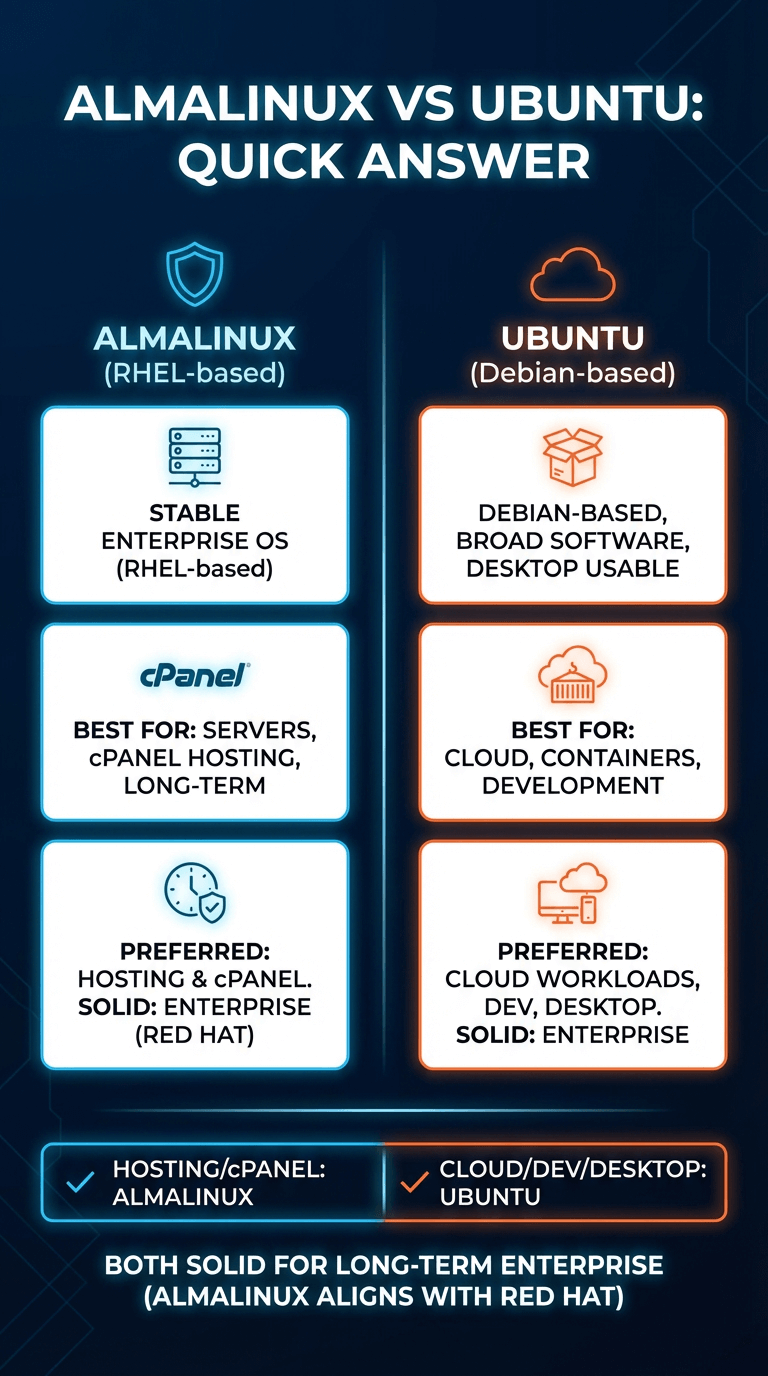
AlmaLinux is a stable, RHEL based enterprise operating system best suited for servers, cPanel hosting, and long term production environments.
Ubuntu is a Debian based operating system offering broader software availability, better desktop usability, and strong cloud and container support.
- For hosting and cPanel, AlmaLinux is the preferred choice.
- For cloud workloads, development, and desktop use, Ubuntu is often the better option.
- For long term enterprise environments, both are solid, but AlmaLinux aligns more closely with Red Hat standards.
AlmaLinux vs Ubuntu Comparison Table
|
Feature |
AlmaLinux |
Ubuntu |
|
Base Distribution |
RHEL compatible |
Debian based |
|
Package Manager |
RPM with DNF |
DEB with APT |
|
Server Performance |
Highly optimized for stability |
Optimized for speed and cloud workloads |
|
Desktop Experience |
Minimal and server focused |
Strong desktop usability |
|
Cloud Support |
Enterprise cloud environments |
Excellent cloud and container support |
|
Web Hosting Compatibility |
Ideal for cPanel and shared hosting |
Limited cPanel support |
|
LTS Cycle |
Up to 10 years |
5 years for LTS |
|
Security |
SELinux |
AppArmor |
|
Best For |
Enterprise servers, VPS hosting |
Development, cloud, desktop |
This table summarizes why AlmaLinux vs Ubuntu server discussions often depend on the intended workload rather than raw performance alone.
What Is AlmaLinux?
AlmaLinux is a free, open source Linux distribution designed to be fully binary compatible with Red Hat Enterprise Linux. It was created as a stable replacement for CentOS after CentOS shifted its focus to CentOS Stream.
AlmaLinux uses the RPM package format and the DNF package manager, making it familiar to administrators with Red Hat based systems. Its core focus is reliability, predictable updates, and enterprise grade performance.
If you want a deeper technical overview, you can read the full guide on what is AlmaLinux on the MonoVM blog.
AlmaLinux Pros
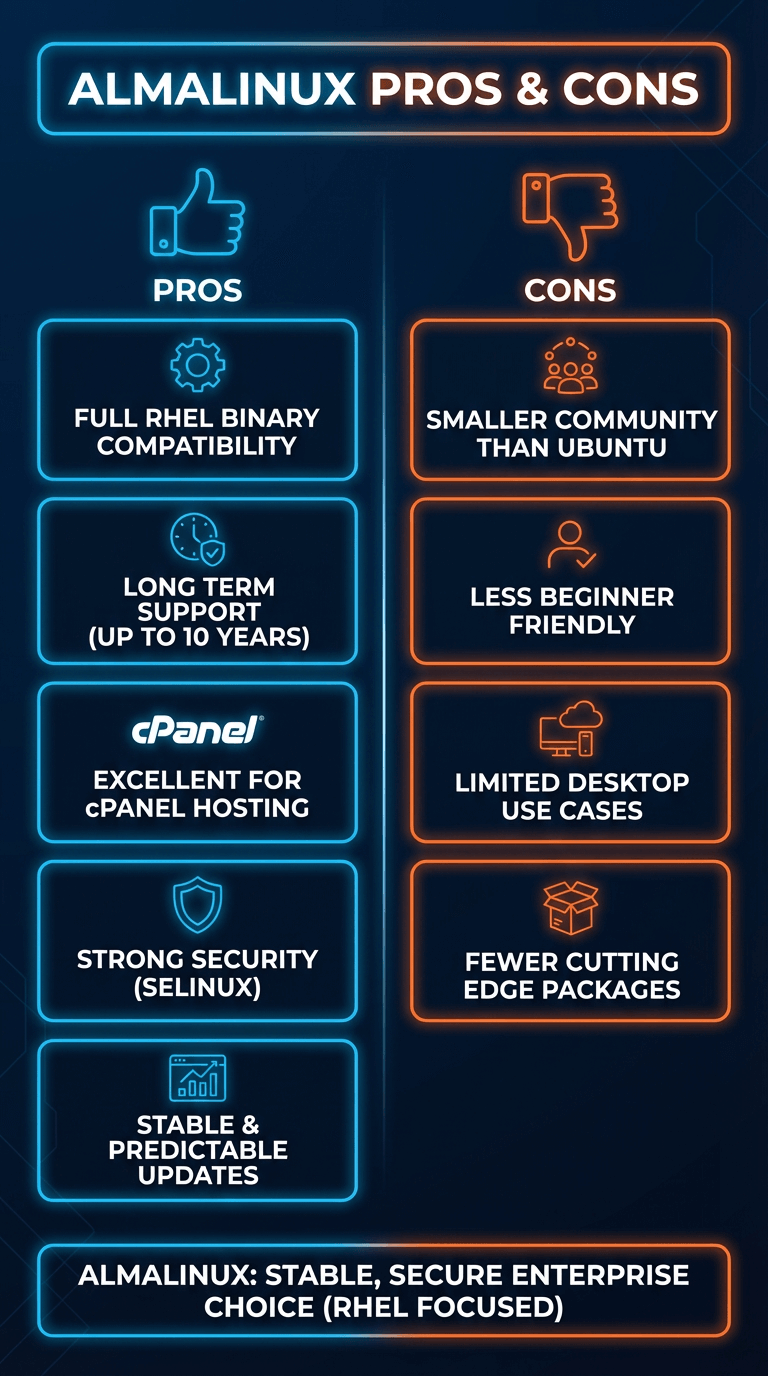
- Full RHEL binary compatibility
- Long term support lifecycle up to 10 years
- Excellent choice for cPanel hosting
- Strong security with SELinux
- Stable and predictable updates
AlmaLinux Cons
- Smaller community compared to Ubuntu
- Less beginner friendly
- Limited desktop use cases
- Fewer cutting edge packages by default
What Is Ubuntu?
Ubuntu is a Debian based Linux distribution developed and maintained by Canonical. It is one of the most widely used Linux operating systems in the world, spanning desktops, servers, VPS environments, and cloud platforms.
Ubuntu uses the APT package manager and DEB packages, which are widely appreciated for simplicity and speed. Ubuntu is often the default choice for developers, DevOps teams, and cloud providers.
For a full breakdown, see the MonoVM article on What is Ubuntu.
Ubuntu Pros
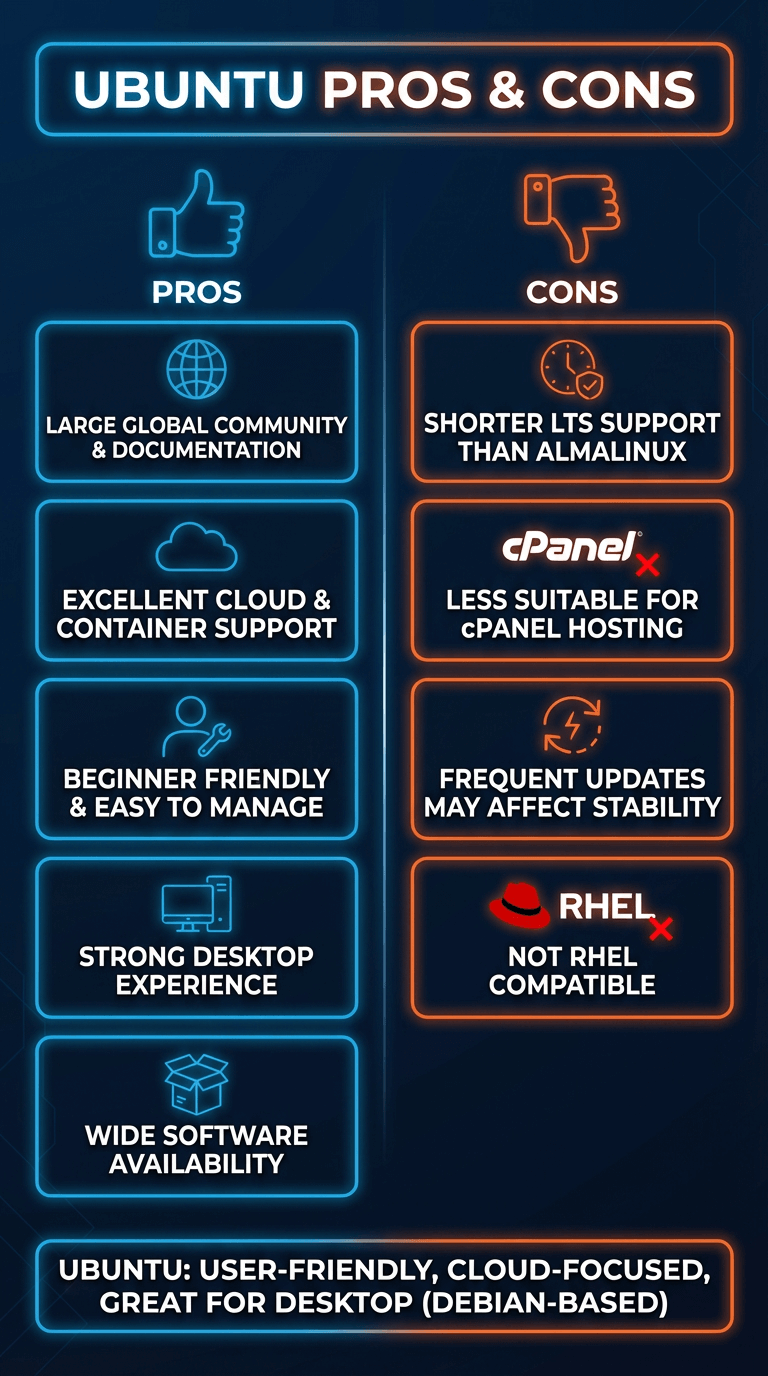
- Large global community and documentation
- Excellent cloud and container support
- Beginner friendly and easy to manage
- Strong desktop experience
- Wide software availability
Ubuntu Cons
- Shorter LTS support compared to AlmaLinux
- Less suitable for cPanel hosting
- Frequent updates may affect long term stability
- Not RHEL compatible
Key Differences Between AlmaLinux vs Ubuntu
Package System RPM DNF vs APT DEB
One of the most important technical differences in AlmaLinux vs Ubuntu is package management.
AlmaLinux uses RPM packages managed by DNF. This system is designed for enterprise environments where stability and dependency control matter more than rapid software changes.
Ubuntu uses DEB packages managed by APT, which emphasizes ease of use and faster access to newer software versions.
Facts:
- AlmaLinux uses RPM and DNF.
- Ubuntu uses DEB and APT.
- RPM is common in enterprise servers.
- APT is preferred for ease of use.
AlmaLinux vs Ubuntu Performance and Server Optimization
When discussing AlmaLinux vs Ubuntu performance, the distinction is not about raw speed but about optimization goals.
AlmaLinux is optimized for long running workloads, database servers, virtualization hosts, and hosting environments. It prioritizes stability over frequent updates, which reduces unexpected downtime.
Ubuntu is optimized for cloud instances, containers, and fast deployment. It performs exceptionally well in VPS and cloud environments where scaling and flexibility matter.
Facts:
- AlmaLinux focuses on stability.
- Ubuntu focuses on speed and flexibility.
- Both perform well on VPS servers.
- Performance depends on workload type.
Security SELinux vs AppArmor
Security is another key aspect of AlmaLinux vs Ubuntu server comparisons.
AlmaLinux uses SELinux, a mandatory access control system that enforces strict security policies at the kernel level. This makes it highly secure but more complex to configure.
Ubuntu uses AppArmor, which is easier to manage and still provides strong security through application level profiles.
Facts:
- AlmaLinux uses SELinux.
- Ubuntu uses AppArmor.
- SELinux is stricter.
- AppArmor is easier to configure.
Support Cycles and Long Term Stability
Support lifecycle is one of the strongest arguments in AlmaLinux vs Ubuntu LTS discussions.
AlmaLinux versions are supported for up to 10 years, matching RHEL lifecycles. This is ideal for enterprises that want minimal OS changes over time.
Ubuntu LTS releases are supported for 5 years. While shorter, this is sufficient for most modern infrastructures and allows smoother upgrades.
Facts:
- AlmaLinux support lasts up to 10 years.
- Ubuntu LTS support lasts 5 years.
- Both receive security updates.
- AlmaLinux favors long term stability.
Compatibility cPanel Docker Kubernetes and Cloud
For hosting providers, cPanel AlmaLinux vs Ubuntu is a critical topic.
cPanel officially supports AlmaLinux and does not support Ubuntu for production environments. This alone makes AlmaLinux the default choice for shared hosting and WHM based setups.
Ubuntu excels in Docker, Kubernetes, and cloud integrations, making it ideal for modern DevOps pipelines.
Facts:
- cPanel supports AlmaLinux.
- cPanel does not support Ubuntu.
- Ubuntu is strong for containers.
- AlmaLinux suits traditional hosting.
Best Use Cases for AlmaLinux vs Ubuntu
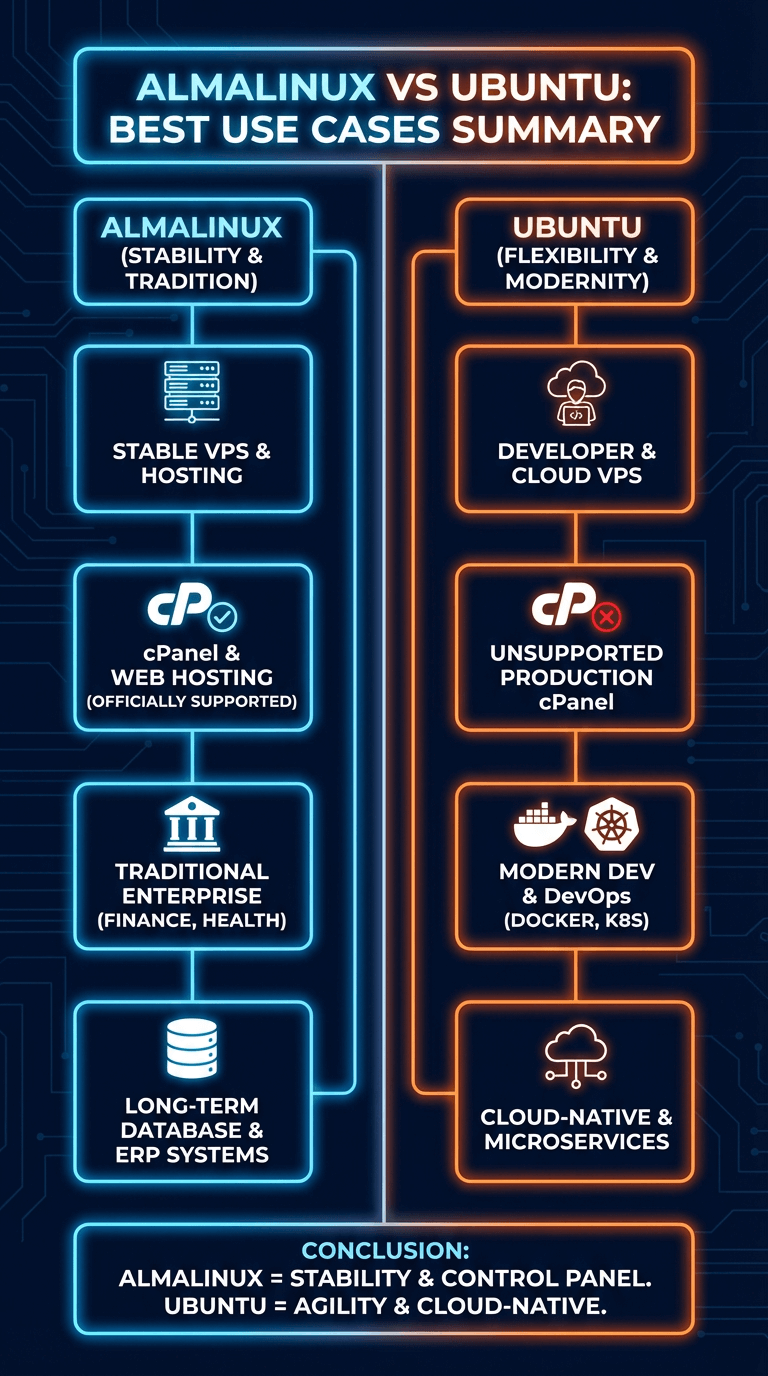
Understanding real world use cases is essential when comparing Almalinux vs ubuntu. While both operating systems are powerful, each one shines in different environments depending on workload, control panel usage, and long term goals.
Best OS for VPS Hosting
When it comes to almalinux vs ubuntu for vps, the choice depends on how the VPS will be used.
AlmaLinux is an excellent option for VPS hosting where stability, predictable updates, and enterprise style workloads are required. Hosting providers often prefer AlmaLinux for VPS plans intended for web hosting, control panels, and long running services.
Ubuntu VPS servers are extremely popular for developers, startups, and cloud native workloads. Ubuntu integrates seamlessly with automation tools, CI CD pipelines, Docker, and Kubernetes.
If you are planning to deploy a stable hosting focused VPS, MonoVM offers high performance AlmaLinux VPS solutions optimized for reliability and long term uptime.
If your priority is flexibility and rapid deployment, you can also explore MonoVM Ubuntu VPS offerings designed for development and cloud workloads.
Facts:
- AlmaLinux VPS is ideal for hosting.
- Ubuntu VPS is ideal for development.
- Both are suitable for production use.
Best OS for cPanel and Web Hosting
The discussion around cpanel almalinux vs ubuntu is very straightforward.
cPanel officially supports AlmaLinux and does not support Ubuntu as a production operating system. This alone makes AlmaLinux the clear winner for shared hosting, reseller hosting, and WHM environments.
AlmaLinux provides:
- Native cPanel compatibility
- Stable PHP and web server environments
- Long term support without disruptive changes
Ubuntu is not recommended for cPanel based hosting. While Ubuntu can run web servers like Nginx and Apache perfectly well, it is better suited for custom stacks rather than traditional control panel hosting.
For hosting businesses or website owners who want a reliable control panel experience, AlmaLinux remains the industry standard.
Best OS for Development and DevOps
For development workflows, alma vs ubuntu often leans in favor of Ubuntu.
Ubuntu provides:
- Faster access to newer programming languages
- Excellent Docker and Kubernetes support
- Strong integration with Git, CI CD tools, and cloud platforms
This makes Ubuntu the preferred choice for DevOps engineers, application developers, and teams building microservices.
AlmaLinux can still be used for development, especially when production environments run on RHEL compatible systems. However, developers may find Ubuntu more convenient due to its broader ecosystem and faster package updates.
Best OS for Enterprise Workloads
In enterprise environments, almalinux vs ubuntu server comparisons often prioritize stability over convenience.
AlmaLinux excels in:
- Financial institutions
- Healthcare systems
- Telecom and regulated industries
- Long term database and ERP systems
Ubuntu is also used in enterprises, particularly in cloud native and container based infrastructures. However, AlmaLinux aligns more closely with traditional enterprise requirements and compliance standards.
AlmaLinux vs Ubuntu vs Debian vs CentOS
A broader comparison helps clarify where each distribution fits.
AlmaLinux vs Ubuntu vs Debian
The AlmaLinux vs Ubuntu vs Debian comparison highlights philosophical differences.
Debian is the upstream project that Ubuntu is based on. Debian is known for extreme stability but slower software updates. Ubuntu builds on Debian to provide easier usability, better hardware support, and cloud readiness.
AlmaLinux is not Debian based. It is RHEL compatible and follows a completely different enterprise oriented development model.
Facts:
- Debian is upstream of Ubuntu.
- AlmaLinux is RHEL compatible.
- Ubuntu focuses on usability.
- AlmaLinux focuses on stability.
AlmaLinux vs Ubuntu vs CentOS
CentOS was historically the bridge between enterprise and community Linux. After CentOS Stream replaced CentOS Linux, AlmaLinux emerged as one of the most trusted successors.
In almalinux vs ubuntu vs centos discussions:
- AlmaLinux replaces traditional CentOS Linux
- Ubuntu remains a separate Debian based alternative
- AlmaLinux maintains long term enterprise compatibility
If you are migrating from CentOS, AlmaLinux is usually the most seamless transition. For a deeper dive into this topic, MonoVM provides a detailed comparison in CentOS vs Ubuntu, which also helps clarify Ubuntu’s positioning against enterprise focused systems.
Almalinux vs Ubuntu vs Kali
The comparison almalinux vs ubuntu vs kali often comes up in security related searches.
Kali Linux is a penetration testing and cybersecurity distribution. It is not designed for servers, hosting, or production workloads.
Ubuntu can be used for security research and development but is not specialized like Kali.
AlmaLinux is designed for secure production environments, not offensive security testing.
Facts:
- Kali Linux is for penetration testing.
- AlmaLinux is for production servers.
- Ubuntu is general purpose.
AlmaLinux vs Ubuntu for Gaming
Although gaming is not a primary use case for either distribution, searches for almalinux vs ubuntu for gaming still occur.
Ubuntu is significantly better suited for gaming due to:
- Better desktop support
- GPU driver compatibility
- Steam and Proton support
AlmaLinux is not designed for gaming and lacks optimized desktop drivers and multimedia support.
Facts:
- Ubuntu is better for gaming.
- AlmaLinux is server focused.
- Gaming is not a target use case for AlmaLinux.
Conclusion and MonoVM Recommendation
The Almalinux vs ubuntu debate does not have a single universal winner. Instead, the right choice depends on your specific needs.
AlmaLinux is ideal for:
- VPS hosting
- cPanel and WHM environments
- Enterprise workloads
- Long term stability and compliance
Ubuntu is ideal for:
- Cloud and containerized applications
- Development and DevOps
- Desktop usage
- Rapid deployment environments
If you are looking for a reliable hosting solution built on enterprise grade infrastructure, MonoVM provides high performance VPS and server solutions with instant setup, global data centers, and 24/7 expert support.
To build a stable hosting environment with long term reliability, explore MonoVM AlmaLinux VPS solutions.
If your project requires flexibility and modern tooling, MonoVM also offers fully optimized Ubuntu VPS servers ready for development and cloud workloads.

An experienced tech and developer blog writer, specializing in VPS hosting and server technologies. Fueled by a passion for innovation, I break down complex technical concepts into digestible content, simplifying tech for everyone.